Thibault Donna L, Graham Kareem L, Lee Lowen Y, Balboni Imelda, Hertzog Paul J, Utz Paul J
Department of Medicine, Division of Immunology and Rheumatology, Stanford University School of Medicine, 269 Campus Drive, Stanford, CA 94305, USA.
Arthritis Res Ther. 2009;11(4):R112. doi: 10.1186/ar2771. Epub 2009 Jul 22.
Systemic lupus erythematosus (SLE) is a chronic autoimmune disease characterized by the production of high-titer IgG autoantibodies directed against nuclear autoantigens. Type I interferon (IFN-I) has been shown to play a pathogenic role in this disease. In the current study, we characterized the role of the IFNAR2 chain of the type I IFN (IFN-I) receptor in the targeting of nucleic acid-associated autoantigens and in B-cell expression of the nucleic acid-sensing Toll-like receptors (TLRs), TLR7 and TLR9, in the pristane model of lupus.
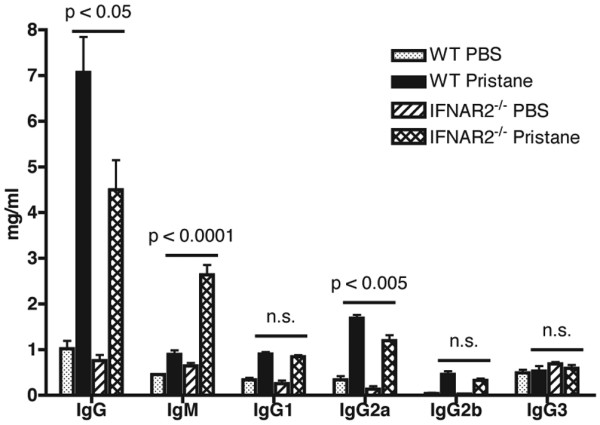
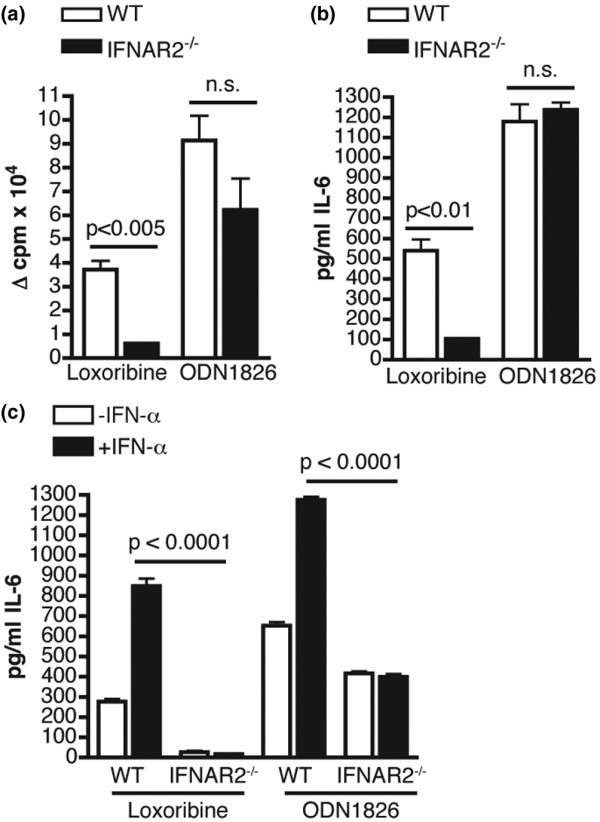
Wild-type (WT) and IFNAR2-/- mice were treated with pristane and monitored for proteinuria on a monthly basis. Autoantibody production was determined by autoantigen microarrays and confirmed using enzyme-linked immunosorbent assay (ELISA) and immunoprecipitation. Serum immunoglobulin isotype levels, as well as B-cell cytokine production in vitro, were quantified by ELISA. B-cell proliferation was measured by thymidine incorporation assay.
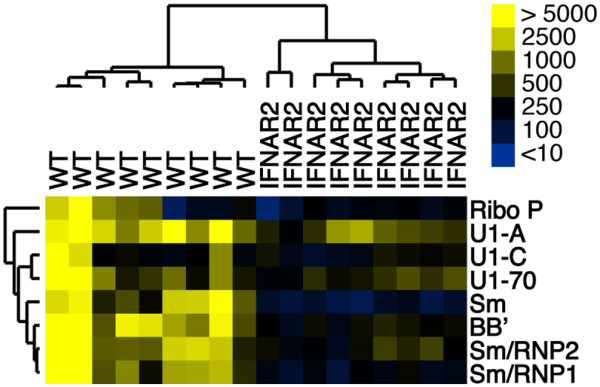
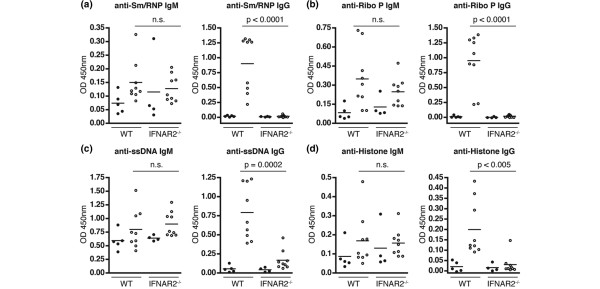
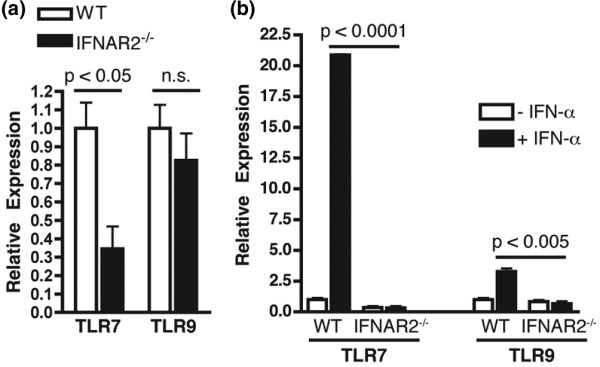
Autoantigen microarray profiling revealed that pristane-treated IFNAR2-/- mice lacked autoantibodies directed against components of the RNA-associated autoantigen complexes Smith antigen/ribonucleoprotein (Sm/RNP) and ribosomal phosphoprotein P0 (RiboP). The level of IgG anti-single-stranded DNA and anti-histone autoantibodies in pristane-treated IFNAR2-/- mice was decreased compared to pristane-treated WT mice. TLR7 expression and activation by a TLR7 agonist were dramatically reduced in B cells from IFNAR2-/- mice. IFNAR2-/- B cells failed to upregulate TLR7 as well as TLR9 expression in response to IFN-I, and effector responses to TLR7 and TLR9 agonists were significantly decreased as compared to B cells from WT mice following treatment with IFN-alpha.
Our studies provide a critical link between the IFN-I pathway and the regulation of TLR-specific B-cell responses in a murine model of SLE.
系统性红斑狼疮(SLE)是一种慢性自身免疫性疾病,其特征是产生针对核自身抗原的高滴度IgG自身抗体。I型干扰素(IFN-I)已被证明在该疾病中起致病作用。在本研究中,我们在狼疮的 pristane 模型中,表征了 I 型干扰素(IFN-I)受体的 IFNAR2 链在核酸相关自身抗原靶向以及核酸感应 Toll 样受体(TLR)TLR7 和 TLR9 的 B 细胞表达中的作用。
用 pristane 处理野生型(WT)和 IFNAR2 - / - 小鼠,并每月监测蛋白尿情况。通过自身抗原微阵列确定自身抗体产生,并使用酶联免疫吸附测定(ELISA)和免疫沉淀进行确认。通过 ELISA 定量血清免疫球蛋白同种型水平以及体外 B 细胞细胞因子产生。通过胸苷掺入试验测量 B 细胞增殖。
自身抗原微阵列分析显示,用 pristane 处理的 IFNAR2 - / - 小鼠缺乏针对与 RNA 相关的自身抗原复合物史密斯抗原/核糖核蛋白(Sm/RNP)和核糖体磷蛋白 P0(RiboP)成分的自身抗体。与用 pristane 处理的 WT 小鼠相比,用 pristane 处理的 IFNAR2 - / - 小鼠中 IgG 抗单链 DNA 和抗组蛋白自身抗体水平降低。IFNAR2 - / - 小鼠的 B 细胞中 TLR7 激动剂诱导的 TLR7 表达和激活显著降低。IFNAR2 - / - B 细胞在响应 IFN-I 时未能上调 TLR7 以及 TLR9 的表达,并且与用 IFN-α 处理后的 WT 小鼠的 B 细胞相比,对 TLR7 和 TLR9 激动剂的效应反应显著降低。
我们的研究在 SLE 小鼠模型中提供了 IFN-I 途径与 TLR 特异性 B 细胞反应调节之间的关键联系。