Department of Rheumatology and Clinical Immunology, Medical Center-University of Freiburg, Faculty of Medicine, University of Freiburg, 79106 Freiburg im Breisgau, Germany.
Department of Neuropathology, Charité-Universitätsmedizin Berlin, Corporate Member of Freie Universität Berlin, Humboldt-Universität zu Berlin and Berlin Institute of Health, 10117 Berlin, Germany.
Int J Mol Sci. 2021 Oct 29;22(21):11747. doi: 10.3390/ijms222111747.
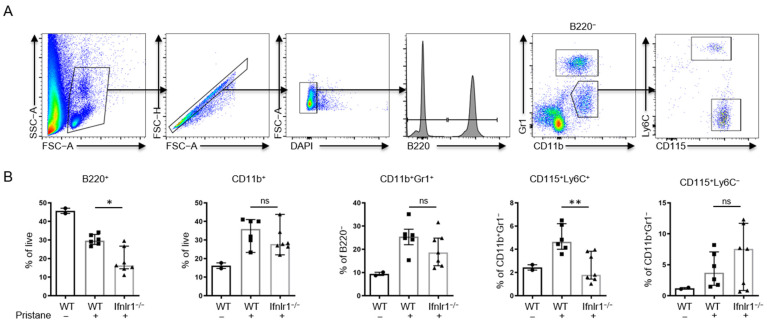
A pivotal role of type I interferons in systemic lupus erythematosus (SLE) is widely accepted. Type III interferons (IFN-λ) however, the most recently discovered cytokines grouped within the interferon family, have not been extensively studied in lupus disease models yet. Growing evidence suggests a role for IFN-λ in regulating both innate and adaptive immune responses, and increased serum concentrations have been described in multiple autoimmune diseases including SLE. Using the pristane-induced lupus model, we found that mice with defective IFN-λ receptors () showed increased survival rates, decreased lipogranuloma formation and reduced anti-dsDNA autoantibody titers in the early phase of autoimmunity development compared to pristane-treated wild-type mice. Moreover, mice treated with pristane had reduced numbers of inflammatory mononuclear phagocytes and cNK cells in their kidneys, resembling untreated control mice. Systemically, circulating B cells and monocytes (CD115Ly6C) were reduced in pristane-treated mice. The present study supports a significant role for type III interferons in the pathogenesis of pristane-induced murine autoimmunity as well as in systemic and renal inflammation. Although the absence of type III interferon receptors does not completely prevent the development of autoantibodies, type III interferon signaling accelerates the development of autoimmunity and promotes a pro-inflammatory environment in autoimmune-prone hosts.
I 型干扰素在系统性红斑狼疮(SLE)中的关键作用已被广泛接受。然而,III 型干扰素(IFN-λ)是最近发现的细胞因子家族成员,在狼疮疾病模型中尚未得到广泛研究。越来越多的证据表明 IFN-λ 在调节固有和适应性免疫反应方面发挥作用,并且在包括 SLE 在内的多种自身免疫性疾病中,血清浓度升高。使用特戊酰肼诱导的狼疮模型,我们发现与特戊酰肼处理的野生型小鼠相比,缺乏 IFN-λ 受体()的小鼠在自身免疫发展的早期阶段具有更高的存活率、减少的脂肪肉芽肿形成和降低的抗 dsDNA 自身抗体滴度。此外,特戊酰肼处理的小鼠肾脏中的炎性单核吞噬细胞和 cNK 细胞数量减少,类似于未处理的对照小鼠。全身性地,特戊酰肼处理的小鼠循环中的 B 细胞和单核细胞(CD115Ly6C)减少。本研究支持 III 型干扰素在特戊酰肼诱导的小鼠自身免疫发病机制以及全身和肾脏炎症中的重要作用。尽管缺乏 III 型干扰素受体并不能完全阻止自身抗体的产生,但 III 型干扰素信号加速了自身免疫的发展,并在自身免疫倾向宿主中促进了促炎环境。