Torlakovic Emina Emilia, Keeler Vicki, Wang Chang, Lim Hyun J, Lining Leslie Ann, Laferté Suzanne
Department of Pathology, Royal University Hospital, College of Medicine, University of Saskatchewan, Saskatoon, Canada.
BMC Cancer. 2009 Jul 24;9:251. doi: 10.1186/1471-2407-9-251.
The discovery of a "serrated neoplasia pathway" has highlighted the role of hyperplastic lesions of the colon as the significant precursor of colorectal adenocarcinoma. In mice, hyperplasia of the colonic mucosa is a regular phenomenon after a challenge with colonic carcinogens indicating that mucosal hyperproliferation and thickening, even without cytological dysplasia, represents an early pre-malignant change. Cyclophilin C-associated protein (CyCAP) has been described to down-modulate endotoxin signaling in colorectal murine mucosa and is a murine orthologue of the tumor-associated antigen 90 K (TAA90K)/mac-2-binding protein.
Female Balb/c wild-type (WT) and CyCAP knock-out (KO) mice (6-8 weeks old) were administered 2 or 6 weekly subcutaneous injections of azoxymethane. The animals were evaluated post-injection at six weeks for aberrant crypt foci (ACF) study and at five months for colon tumor measurement. The thickness of the colon crypts was measured in microns and the number of colonocytes per crypt was also determined in well-oriented crypts. Morphometric analyses of the colon mucosa were also performed in untreated 6-8 weeks old KO and WT animals. Formalin-fixed/paraffin-embedded colon sections were also studied by immunohistochemistry to determine the Ki-67 proliferation fraction of the colon mucosa, beta-catenin cellular localization, cyclin D1, c-myc, and lysozyme in Paneth cells.
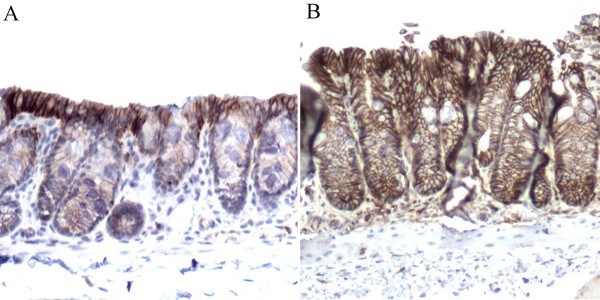
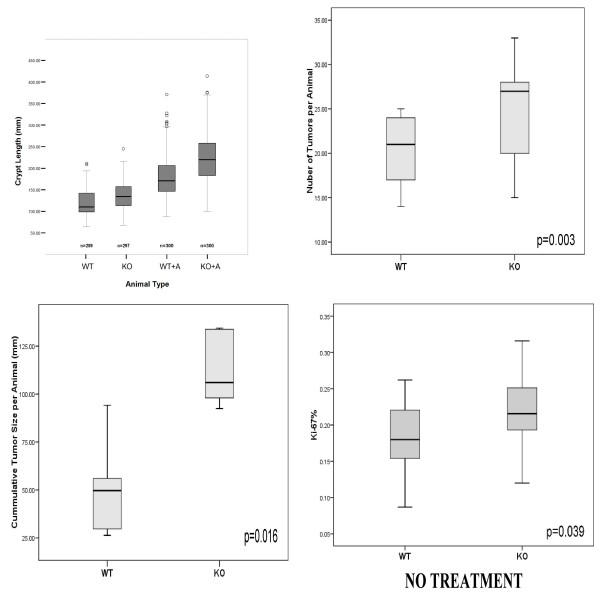
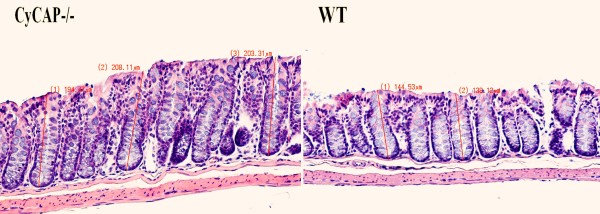
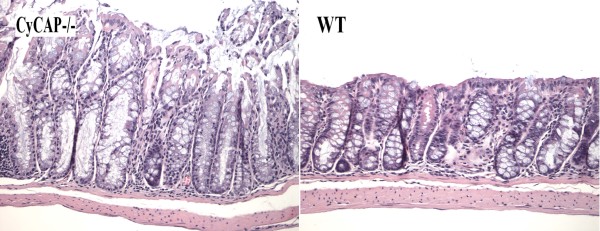
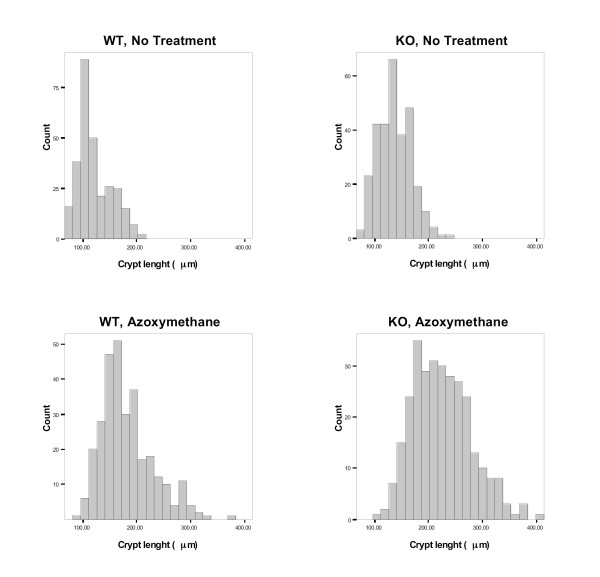
Cyclophilin C-associated protein (CyCAP)-/- mice, spontaneously developed colonic mucosal hyperplasia early in life compared to wild-type mice (WT) (p < 0.0001, T-test) and crypts of colonic mucosa of the (CyCAP)-/- mice show higher proliferation rate (p = 0.039, Mann-Whitney Test) and larger number of cyclin D1-positive cells (p < 0.0001, Mann-Whitney Test). Proliferation fraction and cyclin D1 expression showed positive linear association (p = 0.019, Linear-by-Linear Association). The hyperplasia was even more pronounced in CyCAP-/- mice than in WT after challenge with azoxymethane (p = 0.005, T-test). The length of the crypts (r = 0.723, p = 0.018, Spearman Correlation) and the number of colonocytes per crypt (r = 0.863, p = 0.001, Spearman Correlation) in non-tumorous areas were positively associated with azoxymethane-induced number of tumors. CyCAP-/- developed larger numbers of tumors than WT animals (p = 0.003, T-Test) as well as overall larger tumor mass (p = 0.016, T-Test). Membranous beta-catenin was focally overexpressed in KO mice including proliferative zone of the crypts.
CyCAP-/- represent the first described model of spontaneous colonic mucosal hyperplasia. We conclude that CyCAP-deficient mice spontaneously and after challenge with carcinogen develop significantly more colorectal mucosal hyperplasia, an early stage in murine colonic carcinogenesis.
“锯齿状肿瘤发生途径”的发现突出了结肠增生性病变作为结直肠癌重要前体的作用。在小鼠中,结肠黏膜增生是用结肠致癌物攻击后的常见现象,这表明黏膜过度增殖和增厚,即使没有细胞学异型增生,也代表早期癌前变化。亲环蛋白C相关蛋白(CyCAP)已被描述为可下调结直肠癌小鼠黏膜中的内毒素信号,并且是肿瘤相关抗原90K(TAA90K)/mac-2结合蛋白的小鼠同源物。
对6至8周龄的雌性Balb/c野生型(WT)和CyCAP基因敲除(KO)小鼠每周进行2次或6次皮下注射氧化偶氮甲烷。在注射后6周对动物进行异常隐窝灶(ACF)研究评估,并在5个月时进行结肠肿瘤测量。以微米为单位测量结肠隐窝的厚度,并在排列良好的隐窝中确定每个隐窝的结肠细胞数量。还对未处理的6至8周龄KO和WT动物的结肠黏膜进行形态计量分析。还通过免疫组织化学研究福尔马林固定/石蜡包埋的结肠切片,以确定结肠黏膜的Ki-67增殖分数、β-连环蛋白的细胞定位、细胞周期蛋白D1、c-myc以及潘氏细胞中的溶菌酶。
与野生型小鼠(WT)相比,亲环蛋白C相关蛋白(CyCAP)基因敲除(-/-)小鼠在生命早期自发出现结肠黏膜增生(p<0.0001,t检验),并且(CyCAP)基因敲除(-/-)小鼠的结肠黏膜隐窝显示出更高的增殖率(p = 0.039,曼-惠特尼检验)和更多的细胞周期蛋白D1阳性细胞(p<0.0001,曼-惠特尼检验)。增殖分数与细胞周期蛋白D1表达呈正线性相关(p = 0.019,线性-by-线性关联)。在用氧化偶氮甲烷攻击后,CyCAP基因敲除(-/-)小鼠中的增生比WT小鼠更明显(p = 0.005,t检验)。非肿瘤区域隐窝的长度(r = 0.723,p = 0.018,斯皮尔曼相关性)和每个隐窝的结肠细胞数量(r = 0.863,p = 0.001,斯皮尔曼相关性)与氧化偶氮甲烷诱导的肿瘤数量呈正相关。CyCAP基因敲除(-/-)小鼠比WT动物产生更多的肿瘤(p = 0.003,t检验)以及总体上更大的肿瘤块(p = 0.016,t检验)。膜性β-连环蛋白在KO小鼠中包括隐窝的增殖区局部过度表达。
CyCAP基因敲除(-/-)代表首次描述的自发结肠黏膜增生模型。我们得出结论,CyCAP缺陷小鼠在自发状态下以及在用致癌物攻击后会发生明显更多的结直肠黏膜增生,这是小鼠结肠癌发生的早期阶段。