Frank Gil, Pressman Etan, Ophir Ron, Althan Levia, Shaked Rachel, Freedman Moshe, Shen Shmuel, Firon Nurit
Department of Vegetable Research, Institute of Plant Sciences, The Volcani Center, Agricultural Research Organization, Bet Dagan, Israel.
J Exp Bot. 2009;60(13):3891-908. doi: 10.1093/jxb/erp234. Epub 2009 Jul 23.
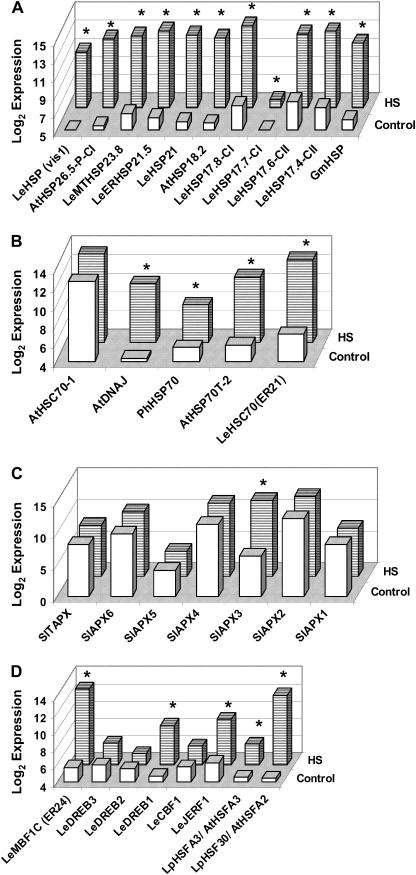
Above-optimal temperatures reduce yield in tomato largely because of the high heat stress (HS) sensitivity of the developing pollen grains. The high temperature response, especially at this most HS-sensitive stage of the plant, is poorly understood. To obtain an overview of molecular mechanisms underlying the HS response (HSR) of microspores, a detailed transcriptomic analysis of heat-stressed maturing tomato microspores was carried out using a combination of Affymetrix Tomato Genome Array and cDNA-amplified fragment length polymorphism (AFLP) techniques. The results were corroborated by reverse transcription-PCR (RT-PCR) and immunoblot analyses. The data obtained reveal the involvement of specific members of the small heat shock protein (HSP) gene family, HSP70 and HSP90, in addition to the HS transcription factors A2 (HSFA2) and HSFA3, as well as factors other than the classical HS-responsive genes. The results also indicate HS regulation of reactive oxygen species (ROS) scavengers, sugars, plant hormones, and regulatory genes that were previously implicated in other types of stress. The use of cDNA-AFLP enabled the detection of genes representing pollen-specific functions that are missing from the tomato Affymetrix chip, such as those involved in vesicle-mediated transport and a pollen-specific, calcium-dependent protein kinase (CDPK2). For several genes, including LeHSFA2, LeHSP17.4-CII, as well as homologues of LeHSP90 and AtVAMP725, higher basal expression levels were detected in microspores of cv. Hazera 3042 (a heat-tolerant cultivar) compared with microspores of cv. Hazera 3017 (a heat-sensitive cultivar), marking these genes as candidates for taking part in microspore thermotolerance. This work provides a comprehensive analysis of the molecular events underlying the HSR of maturing microspores of a crop plant, tomato.
温度高于最适温度会大幅降低番茄产量,这主要是因为发育中的花粉粒对高温胁迫(HS)极为敏感。人们对高温响应,尤其是在植物这个对高温胁迫最为敏感的阶段的响应,了解甚少。为了全面了解小孢子高温胁迫响应(HSR)背后的分子机制,我们结合使用Affymetrix番茄基因组芯片和cDNA扩增片段长度多态性(AFLP)技术,对受热胁迫的成熟番茄小孢子进行了详细的转录组分析。通过逆转录PCR(RT-PCR)和免疫印迹分析对结果进行了验证。所获得的数据揭示了小热休克蛋白(HSP)基因家族的特定成员、HSP70和HSP90的参与,此外还有热应激转录因子A2(HSFA2)和HSFA3,以及除经典热应激响应基因之外的其他因子。结果还表明,热应激对活性氧(ROS)清除剂、糖类、植物激素以及先前涉及其他类型胁迫的调控基因具有调节作用。使用cDNA-AFLP能够检测到番茄Affymetrix芯片中缺失的代表花粉特异性功能的基因,例如那些参与囊泡介导运输的基因以及一种花粉特异性的钙依赖性蛋白激酶(CDPK2)。对于几个基因,包括LeHSFA2、LeHSP17.4-CII以及LeHSP90和AtVAMP725的同源物,在耐热品种Hazera 3042的小孢子中检测到的基础表达水平高于热敏感品种Hazera 3017的小孢子,这表明这些基因是参与小孢子耐热性的候选基因。这项工作对作物番茄成熟小孢子热应激响应背后的分子事件进行了全面分析。