Divani Afshin A, Vazquez Gabriela, Barrett Anna M, Asadollahi Marjan, Luft Andreas R
Minnesota Stroke Initiative, Department of Neurology, University of Minnesota, Minneapolis, MN 55455, USA.
Stroke. 2009 Oct;40(10):3286-92. doi: 10.1161/STROKEAHA.109.559195. Epub 2009 Jul 23.
Stroke survivors are at high risk for falling. Identifying physical, clinical, and social factors that predispose stroke patients to falls may reduce further disability and life-threatening complications, and improve overall quality of life.
We used 5 biennial waves (1998-2006) from the Health and Retirement Study to assess risk factors associated with falling accidents and fall-related injuries among stroke survivors. We abstracted demographic data, living status, self-evaluated general health, and comorbid conditions. We analyzed the rate ratio (RR) of falling and the OR of injury within 2 follow-up years using a multivariate random effects model.
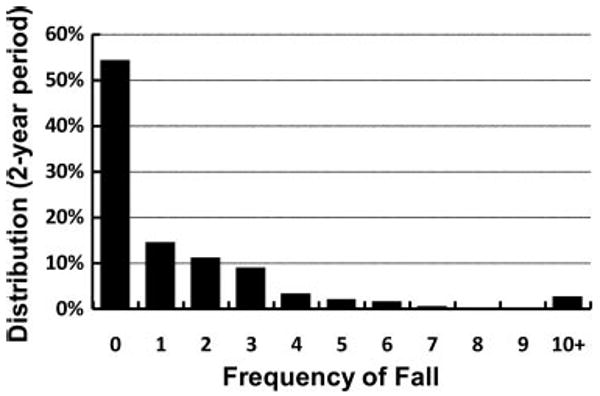
We identified 1174 stroke survivors (mean age+/-SD, 74.4+/-7.2 years; 53% female). The 2-year risks of falling, subsequent injury, and broken hip attributable to fall were 46%, 15%, and 2.1% among the subjects, respectively. Factors associated with an increased frequency of falling were living with spouse as compared to living alone (RR, 1.4), poor general health (RR, 1.1), time from first stroke (RR, 1.2), psychiatric problems (RR, 1.7), urinary incontinence (RR, 1.4), pain (RR, 1.4), motor impairment (RR, 1.2), and past frequency of > or = 3 falls (RR, 1.3). Risk factors associated with fall-related injury were female gender (OR, 1.5), poor general health (OR, 1.2), past injury from fall (OR, 3.2), past frequency of > or = 3 falls (OR, 3.1), psychiatric problems (OR, 1.4), urinary incontinence (OR, 1.4), impaired hearing (OR, 1.6), pain (OR, 1.8), motor impairment (OR, 1.3), and presence of multiple strokes (OR, 3.2).
This study demonstrates the high prevalence of falls and fall-related injuries in stroke survivors, and identifies factors that increase the risk. Modifying these factors may prevent falls, which could lead to improved quality of life and less caregiver burden and cost in this population.
中风幸存者跌倒风险很高。识别使中风患者易发生跌倒的身体、临床和社会因素,可能会减少进一步的残疾和危及生命的并发症,并改善总体生活质量。
我们使用了健康与退休研究中的5个两年期数据(1998 - 2006年)来评估中风幸存者中与跌倒事故及跌倒相关伤害有关的风险因素。我们提取了人口统计学数据、生活状况、自我评估的总体健康状况和共病情况。我们使用多变量随机效应模型分析了在2年随访期内跌倒的率比(RR)和受伤的比值比(OR)。
我们确定了1174名中风幸存者(平均年龄±标准差,74.4±7.2岁;53%为女性)。在这些受试者中,2年内跌倒、随后受伤以及因跌倒导致髋部骨折的风险分别为46%、15%和2.1%。与跌倒频率增加相关的因素包括与独自生活相比与配偶同住(RR,1.4)、总体健康状况差(RR,1.1)、首次中风后的时间(RR,1.2)、精神问题(RR,1.7)、尿失禁(RR,1.4)、疼痛(RR,1.4)、运动障碍(RR,1.2)以及过去跌倒次数≥3次(RR,1.3)。与跌倒相关伤害的风险因素包括女性(OR,1.5)、总体健康状况差(OR,1.2)、过去有跌倒受伤史(OR,3.2)、过去跌倒次数≥3次(OR,3.1)、精神问题(OR,1.4)、尿失禁(OR,1.4)、听力受损(OR,1.6)、疼痛(OR,1.8)、运动障碍(OR,1.3)以及有多次中风史(OR,3.2)。
本研究表明中风幸存者中跌倒及跌倒相关伤害的发生率很高,并确定了增加风险的因素。改变这些因素可能预防跌倒,这可能会改善该人群的生活质量,减轻护理负担并降低成本。