Torras-Llort Mònica, Moreno-Moreno Olga, Azorín Fernando
Institute of Molecular Biology of Barcelona, CSIC, and Institute for Research in Biomedicine (IRB Barcelona), Barcelona, Spain.
EMBO J. 2009 Aug 19;28(16):2337-48. doi: 10.1038/emboj.2009.174. Epub 2009 Jul 23.
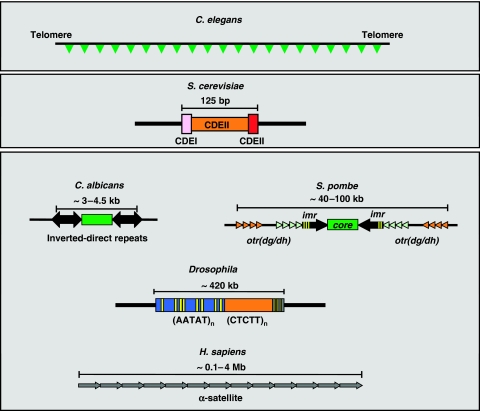
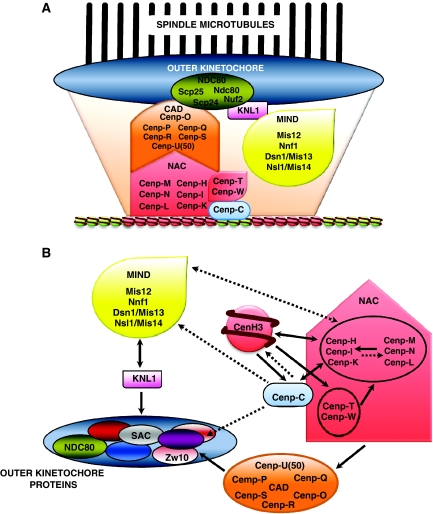
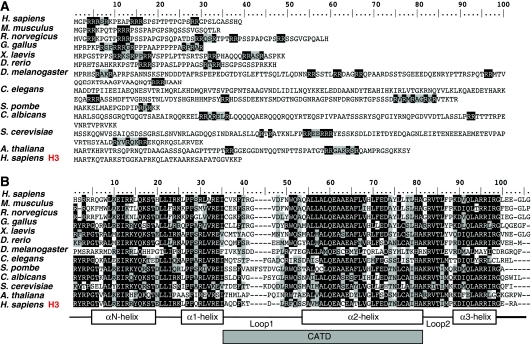
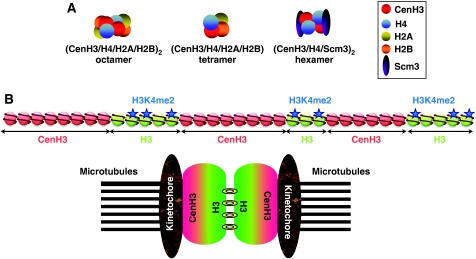
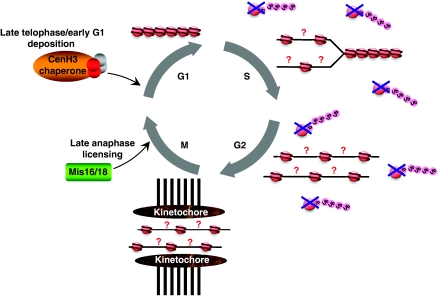
The centromere is a specialised chromosomal structure that regulates faithful chromosome segregation during cell division, as it dictates the site of assembly of the kinetochore, a critical structure that mediates binding of chromosomes to the spindle, monitors bipolar attachment and pulls chromosomes to the poles during anaphase. Identified more than a century ago as the primary constriction of condensed metaphase chromosomes, the centromere remained elusive to molecular characterisation for many years owed to its unusual enrichment in highly repetitive satellite DNA sequences, except in budding yeast. In the last decade, our understanding of centromere structure, organisation and function has increased tremendously. Nowadays, we know that centromere identity is determined epigenetically by the formation of a unique type of chromatin, which is characterised by the presence of the centromere-specific histone H3 variant CenH3, originally called CENP-A, which replaces canonical histone H3 at centromeres. CenH3-chromatin constitutes the physical and functional foundation for kinetochore assembly. This review explores recent studies addressing the structural and functional characterisation of CenH3-chromatin, its assembly and propagation during mitosis, and its contribution to kinetochore assembly.
着丝粒是一种特殊的染色体结构,在细胞分裂过程中调节染色体的准确分离,因为它决定了动粒组装的位点,动粒是一个关键结构,介导染色体与纺锤体的结合,监测双极附着并在后期将染色体拉向两极。着丝粒在一个多世纪前被确定为浓缩中期染色体的主要缢痕,由于其在高度重复的卫星DNA序列中异常富集,多年来一直难以进行分子表征,除了在芽殖酵母中。在过去十年中,我们对着丝粒的结构、组织和功能的理解有了极大的提高。如今,我们知道着丝粒身份是由一种独特类型的染色质的形成在表观遗传上决定的,这种染色质的特征是存在着丝粒特异性组蛋白H3变体CenH3,最初称为CENP-A,它在着丝粒处取代了经典组蛋白H3。CenH3染色质构成了动粒组装的物理和功能基础。本综述探讨了近期关于CenH3染色质的结构和功能表征、其在有丝分裂期间的组装和传播以及其对动粒组装的贡献的研究。