Dutch National Institute for Public Health and the Environment (RIVM), Bilthoven, the Netherlands.
Part Fibre Toxicol. 2009 Jul 24;6:19. doi: 10.1186/1743-8977-6-19.
Exposure to fine ambient particulate matter (PM) has consistently been associated with increased morbidity and mortality. The relationship between exposure to ultrafine particles (UFP) and health effects is less firmly established. If UFP cause health effects independently from coarser fractions, this could affect health impact assessment of air pollution, which would possibly lead to alternative policy options to be considered to reduce the disease burden of PM. Therefore, we organized an expert elicitation workshop to assess the evidence for a causal relationship between exposure to UFP and health endpoints.
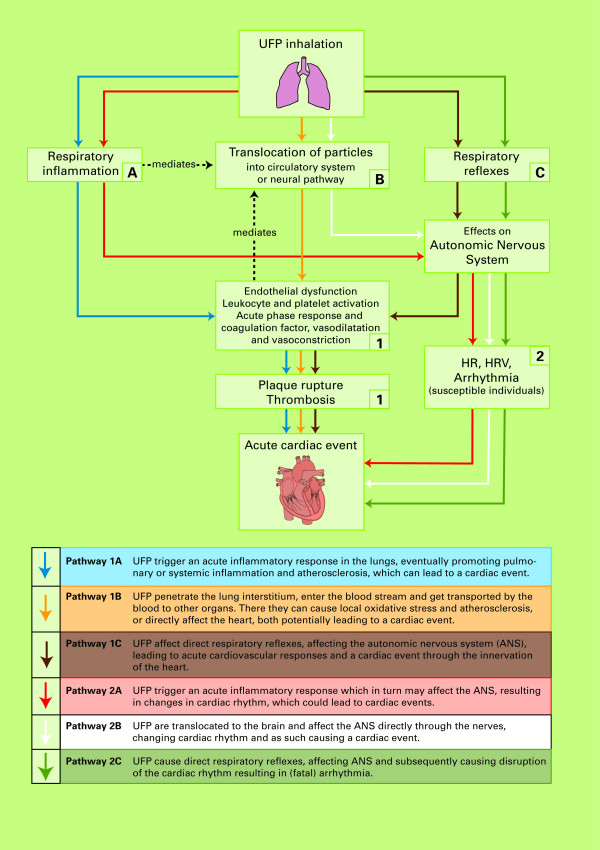
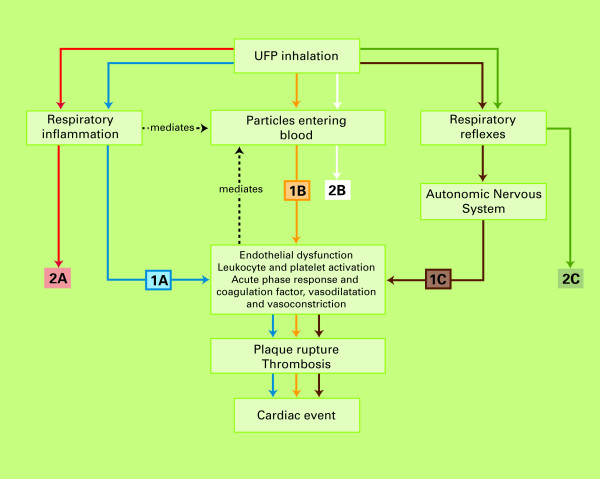
An expert elicitation on the health effects of ambient ultrafine particle exposure was carried out, focusing on: 1) the likelihood of causal relationships with key health endpoints, and 2) the likelihood of potential causal pathways for cardiac events. Based on a systematic peer-nomination procedure, fourteen European experts (epidemiologists, toxicologists and clinicians) were selected, of whom twelve attended. They were provided with a briefing book containing key literature. After a group discussion, individual expert judgments in the form of ratings of the likelihood of causal relationships and pathways were obtained using a confidence scheme adapted from the one used by the Intergovernmental Panel on Climate Change.
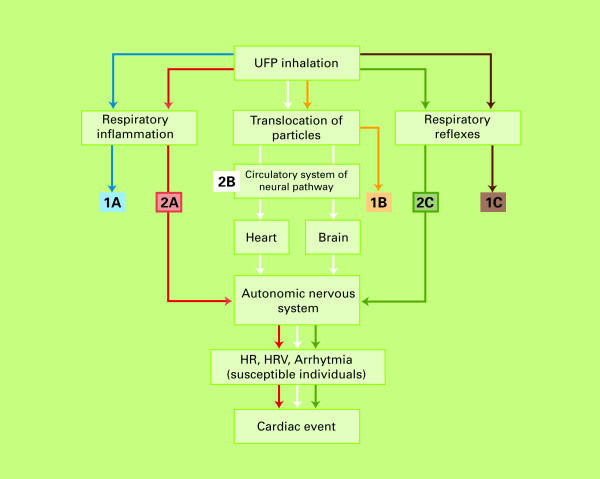
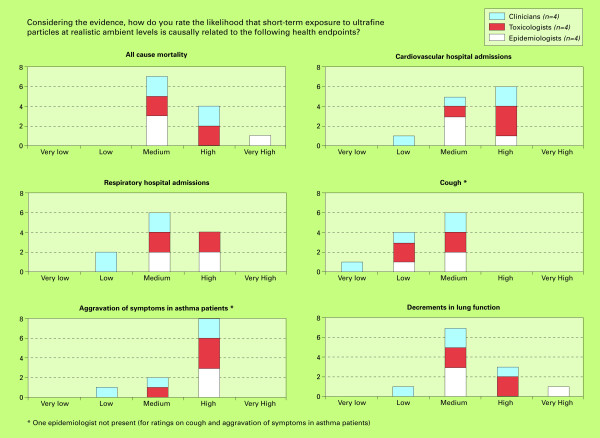
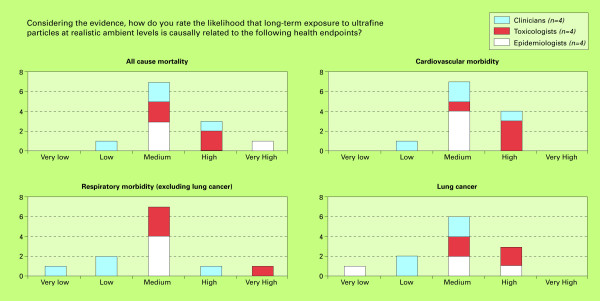
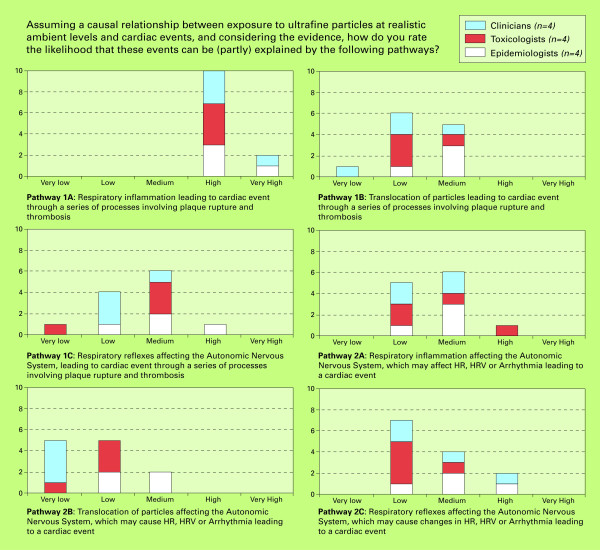
The likelihood of an independent causal relationship between increased short-term UFP exposure and increased all-cause mortality, hospital admissions for cardiovascular and respiratory diseases, aggravation of asthma symptoms and lung function decrements was rated medium to high by most experts. The likelihood for long-term UFP exposure to be causally related to all cause mortality, cardiovascular and respiratory morbidity and lung cancer was rated slightly lower, mostly medium. The experts rated the likelihood of each of the six identified possible causal pathways separately. Out of these six, the highest likelihood was rated for the pathway involving respiratory inflammation and subsequent thrombotic effects.
The overall medium to high likelihood rating of causality of health effects of UFP exposure and the high likelihood rating of at least one of the proposed causal mechanisms explaining associations between UFP and cardiac events, stresses the importance of considering UFP in future health impact assessments of (transport-related) air pollution, and the need for further research on UFP exposure and health effects.
暴露于细颗粒环境污染物(PM)一直与发病率和死亡率的增加有关。暴露于超细颗粒(UFP)与健康影响之间的关系尚未得到充分确立。如果 UFP 独立于较粗颗粒引起健康影响,这可能会影响空气污染健康影响评估,从而可能需要考虑替代政策选择来降低 PM 的疾病负担。因此,我们组织了一次专家征集研讨会,以评估暴露于 UFP 与健康终点之间存在因果关系的证据。
对环境超细颗粒暴露的健康影响进行了专家征集,重点关注:1)与关键健康终点之间因果关系的可能性,以及 2)心脏事件的潜在因果途径的可能性。根据系统的同行提名程序,选择了 14 位欧洲专家(流行病学家、毒理学家和临床医生),其中 12 位出席了会议。他们提供了一份简要介绍书,其中包含主要文献。在小组讨论之后,通过采用适应政府间气候变化专门委员会(IPCC)使用的置信度方案,以评分的形式获得了个人专家对因果关系和途径可能性的判断。
大多数专家认为,短期 UFP 暴露增加与全因死亡率、心血管和呼吸系统疾病住院、哮喘症状恶化和肺功能下降增加之间存在独立因果关系的可能性为中至高。长期 UFP 暴露与全因死亡率、心血管和呼吸系统发病率以及肺癌之间存在因果关系的可能性稍低,大多为中。专家分别对确定的六个可能的因果途径中的每一个进行了评分。在这六个途径中,呼吸道炎症和随后的血栓形成作用途径被评为可能性最高。
UFP 暴露对健康影响的因果关系的中至高可能性评分,以及对解释 UFP 与心脏事件之间关联的至少一种提议的因果机制的高可能性评分,强调了在未来(交通相关)空气污染健康影响评估中考虑 UFP 的重要性,以及对 UFP 暴露和健康影响进行进一步研究的必要性。