Chancellor Rebecca L, Isbell Lynne A
Behav Ecol Sociobiol. 2009 Aug;63(10):1447-1458. doi: 10.1007/s00265-009-0805-7. Epub 2009 Jun 26.
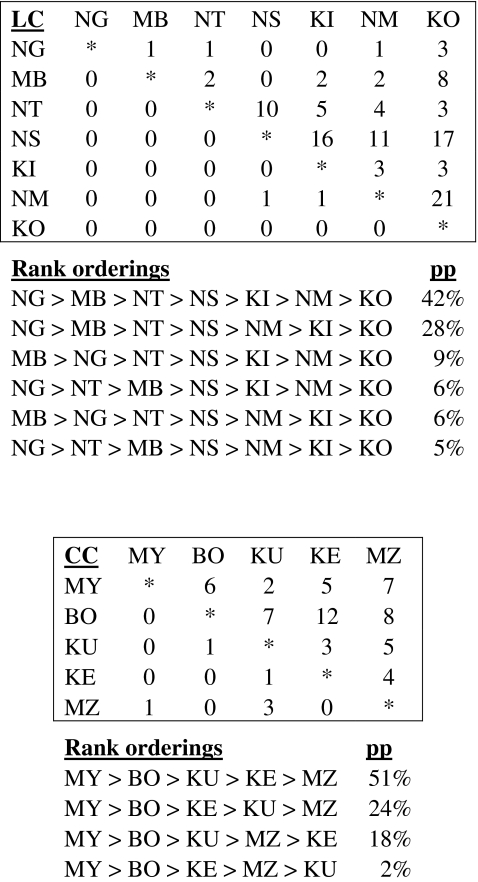
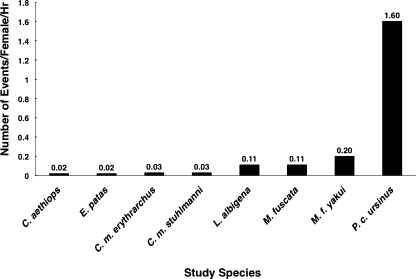
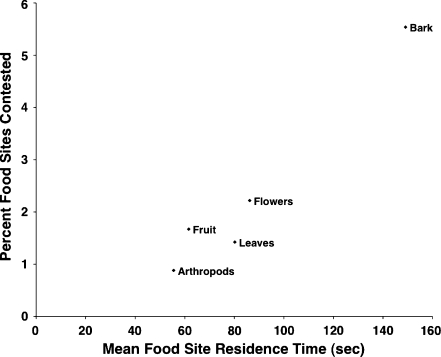
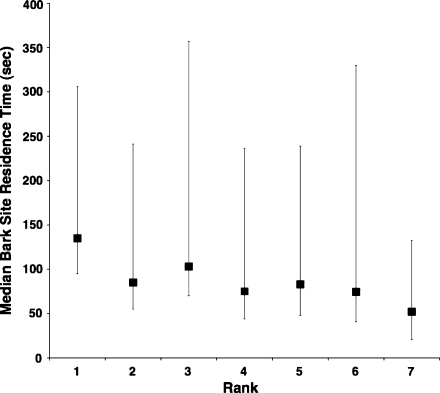
Authors of socioecological models propose that food distribution affects female social relationships in that clumped food resources, such as fruit, result in strong dominance hierarchies and favor coalition formation with female relatives. A number of Old World monkey species have been used to test predictions of the socioecological models. However, arboreal forest-living Old World monkeys have been understudied in this regard, and it is legitimate to ask whether predominantly arboreal primates living in tropical forests exhibit similar or different patterns of behavior. Therefore, the goal of our study was to investigate female dominance relationships in relation to food in gray-cheeked mangabeys (Lophocebus albigena). Since gray-cheeked mangabeys are largely frugivorous, we predicted that females would have linear dominance hierarchies and form coalitions. In addition, recent studies suggest that long food site residence time is another important factor in eliciting competitive interactions. Therefore, we also predicted that when foods had long site residence times, higher-ranking females would be able to spend longer at the resource than lower-ranking females. Analyses showed that coalitions were rare relative to some other Old World primate species, but females had linear dominance hierarchies. We found that, contrary to expectation, fruit was not associated with more agonism and did not involve long site residence times. However, bark, a food with a long site residence time and potentially high resource value, was associated with more agonism, and higher-ranking females were able to spend more time feeding on it than lower-ranking females. These results suggest that higher-ranking females may benefit from higher food and energy intake rates when food site residence times are long. These findings also add to accumulating evidence that food site residence time is a behavioral contributor to female dominance hierarchies in group-living species.
社会生态模型的作者提出,食物分布会影响雌性的社会关系,因为诸如水果等集中分布的食物资源会导致强烈的等级制度,并有利于与雌性亲属结成联盟。许多旧世界猴物种已被用于检验社会生态模型的预测。然而,在这方面,生活在树上的旧世界猴一直未得到充分研究,因此有理由问,生活在热带森林中的主要树栖灵长类动物是否表现出相似或不同的行为模式。因此,我们研究的目的是调查灰颊白眉猴(Lophocebus albigena)中雌性与食物相关的优势关系。由于灰颊白眉猴主要以水果为食,我们预测雌性会有线性的等级制度并结成联盟。此外,最近的研究表明,食物地点停留时间长是引发竞争互动的另一个重要因素。因此,我们还预测,当食物在地点停留时间长时,等级较高的雌性比等级较低的雌性能够在资源处花费更长时间。分析表明,与其他一些旧世界灵长类物种相比,联盟很少见,但雌性有线性的等级制度。我们发现,与预期相反,水果与更多的争斗行为无关,也不涉及长时间的地点停留。然而,树皮是一种在地点停留时间长且潜在资源价值高的食物,与更多的争斗行为有关,等级较高的雌性比等级较低的雌性能够在其上花费更多时间进食。这些结果表明,当食物地点停留时间长时,等级较高的雌性可能会从更高的食物和能量摄入率中受益。这些发现也进一步证明,食物地点停留时间是群居物种中雌性等级制度的一个行为促成因素。