Martínez-François Juan Ramón, Xu Yanping, Lu Zhe
Department of Physiology, Howard Hughes Medical Institute, University of Pennsylvania, Philadelphia, PA 19104, USA.
J Gen Physiol. 2009 Aug;134(2):151-64. doi: 10.1085/jgp.200910240.
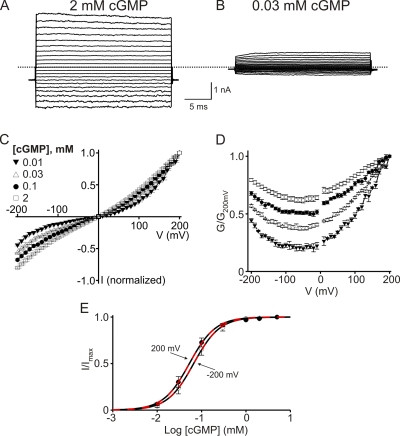
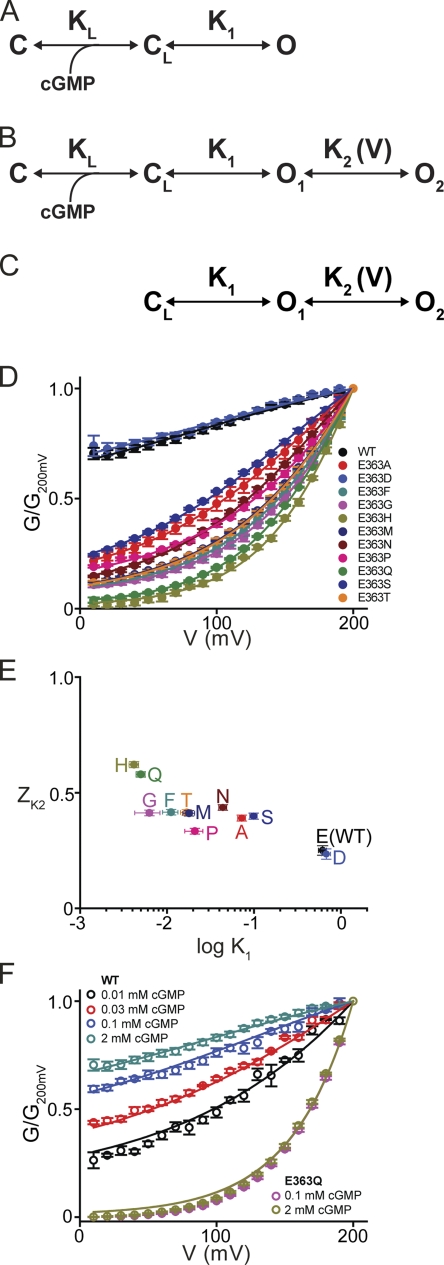
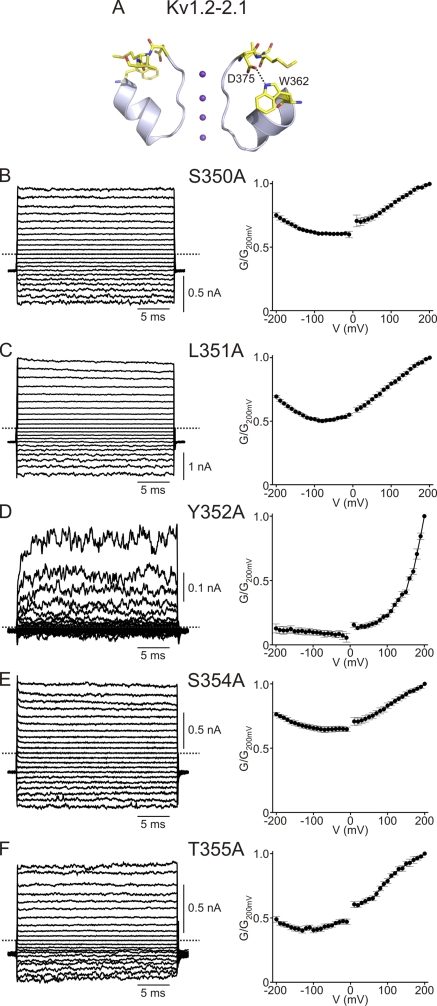
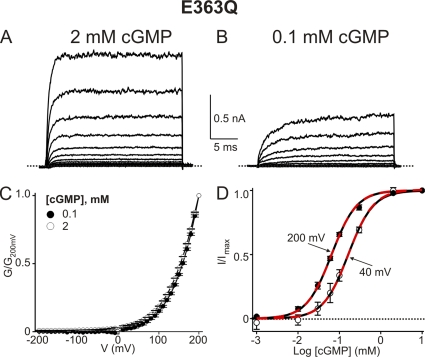
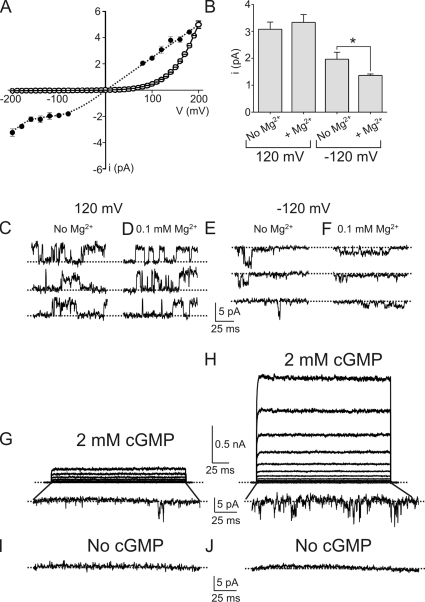
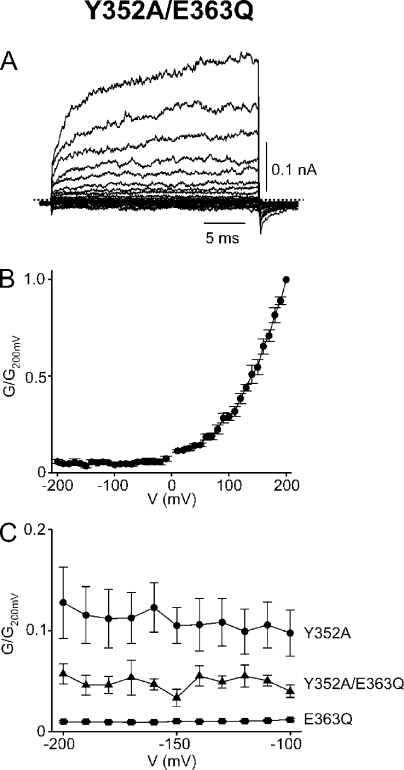
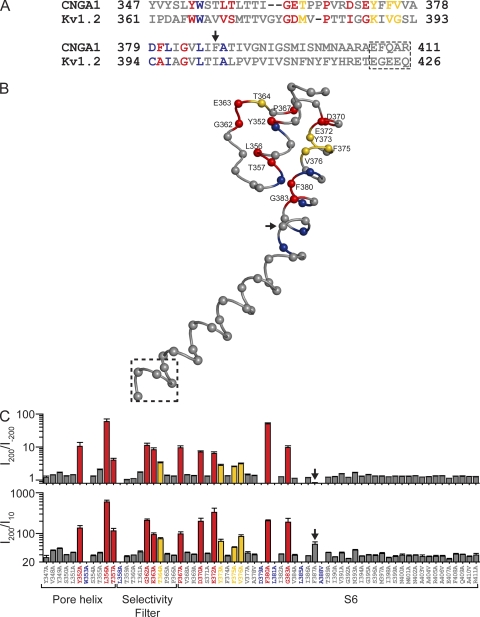
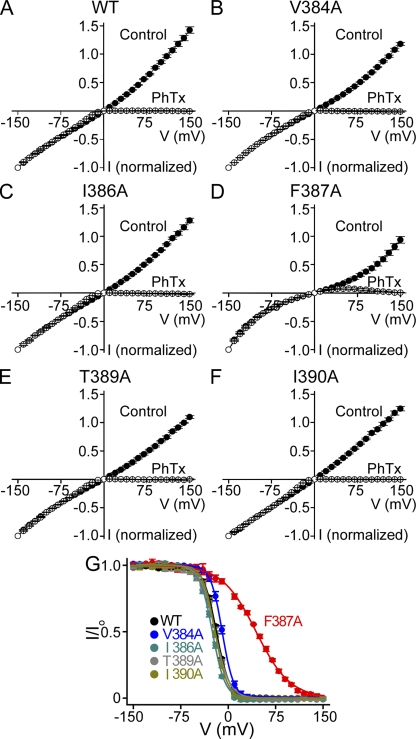
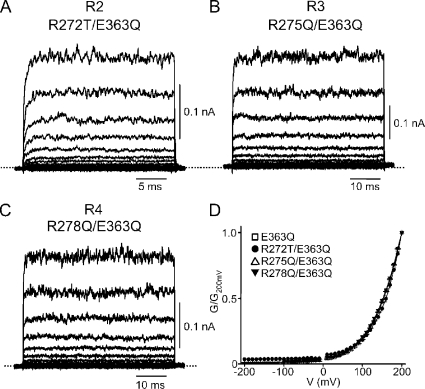
Activity of cyclic nucleotide-gated (CNG) cation channels underlies signal transduction in vertebrate visual receptors. These highly specialized receptor channels open when they bind cyclic GMP (cGMP). Here, we find that certain mutations restricted to the region around the ion selectivity filter render the channels essentially fully voltage gated, in such a manner that the channels remain mostly closed at physiological voltages, even in the presence of saturating concentrations of cGMP. This voltage-dependent gating resembles the selectivity filter-based mechanism seen in KcsA K(+) channels, not the S4-based mechanism of voltage-gated K(+) channels. Mutations that render CNG channels gated by voltage loosen the attachment of the selectivity filter to its surrounding structure, thereby shifting the channel's gating equilibrium toward closed conformations. Significant pore opening in mutant channels occurs only when positive voltages drive the pore from a low-probability open conformation toward a second open conformation to increase the channels' open probability. Thus, the structure surrounding the selectivity filter has evolved to (nearly completely) suppress the expression of inherent voltage-dependent gating of CNGA1, ensuring that the binding of cGMP by itself suffices to open the channels at physiological voltages.
环核苷酸门控(CNG)阳离子通道的活性是脊椎动物视觉受体信号转导的基础。这些高度特化的受体通道在结合环鸟苷酸(cGMP)时会打开。在此,我们发现某些仅限于离子选择性过滤器周围区域的突变使通道基本上完全受电压门控,其方式是即使在存在饱和浓度cGMP的情况下,通道在生理电压下仍大多处于关闭状态。这种电压依赖性门控类似于在KcsA钾通道中看到的基于选择性过滤器的机制,而不是电压门控钾通道基于S4的机制。使CNG通道受电压门控的突变会削弱选择性过滤器与其周围结构的附着,从而使通道的门控平衡向关闭构象移动。突变通道中显著的孔开放仅在正电压将孔从低概率开放构象驱动到第二个开放构象以增加通道开放概率时才会发生。因此,选择性过滤器周围的结构已经进化到(几乎完全)抑制CNGA1固有电压依赖性门控的表达,确保cGMP自身的结合足以在生理电压下打开通道。