Ho Pei-Shan, Chen Pai-Li, Warnakulasuriya Saman, Shieh Tien-Yu, Chen Yun-Kwan, Huang I-Yueh
Division of Oral and Maxillofacial Surgery, Department of Dentistry, Kaoshiung Medical University Hospital, Kaohsiung, Taiwan, Republic of China.
BMC Cancer. 2009 Jul 30;9:260. doi: 10.1186/1471-2407-9-260.
Oral squamous cell carcinoma could be preceded by clinically evident oral potentially malignant disorders (OPMDs). Transformation of OPMDs to cancer has been studied in several population groups. It is difficult to undertake comparisons across populations due to variations in the methods of computation of malignancy rates among different studies. The aim of our study was to estimate the rate of malignant transformation of OPMDs taking into account the duration of follow-up and to identify the significant factors indicative of malignant potential.
A total of 148 male patients with OPMDs were included. They were selected among all consecutive subjects registered at the maxillofacial clinic at a medical hospital in Kaohsiung, Taiwan. The mean follow up period was 37.8 months.
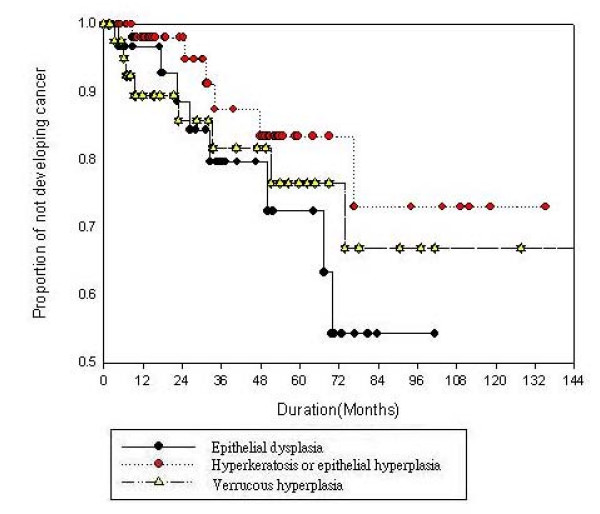
The malignant transformation rate was highest in subjects diagnosed with oral epithelial dysplasia. In this group the transformation rate was 7.62 per 100 persons-year. The rate in the group with verrucous hyperplasia (VH) was 5.21 per 100 persons-year, and in those with hyperkeratosis or epithelial hyperplasia was 3.26 per 100 persons-year. The anatomical site of OPMDs was the only statistically significant variable associated with malignancy. The hazard rate ratio (HRR) was 2.41 times for tongue lesions when compared with buccal lesions.
The reported discrepancies of malignant transformation of OPMDs involve the follow-up time to cancer development and hence it is preferable to use a time-to-event estimation for comparisons. We found that malignant transformation of OPMDs involving the tongue was significantly higher than in other anatomical subsites after adjusting for the clinicopathological type or lifestyle factors at diagnosis.
口腔鳞状细胞癌可能由临床上明显的口腔潜在恶性疾病(OPMDs)发展而来。在多个群体中对OPMDs向癌症的转化进行了研究。由于不同研究中恶性率计算方法的差异,很难在不同人群之间进行比较。我们研究的目的是在考虑随访时间的情况下估计OPMDs的恶性转化率,并确定表明恶性潜能的重要因素。
共纳入148例患有OPMDs的男性患者。他们是从台湾高雄一家医院颌面诊所登记的所有连续受试者中挑选出来的。平均随访期为37.8个月。
诊断为口腔上皮发育异常的受试者恶性转化率最高。在该组中,转化率为每100人年7.62例。疣状增生(VH)组的转化率为每100人年5.21例,角化过度或上皮增生组为每100人年3.26例。OPMDs的解剖部位是与恶性肿瘤相关的唯一具有统计学意义的变量。与颊部病变相比,舌部病变的风险率比(HRR)为2.41倍。
报道的OPMDs恶性转化差异涉及癌症发生的随访时间,因此最好使用事件发生时间估计进行比较。我们发现,在调整诊断时的临床病理类型或生活方式因素后,涉及舌部的OPMDs恶性转化明显高于其他解剖亚部位。