Prince of Wales Medical Research Institute, University of New South Wales, Barker St, Randwick, Sydney, NSW, 2031, Australia.
J Neuroeng Rehabil. 2009 Jul 30;6:31. doi: 10.1186/1743-0003-6-31.
The objective of this study was to examine age and gender differences in seven tests of functional mobility.
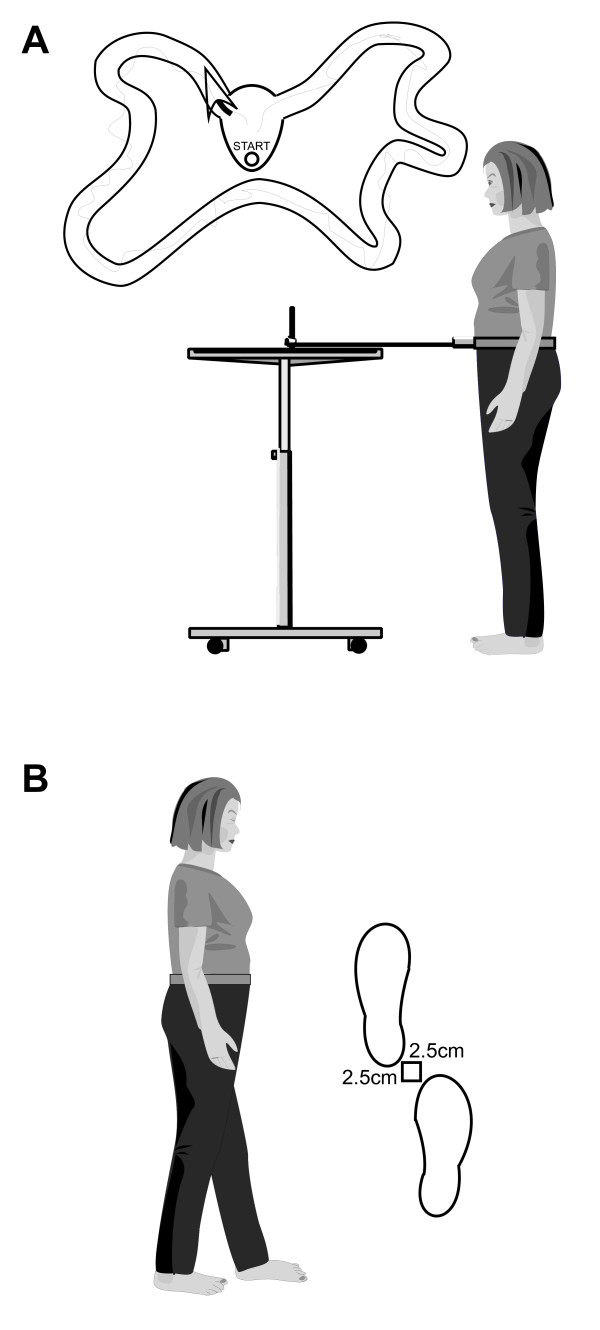
The study included 50 young participants aged 20 to 39 years, and 684 older participants aged 75 to 98 years. Functional mobility measures included the coordinated stability test, the near tandem balance test, the six metre walk test, the sit to stand test with five repetitions, the alternate step test and the stair ascent and descent tests.
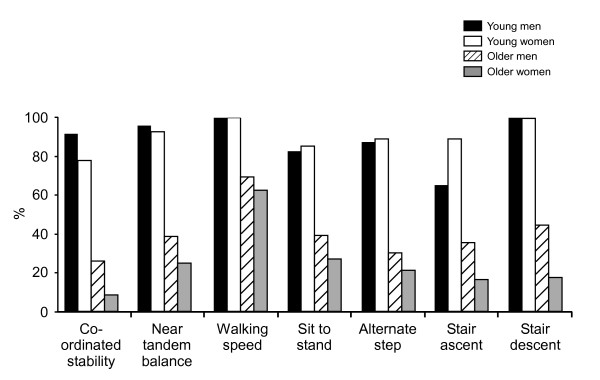
Older participants performed significantly worse than the younger participants in all of the functional mobility tests (p < 0.001), with the older women performing worse than the older men in all of the tests (p < 0.05). Significant correlations were found within the older group among all the functional mobility tests scores (r = 0.24-0.87, p < 0.001), and between functional mobility performance and age (r = 0.14-0.35, p < 0.001). People with arthritis and stroke performed worse than people without these conditions in these tests.
This study provides a normative database for performance of young and older community-dwelling people in a battery of validated and reliable functional mobility tests. The results confirm age-related differences in functional mobility between young and older adults.
本研究旨在检验七种功能性移动测试中年龄和性别差异。
研究纳入了 50 名年龄在 20 至 39 岁的年轻参与者和 684 名年龄在 75 至 98 岁的老年参与者。功能性移动测量包括协调稳定性测试、近并足平衡测试、六米步行测试、五次重复坐站测试、交替踏步测试和上下楼梯测试。
与年轻参与者相比,老年参与者在所有功能性移动测试中表现明显更差(p<0.001),老年女性在所有测试中表现均差于老年男性(p<0.05)。在老年组中,所有功能性移动测试得分之间存在显著相关性(r=0.24-0.87,p<0.001),并且功能性移动表现与年龄之间存在相关性(r=0.14-0.35,p<0.001)。患有关节炎和中风的人在这些测试中的表现差于没有这些疾病的人。
本研究为一组经过验证和可靠的功能性移动测试中年轻和老年社区居住者的表现提供了一个规范数据库。结果证实了年轻人和老年人之间功能性移动的年龄相关差异。