Department of Physiotherapy, Faculty of Health Sciences, Oslo Metropolitan University, Pilestredet, St. Olavs Plass, P.O. Box 4, 0130, Oslo, Norway.
Department of Chronic Diseases and Ageing, Norwegian Institute of Public Health, Oslo, Norway.
BMC Geriatr. 2019 Aug 8;19(1):216. doi: 10.1186/s12877-019-1234-8.
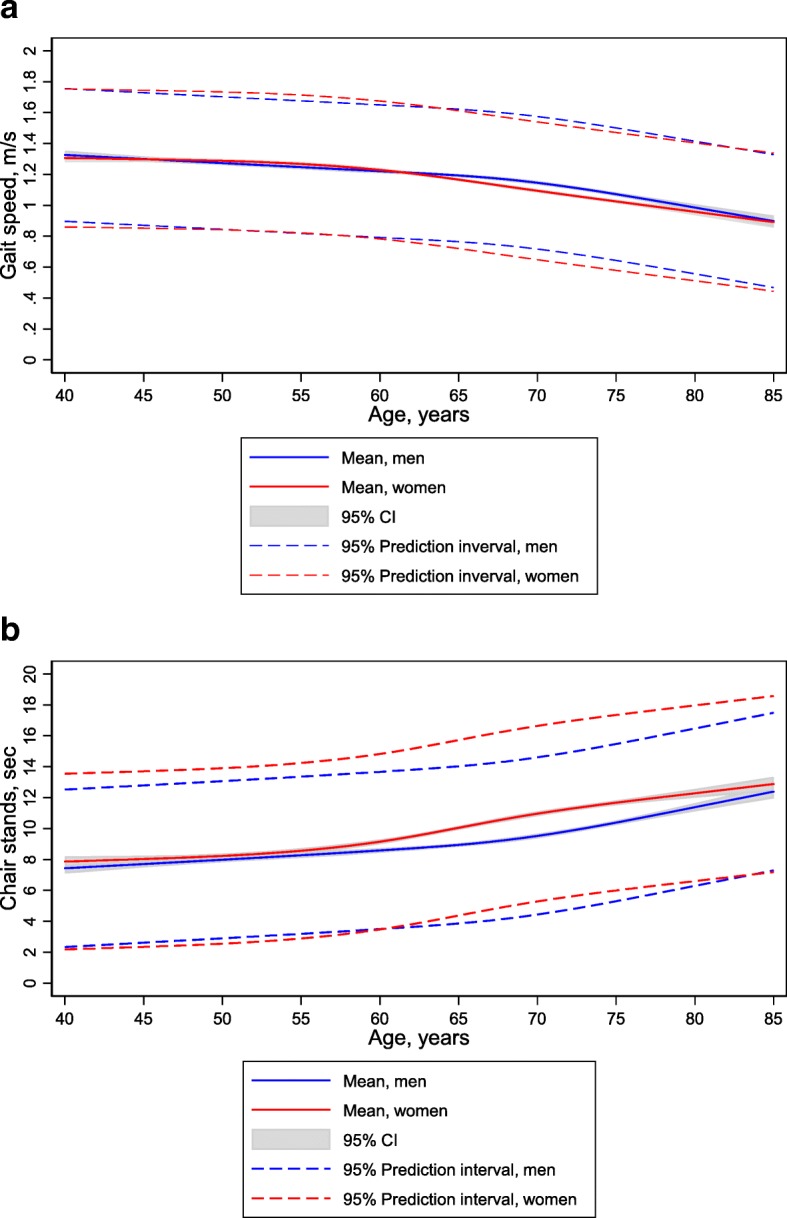
The Short Physical Performance Battery (SPPB) is a common well-established instrument to measure physical performance. It involves a timed 4-m walk, timed repeated chair sit-to-stand test, and 10-s balance tests (side-by-side, semi-tandem, and full-tandem). We aimed to establish reference values for community-dwelling Norwegian adults aged 40 years or older in terms of (1) the total score; (2) the three subtest scores; and (3) the time to complete the repeated chair sit-to-stand test and the walking speed. Additionally, we explored floor and ceiling effects for the SPPB.
The study population comprised home dwellers aged 40 years or more who participated in the 7th wave of the Tromsø study. A sample of 7474 participants (53.2% women) completed the SPPB. Crude mean values and standard deviations (SD) were evaluated according to sex and age group. Mean values at specific ages were then estimated using linear regression, along with corresponding 95% confidence intervals. Additionally, quantile regression was used to estimate age-specific percentiles (5th, 10th, 25th, 50th, 75th, 90th, and 95th percentiles).
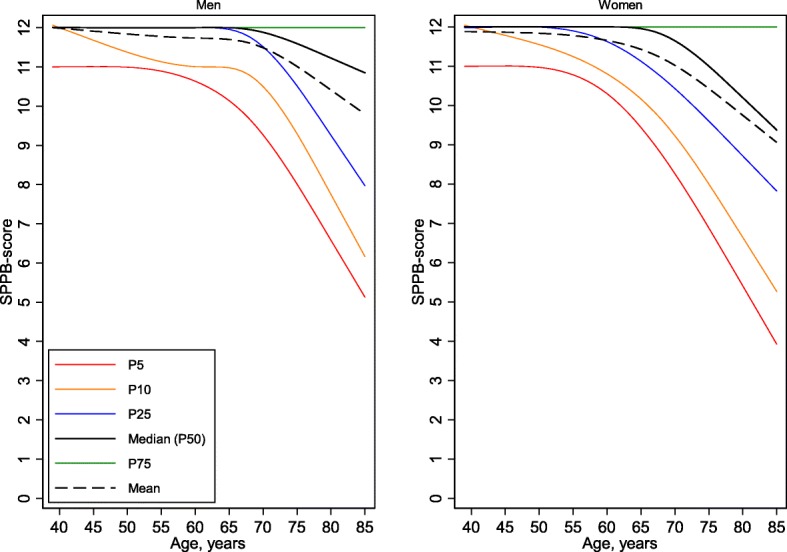
Considerable variability in SPPB scores was observed. The mean SPPB total score of the entire sample was 11.4 (SD 1.3) points. On average, the SPPB total score was 0.28 points greater in men than in women (p < 0.001). Significant sex differences were observed in all five age groups (40-49, 50-59, 60-69, 70-74, 75-79, and 80+ years). The main decline in the physical function occurred in the mid-sixties, with a slightly earlier decline in women than in men. Ceiling effects were observed in all age groups.
The present study provides comprehensive, up-to-date normative values for SPPB measures in community-dwelling Norwegians aged at least 40 years that may be used to interpret the results of studies evaluating and establishing appropriate treatment goals. Because of ceiling effects, the SPPB has important limitations for the assessment of physical functioning across the full spectrum of the community-dwelling adults aged 40+ years. Furthermore, we conclude that performance on the SPPB should be reported in terms of the total sum score and registered time to complete the repeated chair sit-to stand test and timed 4-m walk test.
简短体能表现电池(SPPB)是一种常用的、成熟的测量身体机能的工具。它包括一个计时 4 米行走、计时重复坐站测试和 10 秒平衡测试(并排、半前后脚、全前后脚)。我们旨在为挪威 40 岁或以上的社区居住成年人制定以下参考值:(1)总分;(2)三个分测试分数;(3)完成重复坐站测试和行走速度的时间。此外,我们还探讨了 SPPB 的地板和天花板效应。
研究人群包括居住在自家的 40 岁或以上的参与者,他们参加了特罗姆瑟研究的第 7 波。共有 7474 名参与者(53.2%为女性)完成了 SPPB。根据性别和年龄组评估了粗均值和标准差(SD)。然后使用线性回归估计特定年龄的均值,以及相应的 95%置信区间。此外,还使用分位数回归估计年龄特定的百分位数(第 5、10、25、50、75、90 和 95 百分位数)。
SPPB 评分存在相当大的差异。整个样本的 SPPB 总分平均值为 11.4(SD 1.3)分。平均而言,男性的 SPPB 总分比女性高 0.28 分(p<0.001)。在所有五个年龄组(40-49、50-59、60-69、70-74、75-79 和 80 岁以上)都观察到了明显的性别差异。身体机能的主要下降发生在 60 多岁中期,女性的下降略早于男性。在所有年龄组都观察到了天花板效应。
本研究提供了全面、最新的挪威社区居住者 SPPB 测量值的参考值,可用于解释评估和确定适当治疗目标的研究结果。由于天花板效应,SPPB 在评估 40 岁以上社区居住成年人的身体机能方面存在重要局限性。此外,我们的结论是,SPPB 的表现应该以总分和完成重复坐站测试和计时 4 米行走测试的注册时间来报告。