Vempati Ramaprabhu, Bijlani Ramesh Lal, Deepak Kishore Kumar
Department of Physiology, All India Institute of Medical Sciences, New Delhi, India.
BMC Pulm Med. 2009 Jul 30;9:37. doi: 10.1186/1471-2466-9-37.
There is a substantial body of evidence on the efficacy of yoga in the management of bronchial asthma. Many studies have reported, as the effects of yoga on bronchial asthma, significant improvements in pulmonary functions, quality of life and reduction in airway hyper-reactivity, frequency of attacks and medication use. In addition, a few studies have attempted to understand the effects of yoga on exercise-induced bronchoconstriction (EIB) or exercise tolerance capacity. However, none of these studies has investigated any immunological mechanisms by which yoga improves these variables in bronchial asthma.
The present randomized controlled trial (RCT) was conducted on 57 adult subjects with mild or moderate bronchial asthma who were allocated randomly to either the yoga (intervention) group (n = 29) or the wait-listed control group (n = 28). The control group received only conventional care and the yoga group received an intervention based on yoga, in addition to the conventional care. The intervention consisted of 2-wk supervised training in lifestyle modification and stress management based on yoga followed by closely monitored continuation of the practices at home for 6-wk. The outcome measures were assessed in both the groups at 0 wk (baseline), 2, 4 and 8 wk by using Generalized Linear Model (GLM) repeated measures followed by post-hoc analysis.
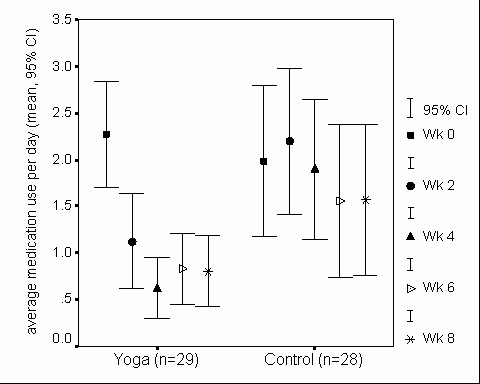
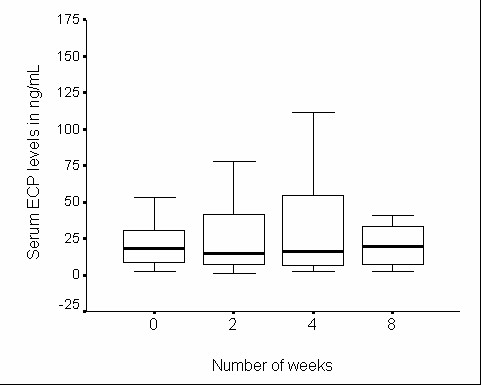
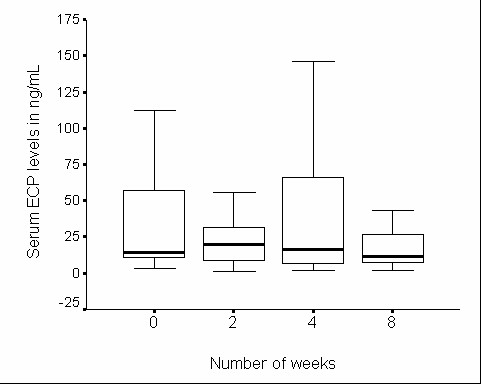
In the yoga group, there was a steady and progressive improvement in pulmonary function, the change being statistically significant in case of the first second of forced expiratory volume (FEV1) at 8 wk, and peak expiratory flow rate (PEFR) at 2, 4 and 8 wk as compared to the corresponding baseline values. There was a significant reduction in EIB in the yoga group. However, there was no corresponding reduction in the urinary prostaglandin D2 metabolite (11beta prostaglandin F2alpha) levels in response to the exercise challenge. There was also no significant change in serum eosinophilic cationic protein levels during the 8-wk study period in either group. There was a significant improvement in Asthma Quality of Life (AQOL) scores in both groups over the 8-wk study period. But the improvement was achieved earlier and was more complete in the yoga group. The number-needed-to-treat worked out to be 1.82 for the total AQOL score. An improvement in total AQOL score was greater than the minimal important difference and the same outcome was achieved for the sub-domains of the AQOL. The frequency of rescue medication use showed a significant decrease over the study period in both the groups. However, the decrease was achieved relatively earlier and was more marked in the yoga group than in the control group.
The present RCT has demonstrated that adding the mind-body approach of yoga to the predominantly physical approach of conventional care results in measurable improvement in subjective as well as objective outcomes in bronchial asthma. The trial supports the efficacy of yoga in the management of bronchial asthma. However, the preliminary efforts made towards working out the mechanism of action of the intervention have not thrown much light on how yoga works in bronchial asthma.
Current Controlled Trials ISRCTN00815962.
有大量证据表明瑜伽对支气管哮喘的治疗有效。许多研究报告称,作为瑜伽对支气管哮喘的影响,肺功能、生活质量有显著改善,气道高反应性、发作频率和药物使用减少。此外,一些研究试图了解瑜伽对运动诱发支气管收缩(EIB)或运动耐受能力的影响。然而,这些研究均未调查瑜伽改善支气管哮喘这些变量的任何免疫机制。
本随机对照试验(RCT)对57名轻度或中度支气管哮喘成年受试者进行,他们被随机分配到瑜伽(干预)组(n = 29)或等待名单对照组(n = 28)。对照组仅接受常规护理,瑜伽组除常规护理外,还接受基于瑜伽的干预。干预包括为期2周的基于瑜伽的生活方式改变和压力管理的监督训练,随后在家中密切监测持续练习6周。在0周(基线)、2周、4周和8周时,使用广义线性模型(GLM)重复测量,然后进行事后分析,对两组的结果指标进行评估。
在瑜伽组中,肺功能有稳定且逐步的改善,与相应的基线值相比,8周时第一秒用力呼气量(FEV1)以及2周、4周和8周时的呼气峰值流速(PEFR)的变化具有统计学意义。瑜伽组的EIB显著降低。然而,运动激发后尿前列腺素D2代谢物(11β前列腺素F2α)水平没有相应降低。在8周的研究期间,两组血清嗜酸性阳离子蛋白水平均无显著变化。在8周的研究期间,两组的哮喘生活质量(AQOL)评分均有显著改善。但瑜伽组改善更早且更完全。总AQOL评分的治疗所需人数为1.82。总AQOL评分的改善大于最小重要差异,AQOL的子领域也取得了相同的结果。在研究期间,两组急救药物的使用频率均显著下降。然而,瑜伽组下降相对更早且比对照组更明显。
本随机对照试验表明,在以身体为主的常规护理方法中加入身心结合的瑜伽方法,可使支气管哮喘的主观和客观结果得到可测量的改善。该试验支持瑜伽对支气管哮喘的治疗效果。然而,为研究干预作用机制所做的初步努力并未阐明瑜伽在支气管哮喘中的作用方式。
当前对照试验ISRCTN00815962。