Newbury Dianne F, Winchester Laura, Addis Laura, Paracchini Silvia, Buckingham Lyn-Louise, Clark Ann, Cohen Wendy, Cowie Hilary, Dworzynski Katharina, Everitt Andrea, Goodyer Ian M, Hennessy Elizabeth, Kindley A David, Miller Laura L, Nasir Jamal, O'Hare Anne, Shaw Duncan, Simkin Zoe, Simonoff Emily, Slonims Vicky, Watson Jocelynne, Ragoussis Jiannis, Fisher Simon E, Seckl Jonathon R, Helms Peter J, Bolton Patrick F, Pickles Andrew, Conti-Ramsden Gina, Baird Gillian, Bishop Dorothy V M, Monaco Anthony P
Wellcome Trust Centre for Human Genetics, University of Oxford, Oxford, UK.
Am J Hum Genet. 2009 Aug;85(2):264-72. doi: 10.1016/j.ajhg.2009.07.004. Epub 2009 Jul 30.
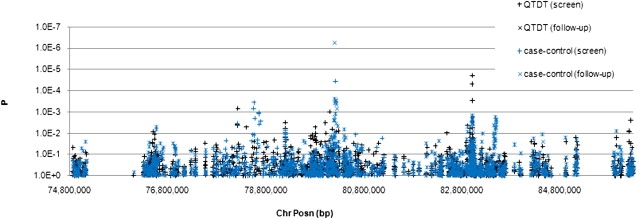
Specific language impairment (SLI) is a common developmental disorder characterized by difficulties in language acquisition despite otherwise normal development and in the absence of any obvious explanatory factors. We performed a high-density screen of SLI1, a region of chromosome 16q that shows highly significant and consistent linkage to nonword repetition, a measure of phonological short-term memory that is commonly impaired in SLI. Using two independent language-impaired samples, one family-based (211 families) and another selected from a population cohort on the basis of extreme language measures (490 cases), we detected association to two genes in the SLI1 region: that encoding c-maf-inducing protein (CMIP, minP = 5.5 x 10(-7) at rs6564903) and that encoding calcium-transporting ATPase, type2C, member2 (ATP2C2, minP = 2.0 x 10(-5) at rs11860694). Regression modeling indicated that each of these loci exerts an independent effect upon nonword repetition ability. Despite the consistent findings in language-impaired samples, investigation in a large unselected cohort (n = 3612) did not detect association. We therefore propose that variants in CMIP and ATP2C2 act to modulate phonological short-term memory primarily in the context of language impairment. As such, this investigation supports the hypothesis that some causes of language impairment are distinct from factors that influence normal language variation. This work therefore implicates CMIP and ATP2C2 in the etiology of SLI and provides molecular evidence for the importance of phonological short-term memory in language acquisition.
特定语言障碍(SLI)是一种常见的发育障碍,其特征是尽管其他方面发育正常且没有任何明显的解释因素,但在语言习得方面仍存在困难。我们对SLI1进行了高密度筛查,SLI1位于16号染色体q区域,与非词重复表现出高度显著且一致的连锁关系,非词重复是一种语音短期记忆指标,在SLI中通常受损。我们使用了两个独立的语言障碍样本,一个是基于家系的样本(211个家系),另一个是根据极端语言测量从人群队列中选取的样本(490例),我们在SLI1区域检测到与两个基因的关联:编码c-maf诱导蛋白的基因(CMIP,在rs6564903处最小P值 = 5.5 × 10⁻⁷)和编码钙转运ATP酶2C型成员2的基因(ATP2C2,在rs11860694处最小P值 = 2.0 × 10⁻⁵)。回归模型表明,这些位点中的每一个都对非词重复能力产生独立影响。尽管在语言障碍样本中发现了一致的结果,但在一个未经过筛选的大型队列(n = 3612)中进行的调查未检测到关联。因此,我们提出CMIP和ATP2C2中的变异主要在语言障碍的背景下调节语音短期记忆。因此,这项研究支持了这样一种假设,即语言障碍的某些原因与影响正常语言变异的因素不同。这项工作因此表明CMIP和ATP2C2与SLI的病因有关,并为语音短期记忆在语言习得中的重要性提供了分子证据。