Xie Pengfei, Zeng Ana, Qin Zhongjun
Key Laboratory of Synthetic Biology, Shanghai Institute of Plant Physiology and Ecology, Shanghai, PR China.
BMC Microbiol. 2009 Aug 4;9:157. doi: 10.1186/1471-2180-9-157.
Streptomyces coelicolor is the most studied Streptomyces species and an excellent model for studying differentiation and antibiotic production. To date, many genes have been identified to be required for its differentiation (e.g. bld genes for aerial growth and whi genes for sporulation) and antibiotics production (including actII-orf4, redD, cdaR as pathway-specific regulatory genes and afsR, absA1/A2 as pleiotropic regulatory genes).
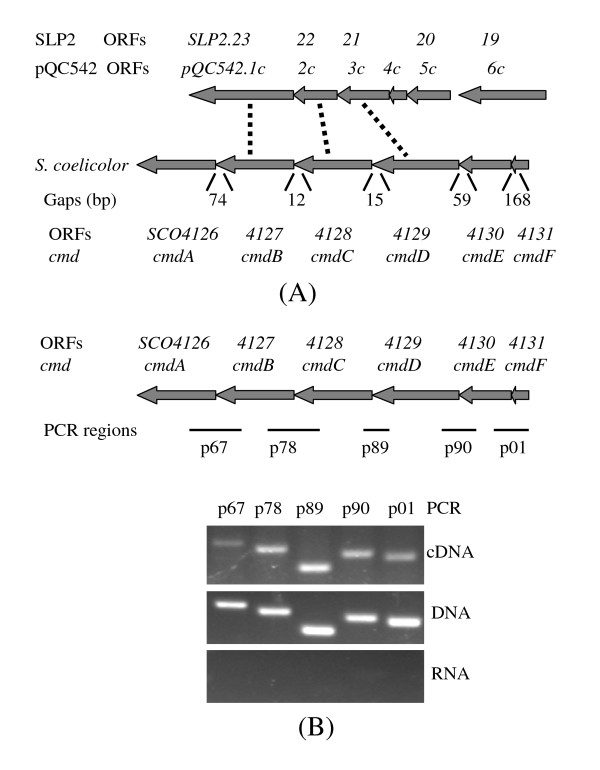
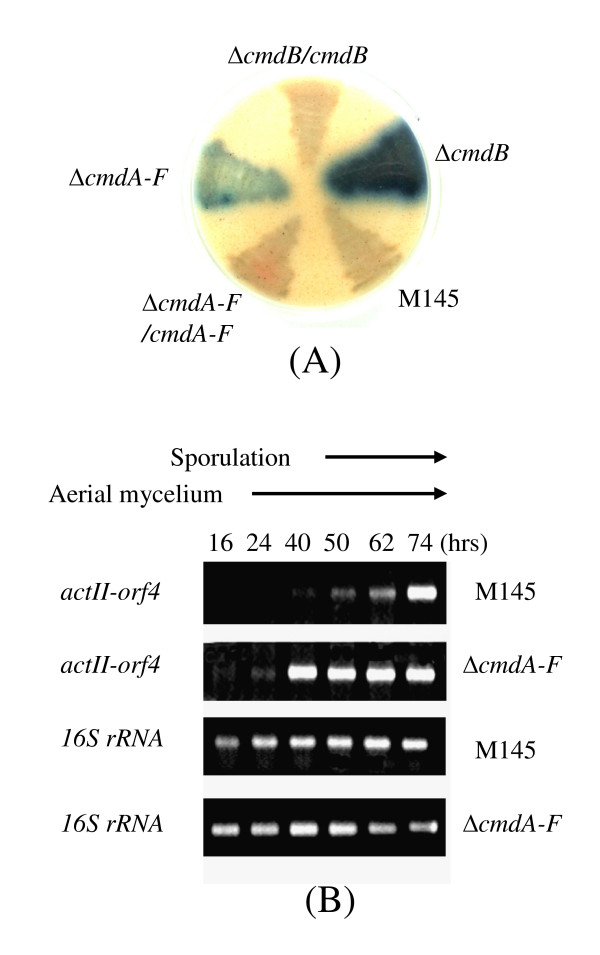
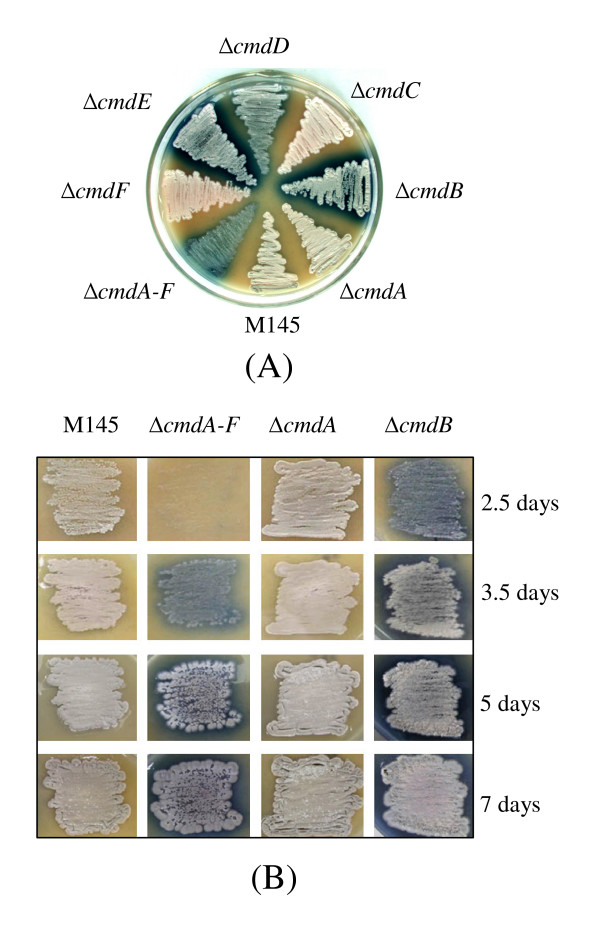
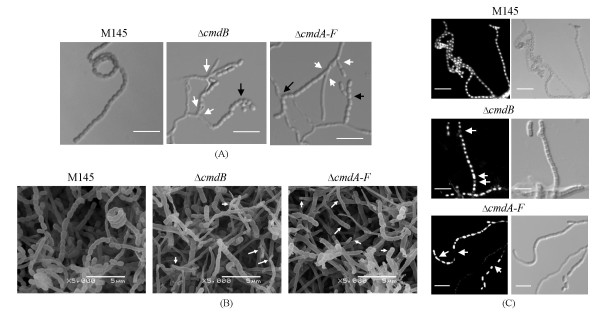
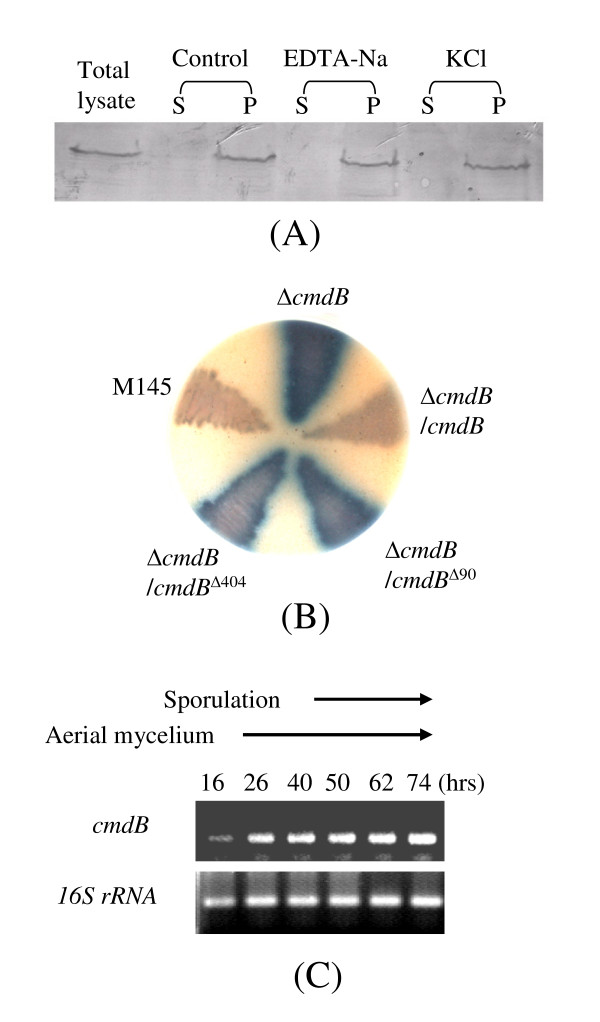
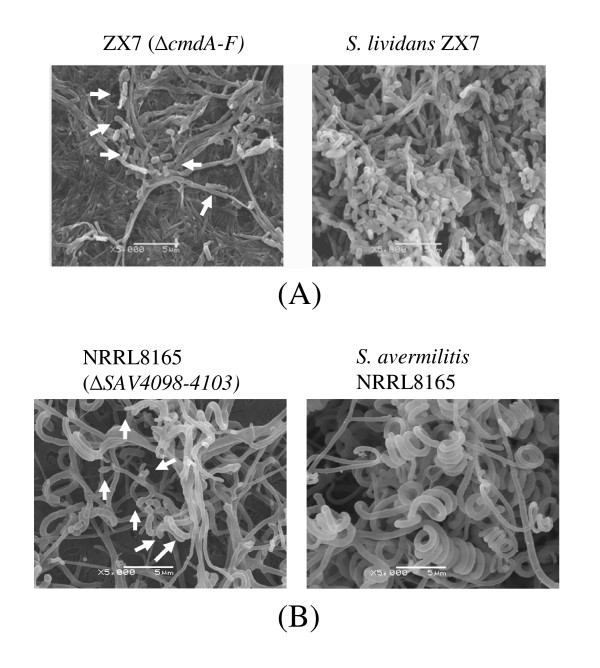
A gene cluster containing six genes (SCO4126-4131) was proved to be co-transcribed in S. coelicolor. Deletions of cmdABCDEF (SCO4126-4131) displayed defective sporulation including formation of aberrant branches, and abnormalities in chromosome segregation and spore septation. Disruption mutants of apparently orthologous genes of S. lividans and S. avermitilis also showed defective sporulation, implying that the role of these genes is similar among Streptomyces. Transcription of cmdB, and therefore presumably of the whole operon, was regulated developmentally. Five of the encoded proteins (CmdA, C, D, E, F) were predicted membrane proteins. The other, CmdB, a predicted ATP/GTP-binding protein with an ABC-transporter-ATPase domain shown here to be essential for its function, was also located on the cell membrane. These results indicate that CmdABCDEF proteins mainly affect Streptomyces differentiation at an early stage of aerial hyphae formation, and suggest that these proteins may form a complex on cell membrane for proper segregation of chromosomes. In addition, deletions of cmdABCDEF also revealed over-production of blue-pigmented actinorhodin (Act) via activation of transcription of the pathway-specific regulatory gene actII-orf4 of actinorhodin biosynthesis.
In this study, six co-transcribed genes cmdABCDEF were identified by their effects on differentiation and antibiotic production in Streptomyces coelicolor A3(2). These six membrane-located proteins are possibly assembled into a complex to function.
天蓝色链霉菌是研究最多的链霉菌物种,也是研究分化和抗生素生产的优秀模型。迄今为止,已鉴定出许多基因参与其分化(例如参与气生菌丝生长的bld基因和参与孢子形成的whi基因)以及抗生素生产(包括作为途径特异性调控基因的actII-orf4、redD、cdaR和作为多效调控基因的afsR、absA1/A2)。
证明了一个包含六个基因(SCO4126 - 4131)的基因簇在天蓝色链霉菌中是共转录的。cmdABCDEF(SCO4126 - 4131)缺失显示出孢子形成缺陷,包括异常分支的形成以及染色体分离和孢子隔膜的异常。淡紫灰链霉菌和阿维链霉菌明显同源基因的破坏突变体也显示出孢子形成缺陷,这意味着这些基因在链霉菌中的作用相似。cmdB的转录,因此推测整个操纵子的转录,受到发育调控。编码的六种蛋白质中的五种(CmdA、C、D、E、F)被预测为膜蛋白。另一种,CmdB,是一种预测的具有ABC转运蛋白 - ATP酶结构域的ATP / GTP结合蛋白,此处显示其功能必不可少,也位于细胞膜上。这些结果表明,CmdABCDEF蛋白主要在气生菌丝形成的早期阶段影响链霉菌的分化,并表明这些蛋白可能在细胞膜上形成复合物以实现染色体的正确分离。此外,cmdABCDEF的缺失还通过激活放线紫红素生物合成途径特异性调控基因actII - orf4的转录,揭示了蓝色色素放线紫红素(Act)的过量产生。
在本研究中,通过对天蓝色链霉菌A3(2)分化和抗生素生产的影响鉴定出六个共转录基因cmdABCDEF。这六种位于膜上的蛋白质可能组装成复合物发挥功能。