
纺锤体装配检验点的反向工程。
Reverse engineering of the spindle assembly checkpoint.
机构信息
Department of Molecular Genetics, Weizmann Institute of Science, Rehovot, Israel.
出版信息
PLoS One. 2009 Aug 4;4(8):e6495. doi: 10.1371/journal.pone.0006495.
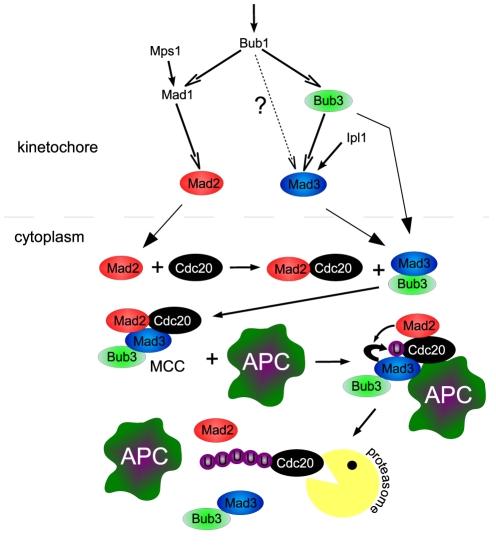
The Spindle Assembly Checkpoint (SAC) is an intracellular mechanism that ensures proper chromosome segregation. By inhibiting Cdc20, a co-factor of the Anaphase Promoting Complex (APC), the checkpoint arrests the cell cycle until all chromosomes are properly attached to the mitotic spindle. Inhibition of Cdc20 is mediated by a conserved network of interacting proteins. The individual functions of these proteins are well characterized, but understanding of their integrated function is still rudimentary. We here describe our attempts to reverse-engineer the SAC network based on gene deletion phenotypes. We begun by formulating a general model of the SAC which enables us to predict the rate of chromosomal missegregation for any putative set of interactions between the SAC proteins. Next the missegregation rates of seven yeast strains are measured in response to the deletion of one or two checkpoint proteins. Finally, we searched for the set of interactions that correctly predicted the observed missegregation rates of all deletion mutants. Remarkably, although based on only seven phenotypes, the consistent network we obtained successfully reproduces many of the known properties of the SAC. Further insights provided by our analysis are discussed.
纺锤体组装检查点(SAC)是一种确保染色体正确分离的细胞内机制。通过抑制细胞分裂周期蛋白 20(Cdc20),即后期促进复合物(APC)的一个辅助因子,检查点将细胞周期阻滞,直到所有染色体都正确地连接到有丝分裂纺锤体上。Cdc20 的抑制是通过一个保守的相互作用蛋白网络介导的。这些蛋白的各个功能都得到了很好的描述,但它们的综合功能的理解仍然是初步的。我们在这里描述了我们根据基因缺失表型来反向设计 SAC 网络的尝试。我们首先制定了一个 SAC 的通用模型,使我们能够预测任何一组 SAC 蛋白之间的相互作用发生染色体错误分离的速率。接下来,我们测量了七种酵母菌株在缺失一个或两个检查点蛋白时的染色体错误分离率。最后,我们搜索了一组能够正确预测所有缺失突变体观察到的错误分离率的相互作用。值得注意的是,尽管只有七个表型,但我们得到的一致网络成功地再现了 SAC 的许多已知特性。我们的分析提供了进一步的见解,讨论如下。


 Zotero 插件