Division of Lipoprotein Disorders, Presbyterian Center for Preventive Cardiology, Charlotte, NC.
J Clin Lipidol. 2007 Dec;1(6):583-92. doi: 10.1016/j.jacl.2007.10.001.
The cholesterol content of LDL particles is variable, causing frequent discrepancies between concentrations of LDL cholesterol and LDL particle number. In managing patients at risk for cardiovascular disease (CVD) to LDL target levels, it is unclear whether LDL cholesterol provides the optimum measure of residual risk and adequacy of LDL lowering treatment.
To compare the ability of alternative measures of LDL to provide CVD risk discrimination at relatively low levels consistent with current therapeutic targets.
Concentrations of LDL cholesterol (LDL-C) and non-HDL cholesterol (non-HDL-C) were measured chemically and LDL particle number (LDL-P) and VLDL particle number (VLDL-P) were measured by nuclear magnetic resonance (NMR) in 3066 middle-aged white participants (53% women) without CVD in the Framingham Offspring cohort. The main outcome measure was incidence of first CVD event.
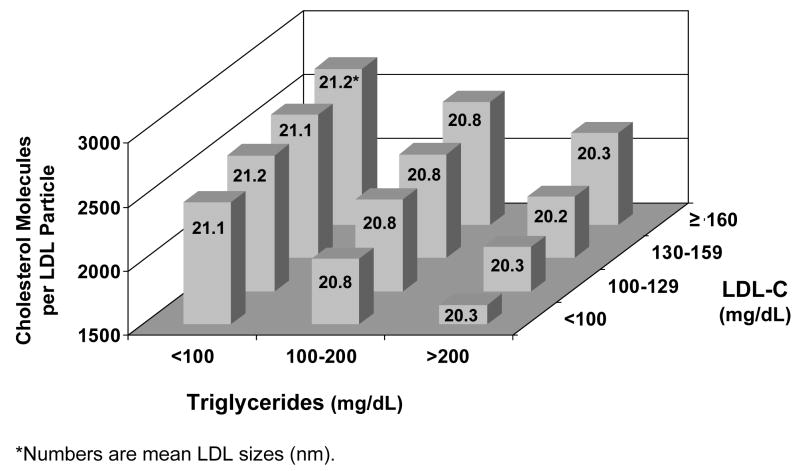
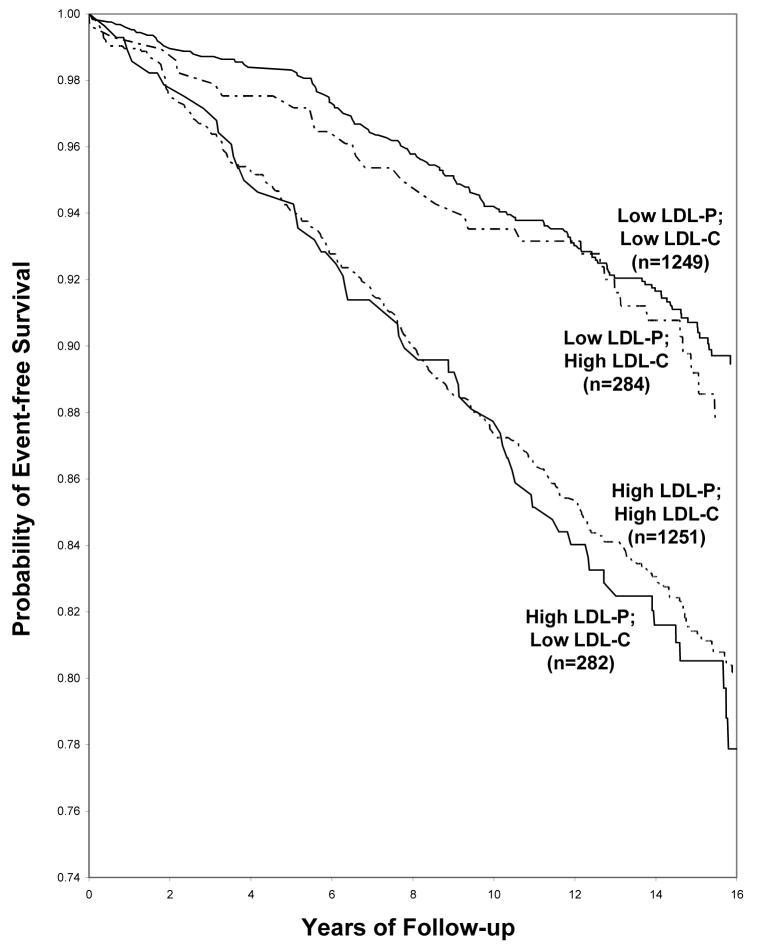
At baseline, the cholesterol content per LDL particle was negatively associated with triglycerides and positively associated with LDL-C. On follow-up (median 14.8 yrs), 265 men and 266 women experienced a CVD event. In multivariable models adjusting for non-lipid CVD risk factors, LDL-P was related more strongly to future CVD in both sexes than LDL-C or non-HDL-C. Subjects with a low level of LDL-P (<25(th) percentile) had a lower CVD event rate (59 events per 1000 person-years) than those with an equivalently low level of LDL-C or non-HDL-C (81 and 74 events per 1000 person-years, respectively).
In a large community-based sample, LDL-P was a more sensitive indicator of low CVD risk than either LDL-C or non-HDL-C, suggesting a potential clinical role for LDL-P as a goal of LDL management.
LDL 颗粒中的胆固醇含量是可变的,导致 LDL 胆固醇浓度和 LDL 颗粒数之间经常存在差异。在将心血管疾病(CVD)风险患者管理至 LDL 目标水平时,尚不清楚 LDL 胆固醇是否提供了剩余风险的最佳衡量标准以及 LDL 降低治疗的充分性。
比较替代 LDL 测量指标在与当前治疗目标一致的相对较低水平下提供 CVD 风险区分的能力。
在弗雷明汉后代队列中,3066 名中年白人参与者(53%为女性)中,通过化学方法测量 LDL 胆固醇(LDL-C)和非高密度脂蛋白胆固醇(非-HDL-C)浓度,通过核磁共振(NMR)测量 LDL 颗粒数(LDL-P)和极低密度脂蛋白颗粒数(VLDL-P)。主要结局指标是首次 CVD 事件的发生率。
在基线时,每个 LDL 颗粒的胆固醇含量与甘油三酯呈负相关,与 LDL-C 呈正相关。在随访期间(中位数 14.8 年),265 名男性和 266 名女性发生了 CVD 事件。在调整非脂质 CVD 危险因素的多变量模型中,LDL-P 在两性中与未来 CVD 的相关性均强于 LDL-C 或非-HDL-C。LDL-P 水平较低(<第 25 百分位数)的受试者的 CVD 事件发生率(每 1000 人年 59 例)低于 LDL-C 或非-HDL-C 水平相当低的受试者(分别为每 1000 人年 81 例和 74 例)。
在大型社区样本中,LDL-P 是低 CVD 风险的更敏感指标,优于 LDL-C 或非-HDL-C,提示 LDL-P 作为 LDL 管理目标具有潜在的临床作用。