Montell Craig
Department of Biological Chemistry, Center for Sensory Biology, The Johns Hopkins University School of Medicine, Baltimore, MD 21205, USA.
Curr Opin Neurobiol. 2009 Aug;19(4):345-53. doi: 10.1016/j.conb.2009.07.001. Epub 2009 Aug 5.
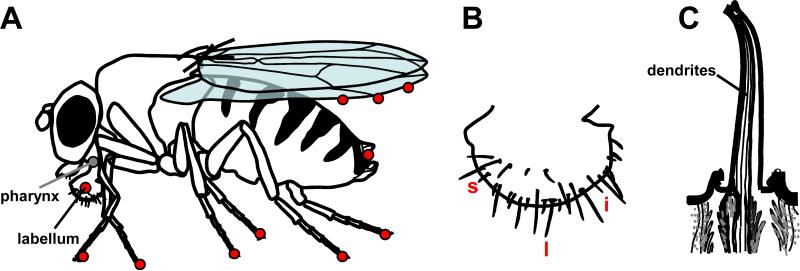
Insects such as the fruit fly, Drosophila melanogaster, rely on contact chemosensation to detect nutrient-rich foods, to avoid consuming toxic chemicals, and to select mates and hospitable zones to deposit eggs. Flies sense tastants and nonvolatile pheromones through gustatory bristles and pegs distributed on multiple body parts including the proboscis, wing margins, legs, and ovipositor. The sensilla house gustatory receptor neurons, which express members of the family of 68 gustatory receptors (GRs). In contrast to mammalian chemosensation or Drosophila olfaction, which are initiated by receptors composed of dimers of one or two receptor types, the functional Drosophila GRs may include three or more subunits. Several GRs appear to be expressed in multiple cell types that are not associated with contact chemosensation raising the possibility that these proteins may have roles that extend beyond the detection of tastants and pheromones.
诸如果蝇(黑腹果蝇)之类的昆虫依靠接触化学感应来检测营养丰富的食物,避免摄入有毒化学物质,并选择配偶和适宜产卵的区域。果蝇通过分布在包括喙、翅缘、腿和产卵器在内的多个身体部位的味觉刚毛和栓来感知味觉物质和非挥发性信息素。这些感觉器容纳味觉受体神经元,这些神经元表达68种味觉受体(GR)家族的成员。与由一种或两种受体类型的二聚体组成的受体引发的哺乳动物化学感应或果蝇嗅觉不同,功能性果蝇GR可能包括三个或更多亚基。几种GR似乎在与接触化学感应无关的多种细胞类型中表达,这增加了这些蛋白质可能具有超出味觉物质和信息素检测范围的作用的可能性。