Moen Thomas, Baranski Matthew, Sonesson Anna K, Kjøglum Sissel
Aqua Gen AS, Trondheim, Norway.
BMC Genomics. 2009 Aug 7;10:368. doi: 10.1186/1471-2164-10-368.
Infectious pancreatic necrosis (IPN) is one of the most prevalent and economically devastating diseases in Atlantic salmon (Salmo salar) farming worldwide. The disease causes large mortalities at both the fry- and post-smolt stages. Family selection for increased IPN resistance is performed through the use of controlled challenge tests, where survival rates of sib-groups are recorded. However, since challenge-tested animals cannot be used as breeding candidates, within-family selection is not performed and only half of the genetic variation for IPN resistance is being exploited. DNA markers linked to quantitative trait loci (QTL) affecting IPN resistance would therefore be a powerful selection tool. The aim of this study was to identify and fine-map QTL for IPN-resistance in Atlantic salmon, for use in marker-assisted selection to increase the rate of genetic improvement for this trait.
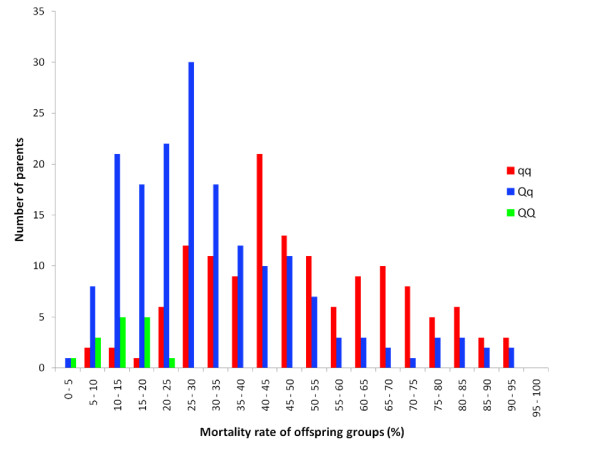
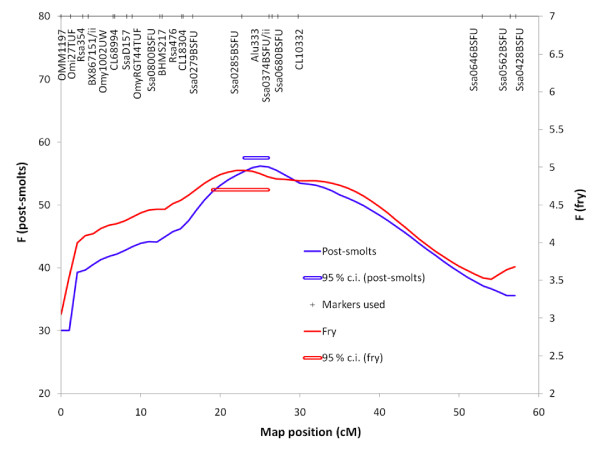
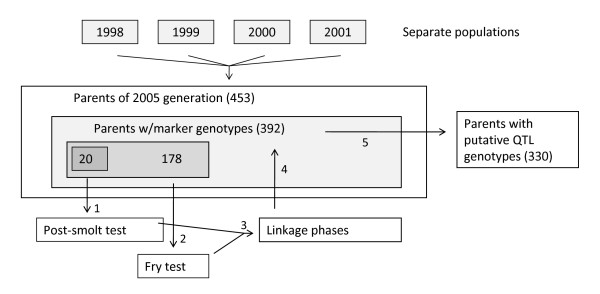
A genome scan was carried out using 10 large full-sib families of challenge-tested Atlantic salmon post-smolts and microsatellite markers distributed across the genome. One major QTL for IPN-resistance was detected, explaining 29% and 83% of the phenotypic and genetic variances, respectively. This QTL mapped to the same location as a QTL recently detected in a Scottish Atlantic salmon population. The QTL was found to be segregating in 10 out of 20 mapping parents, and subsequent fine-mapping with additional markers narrowed the QTL peak to a 4 cM region on linkage group 21. Challenge-tested fry were used to show that the QTL had the same effect on fry as on post-smolt, with the confidence interval for QTL position in fry overlapping the confidence interval found in post-smolts. A total of 178 parents were tested for segregation of the QTL, identifying 72 QTL-heterozygous parents. Genotypes at QTL-heterozygous parents were used to determine linkage phases between alleles at the underlying DNA polymorphism and alleles at single markers or multi-marker haplotypes. One four-marker haplotype was found to be the best predictor of QTL alleles, and was successfully used to deduce genotypes of the underlying polymorphism in 72% of the parents of the next generation within a breeding nucleus. A highly significant population-level correlation was found between deduced alleles at the underlying polymorphism and survival of offspring groups in the fry challenge test, parents with the three deduced genotypes (QQ, Qq, qq) having mean offspring mortality rates of 0.13, 0.32, and 0.49, respectively. The frequency of the high-resistance allele (Q) in the population was estimated to be 0.30. Apart from this major QTL, one other experiment-wise significant QTL for IPN-resistance was detected, located on linkage group 4.
The QTL confirmed in this study represents a case of a major gene explaining the bulk of genetic variation for a presumed complex trait. QTL genotypes were deduced within most parents of the 2005 generation of a major breeding company, providing a solid framework for linkage-based MAS within the whole population in subsequent generations. Since haplotype-trait associations valid at the population level were found, there is also a potential for MAS based on linkage disequilibrium (LD). However, in order to use MAS across many generations without reassessment of linkage phases between markers and the underlying polymorphism, the QTL needs to be positioned with even greater accuracy. This will require higher marker densities than are currently available.
传染性胰腺坏死(IPN)是全球大西洋鲑(Salmo salar)养殖中最普遍且在经济上具有毁灭性的疾病之一。该疾病在鱼苗期和后幼鲑阶段都会导致大量死亡。通过使用对照攻毒试验来进行提高IPN抗性的家系选择,在试验中记录同胞组的存活率。然而,由于经过攻毒试验的动物不能用作育种候选者,因此无法进行家系内选择,仅利用了IPN抗性遗传变异的一半。因此,与影响IPN抗性的数量性状基因座(QTL)连锁的DNA标记将是一种强大的选择工具。本研究的目的是鉴定和精细定位大西洋鲑中IPN抗性的QTL,用于标记辅助选择,以提高该性状的遗传改良速率。
使用10个经过攻毒试验的大西洋鲑后幼鲑的大型全同胞家系和分布于全基因组的微卫星标记进行了全基因组扫描。检测到一个主要的IPN抗性QTL,分别解释了表型变异和遗传变异的29%和83%。该QTL定位于与最近在一个苏格兰大西洋鲑种群中检测到的QTL相同的位置。发现该QTL在20个作图亲本中的10个中发生分离,随后用额外的标记进行精细定位,将QTL峰值缩小到连锁群21上的一个4 cM区域。经过攻毒试验的鱼苗用于表明该QTL对鱼苗的影响与对后幼鲑的影响相同,鱼苗中QTL位置的置信区间与后幼鲑中发现的置信区间重叠。总共对178个亲本进行了QTL分离检测,鉴定出72个QTL杂合亲本。利用QTL杂合亲本的基因型来确定潜在DNA多态性位点的等位基因与单个标记或多标记单倍型等位基因之间的连锁相。发现一个四标记单倍型是QTL等位基因的最佳预测指标,并成功用于推断育种核心群中72%的下一代亲本中潜在多态性的基因型。在鱼苗攻毒试验中,发现潜在多态性位点的推断等位基因与后代群体的存活率之间存在高度显著的群体水平相关性,具有三种推断基因型(QQ、Qq、qq)的亲本其后代平均死亡率分别为0.13、0.32和0.49。估计群体中高抗性等位基因(Q)的频率为0.30。除了这个主要的QTL外,还检测到另一个在实验水平上显著的IPN抗性QTL,位于连锁群4上。
本研究中确认的QTL代表了一个主要基因的情况,该基因解释了一个假定复杂性状的大部分遗传变异。在一家大型育种公司2005代的大多数亲本中推断出了QTL基因型,为后代整个群体中基于连锁的标记辅助选择提供了坚实的框架。由于发现了在群体水平上有效的单倍型-性状关联,基于连锁不平衡(LD)的标记辅助选择也具有潜力。然而,为了在不重新评估标记与潜在多态性之间的连锁相的情况下跨多代使用标记辅助选择,需要更精确地定位QTL。这将需要比目前可用的更高的标记密度。