Moen Thomas, Sonesson Anna K, Hayes Ben, Lien Sigbjørn, Munck Hege, Meuwissen Theo H E
AKVAFORSK - Institute of Aquaculture Research, As, Norway.
BMC Genet. 2007 Aug 14;8:53. doi: 10.1186/1471-2156-8-53.
Infectious Salmon Anaemia (ISA) is a viral disease affecting farmed Atlantic salmon (Salmo salar) worldwide. The identification of Quantitative Trait Loci (QTL) affecting resistance to the disease could improve our understanding of the genetics underlying the trait and provide a means for Marker-Assisted Selection. We previously performed a genome scan on commercial Atlantic salmon families challenge tested for ISA resistance, identifying several putative QTL. In the present study, we set out to validate the strongest of these QTL in a larger family material coming from the same challenge test, and to determine the position of the QTL by interval mapping. We also wanted to explore different ways of performing QTL analysis within a survival analysis framework (i.e. using time-to-event data), and to compare results using survival analysis with results from analysis on the dichotomous trait 'affected/resistant'.
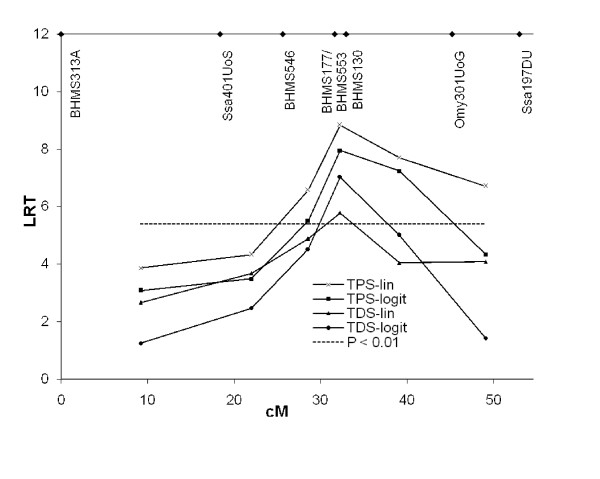
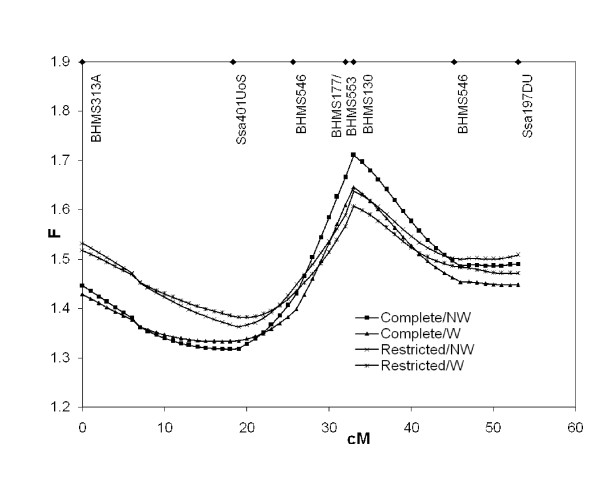
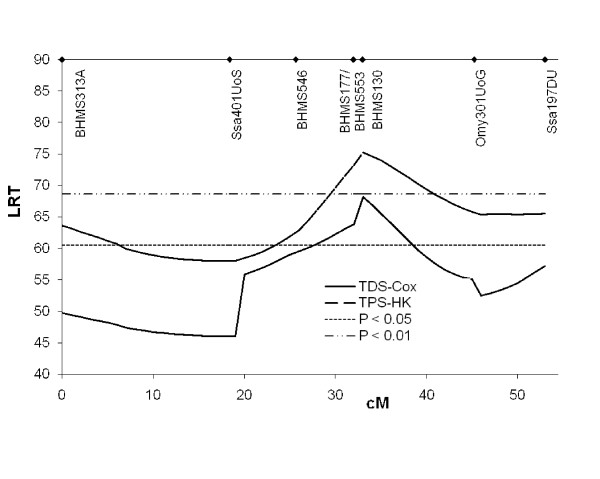
The QTL, located on Atlantic salmon linkage group 8 (following SALMAP notation), was confirmed in the new data set. Its most likely position was at a marker cluster containing markers BHMS130, BHMS170 and BHMS553. Significant segregation distortion was observed in the same region, but was shown to be unrelated to the QTL. A maximum likelihood procedure for identifying QTL, based on the Cox proportional hazard model, was developed. QTL mapping was also done using the Haley-Knott method (affected/resistant data), and within a variance-component framework (affected/resistant data and time-to-event data). In all cases, analysis using affected/resistant data gave stronger evidence for a QTL than did analysis using time-to-event data.
A QTL for resistance to Infectious Salmon Anaemia in Atlantic salmon was validated in this study, and its more precise location on linkage group eight was determined. The QTL explained 6% of the phenotypic variation in resistance to the disease. The linkage group also displayed significant segregation distortion. Survival models proved in this case not to be more suitable than models based on the dichotomous trait 'affected/resistant' for analysing the data.
传染性鲑鱼贫血症(ISA)是一种影响全球养殖大西洋鲑(Salmo salar)的病毒性疾病。鉴定影响该疾病抗性的数量性状基因座(QTL)有助于增进我们对该性状遗传基础的理解,并为标记辅助选择提供一种方法。我们之前对经过传染性鲑鱼贫血症抗性挑战测试的商业大西洋鲑家族进行了全基因组扫描,鉴定出了几个假定的QTL。在本研究中,我们着手在来自相同挑战测试的更大的家族材料中验证这些QTL中最强的一个,并通过区间定位确定该QTL的位置。我们还想探索在生存分析框架内(即使用事件发生时间数据)进行QTL分析的不同方法,并将生存分析的结果与基于二分性状“患病/抗性”的分析结果进行比较。
位于大西洋鲑连锁群8上的QTL(采用SALMAP标记法)在新数据集中得到了证实。其最可能的位置在一个包含标记BHMS130、BHMS170和BHMS553的标记簇处。在同一区域观察到了显著的偏分离现象,但结果表明其与该QTL无关。基于Cox比例风险模型开发了一种用于鉴定QTL的最大似然程序。QTL定位也使用了Haley-Knott方法(患病/抗性数据),并在方差成分框架内进行(患病/抗性数据和事件发生时间数据)。在所有情况下,使用患病/抗性数据的分析比使用事件发生时间数据的分析提供了更强的QTL证据。
本研究验证了大西洋鲑中一个抗传染性鲑鱼贫血症的QTL,并确定了其在连锁群8上更精确的位置。该QTL解释了该疾病抗性中6%的表型变异。该连锁群还表现出显著的偏分离现象。在这种情况下,生存模型被证明并不比基于二分性状“患病/抗性”的模型更适合分析数据。