Lacaze Paul, Raza Sobia, Sing Garwin, Page David, Forster Thorsten, Storm Petter, Craigon Marie, Awad Tarif, Ghazal Peter, Freeman Tom C
Division of Pathway Medicine, The University of Edinburgh, The Chancellor's Building, College of Medicine, Edinburgh, UK.
BMC Genomics. 2009 Aug 10;10:372. doi: 10.1186/1471-2164-10-372.
Interferons (IFNs) are potent antiviral cytokines capable of reprogramming the macrophage phenotype through the induction of interferon-stimulated genes (ISGs). Here we have used targeted RNA interference to suppress the expression of a number of key genes associated with IFN signalling in murine macrophages prior to stimulation with interferon-gamma. Genome-wide changes in transcript abundance caused by siRNA activity were measured using exon-level microarrays in the presence or absence of IFNgamma.
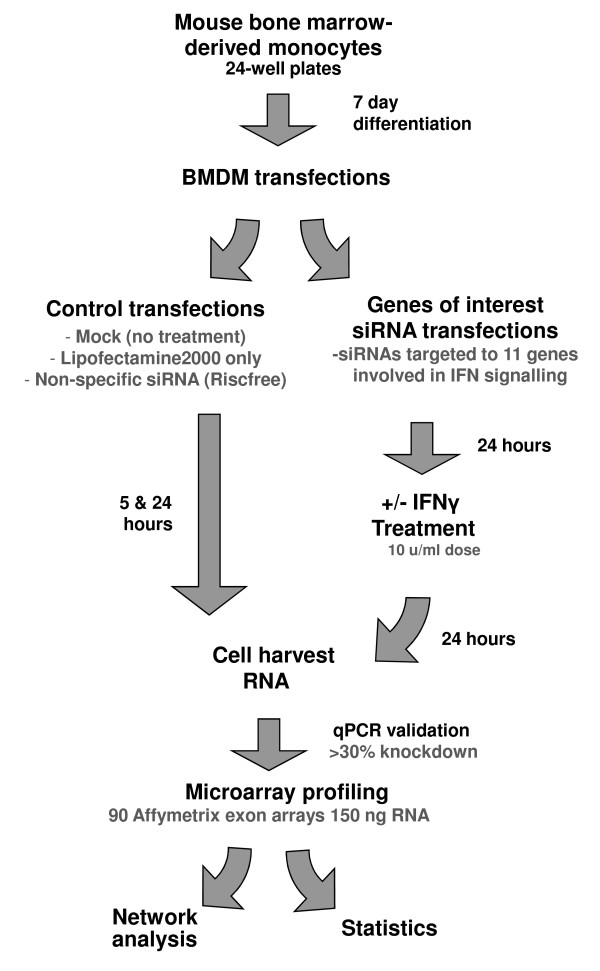
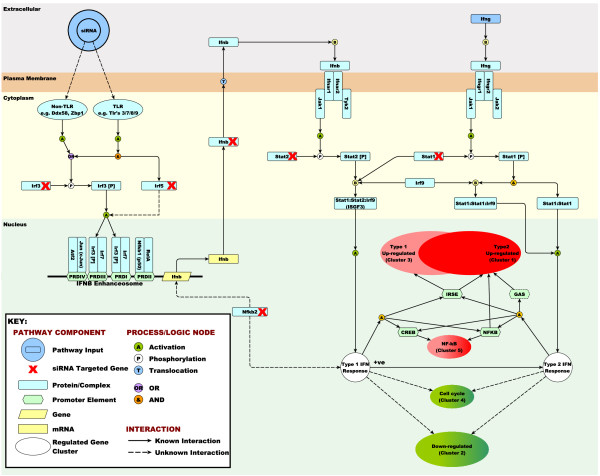
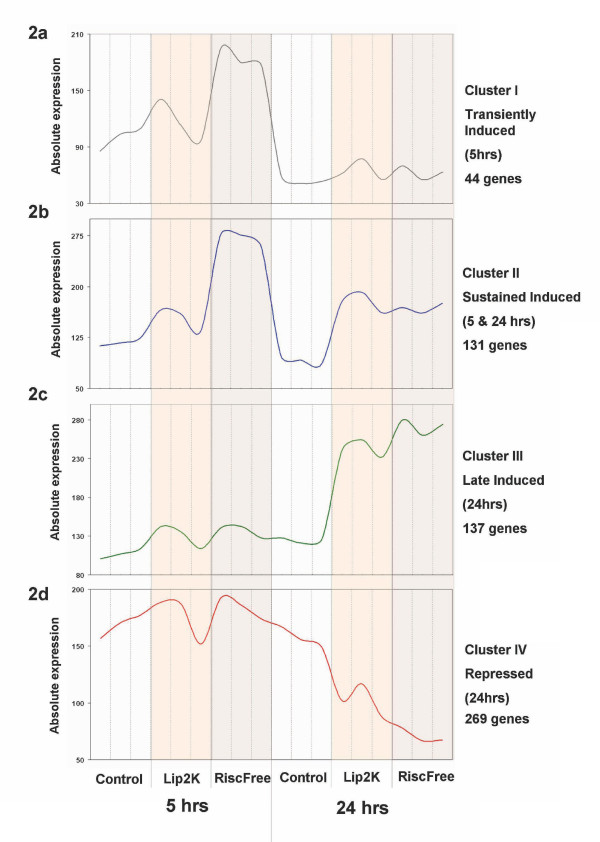
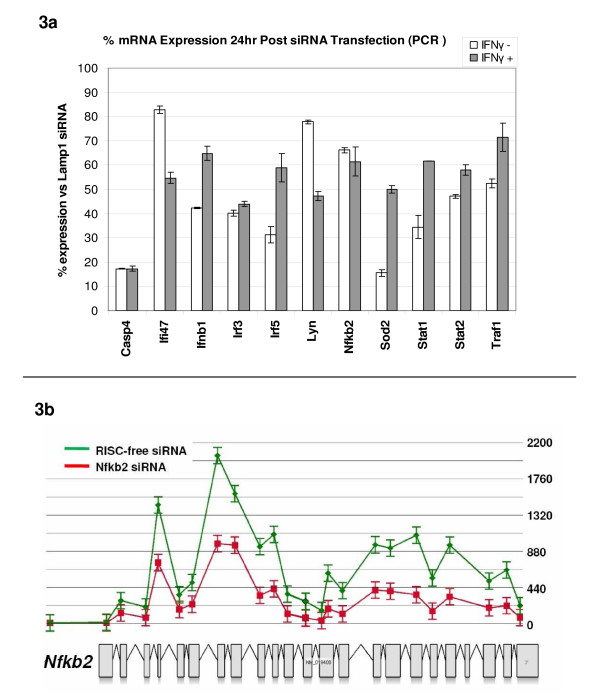
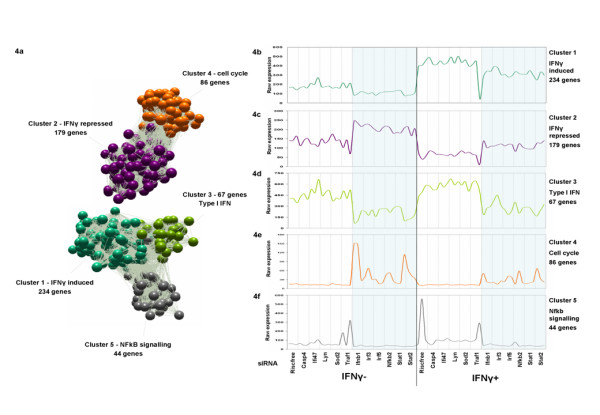
Transfection of murine bone-marrow derived macrophages (BMDMs) with a non-targeting (control) siRNA and 11 sequence-specific siRNAs was performed using a cationic lipid transfection reagent (Lipofectamine2000) prior to stimulation with IFNgamma. Total RNA was harvested from cells and gene expression measured on Affymetrix GeneChip Mouse Exon 1.0 ST Arrays. Network-based analysis of these data revealed six siRNAs to cause a marked shift in the macrophage transcriptome in the presence or absence IFNgamma. These six siRNAs targeted the Ifnb1, Irf3, Irf5, Stat1, Stat2 and Nfkb2 transcripts. The perturbation of the transcriptome by the six siRNAs was highly similar in each case and affected the expression of over 600 downstream transcripts. Regulated transcripts were clustered based on co-expression into five major groups corresponding to transcriptional networks associated with the type I and II IFN response, cell cycle regulation, and NF-KB signalling. In addition we have observed a significant non-specific immune stimulation of cells transfected with siRNA using Lipofectamine2000, suggesting use of this reagent in BMDMs, even at low concentrations, is enough to induce a type I IFN response.
Our results provide evidence that the type I IFN response in murine BMDMs is dependent on Ifnb1, Irf3, Irf5, Stat1, Stat2 and Nfkb2, and that siRNAs targeted to these genes results in perturbation of key transcriptional networks associated with type I and type II IFN signalling and a suppression of macrophage M1 polarization.
干扰素(IFN)是一类强效抗病毒细胞因子,能够通过诱导干扰素刺激基因(ISG)来重新编程巨噬细胞表型。在此,我们利用靶向RNA干扰技术,在γ干扰素刺激小鼠巨噬细胞之前,抑制一些与IFN信号传导相关的关键基因的表达。在有或无γ干扰素的情况下,使用外显子水平微阵列测量由siRNA活性引起的全基因组转录本丰度变化。
在用γ干扰素刺激之前,使用阳离子脂质转染试剂(Lipofectamine2000)将非靶向(对照)siRNA和11种序列特异性siRNA转染至小鼠骨髓来源的巨噬细胞(BMDM)。从细胞中收获总RNA,并在Affymetrix GeneChip Mouse Exon 1.0 ST阵列上测量基因表达。对这些数据进行基于网络的分析发现,在有或无γ干扰素的情况下,六种siRNA会导致巨噬细胞转录组发生显著变化。这六种siRNA靶向Ifnb1、Irf3、Irf5、Stat1、Stat2和Nfkb2转录本。六种siRNA对转录组的扰动在每种情况下都高度相似,并影响了600多个下游转录本的表达。根据共表达将受调控的转录本聚类为五个主要组,分别对应于与I型和II型IFN反应、细胞周期调控以及NF-κB信号传导相关的转录网络。此外,我们观察到使用Lipofectamine2000转染siRNA的细胞存在显著的非特异性免疫刺激,这表明即使在低浓度下,在BMDM中使用该试剂也足以诱导I型IFN反应。
我们的结果表明,小鼠BMDM中的I型IFN反应依赖于Ifnb1、Irf3、Irf5、Stat1、Stat2和Nfkb2,靶向这些基因的siRNA会导致与I型和II型IFN信号传导相关的关键转录网络受到扰动,并抑制巨噬细胞M1极化。