Bennett Robert M, Friend Ronald, Jones Kim D, Ward Rachel, Han Bobby K, Ross Rebecca L
Fibromyalgia Research Unit, Oregon Health & Science University, 3455 SW Veterans Road, Portland, OR 97239, USA.
Arthritis Res Ther. 2009;11(4):R120. doi: 10.1186/ar2783. Epub 2009 Aug 10.
The Fibromyalgia Impact Questionnaire (FIQ) is a commonly used instrument in the evaluation of fibromyalgia (FM) patients. Over the last 18 years, since the publication of the original FIQ, several deficiencies have become apparent and the cumbersome scoring algorithm has been a barrier to widespread clinical use. The aim of this paper is to describe and validate a revised version of the FIQ: the FIQR.
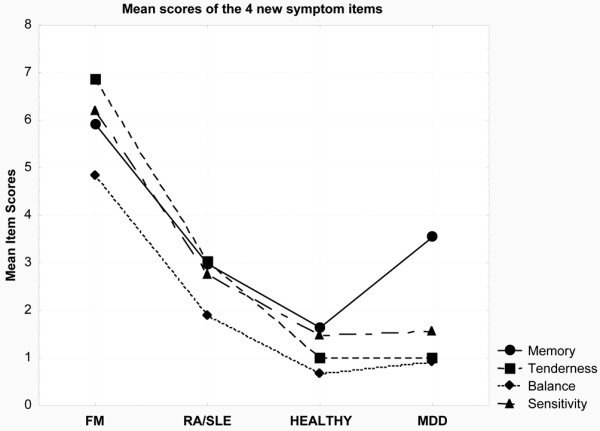
The FIQR was developed in response to known deficiencies of the FIQ with the help of a patient focus group. The FIQR has the same 3 domains as the FIQ (that is, function, overall impact and symptoms). It differs from the FIQ in having modified function questions and the inclusion of questions on memory, tenderness, balance and environmental sensitivity. All questions are graded on a 0-10 numeric scale. The FIQR was administered online and the results were compared to the same patient's online responses to the 36-Item Short Form Health Survey (SF-36) and the original FIQ.
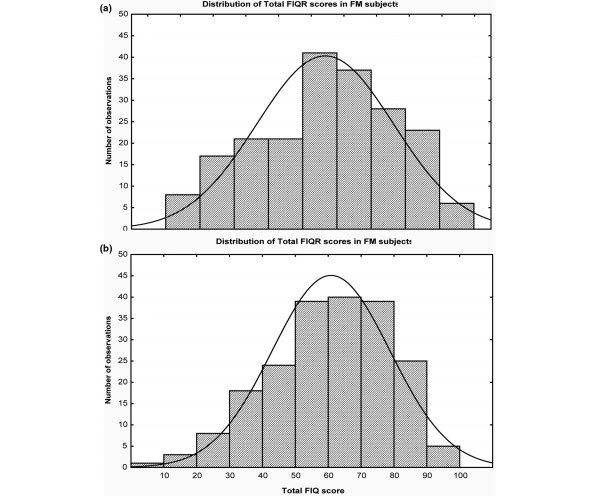
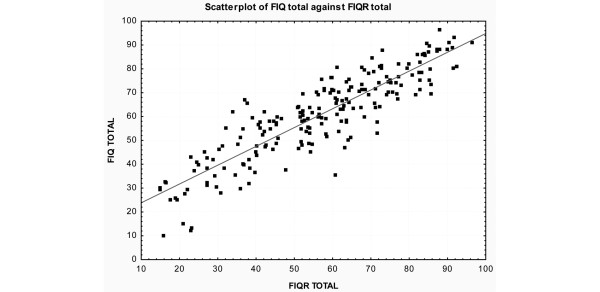
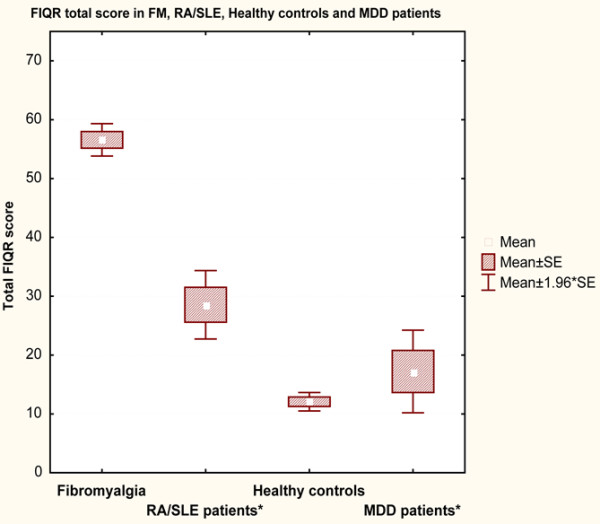
The FIQR was completed online by 202 FM patients, 51 rheumatoid arthritis (RA) or systemic lupus erythematosus (SLE) patients (31 RA and 20 SLE), 11 patients with major depressive disorder (MDD) and 213 healthy controls (HC). The mean total FIQR score was 56.6 +/- 19.9 compared to a total FIQ score of 60.6 +/- 17.8 (P < 0.03). The total scores of the FIQR and FIQ were closely correlated (r = 0.88, P < 0.001). Each of the 3 domains of the FIQR correlated well with the 3 related FIQ domains (r = 0.69 to 0.88, P < 0.01). The FIQR showed good correlation with comparable domains in the SF-36, with a multiple regression analysis showing that the three FIQR domain scores predicted the 8 SF-36 subscale scores. The FIQR had good discriminant ability between FM and the 3 other groups; total FIQR scores were HC (12.1 +/- 11.6), RA/SLE (28.6 +/- 21.2) and MDD (17.3 +/- 11.8). The patient completion time was 1.3 minutes; scoring took about 1 minute.
The FIQR is an updated version of the FIQ that has good psychometric properties, can be completed in less than 2 minutes and is easy to score. It has scoring characteristics comparable to the original FIQ, making it possible to compare past FIQ results with future FIQR results.
纤维肌痛影响问卷(FIQ)是评估纤维肌痛(FM)患者时常用的工具。自最初的FIQ发表后的18年里,一些缺陷已变得明显,且繁琐的评分算法一直是其广泛临床应用的障碍。本文旨在描述并验证FIQ的修订版:FIQR。
在患者焦点小组的帮助下,针对FIQ已知的缺陷开发了FIQR。FIQR与FIQ具有相同的3个领域(即功能、总体影响和症状)。它与FIQ的不同之处在于修改了功能问题,并纳入了关于记忆、压痛、平衡和环境敏感性的问题。所有问题均采用0至10的数字评分量表。FIQR通过在线方式进行施测,并将结果与同一患者对36项简短健康调查(SF - 36)和原始FIQ的在线回答进行比较。
202名FM患者、51名类风湿性关节炎(RA)或系统性红斑狼疮(SLE)患者(31名RA和20名SLE)、11名重度抑郁症(MDD)患者和213名健康对照者(HC)通过在线方式完成了FIQR。FIQR的平均总得分是56.6±19.9,而FIQ的总得分是60.6±17.8(P < 0.03)。FIQR和FIQ的总得分密切相关(r = 0.88,P < 0.001)。FIQR的3个领域中的每一个都与FIQ的3个相关领域密切相关(r = 0.69至0.88,P < 0.01)。FIQR与SF - 36中可比领域显示出良好的相关性,多元回归分析表明,FIQR的三个领域得分可预测SF - 36的8个分量表得分。FIQR在FM与其他3组之间具有良好的判别能力;FIQR的总得分分别为HC(12.1±11.6)、RA/SLE(28.6±21.2)和MDD(17.3±11.8)。患者完成时间为1.3分钟;评分大约需要1分钟。
FIQR是FIQ的更新版本,具有良好的心理测量特性,可在不到2分钟内完成且易于评分。它具有与原始FIQ相当的评分特征,使得能够将过去的FIQ结果与未来的FIQR结果进行比较。