Max Planck Institute for Biological Cybernetics, Spemannstr. 41, 72076 Tübingen, Germany.
Exp Brain Res. 2010 Jan;200(3-4):251-8. doi: 10.1007/s00221-009-1953-8. Epub 2009 Aug 8.
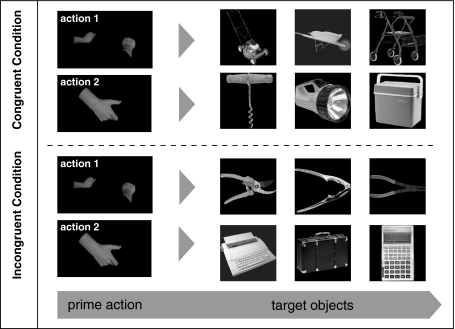
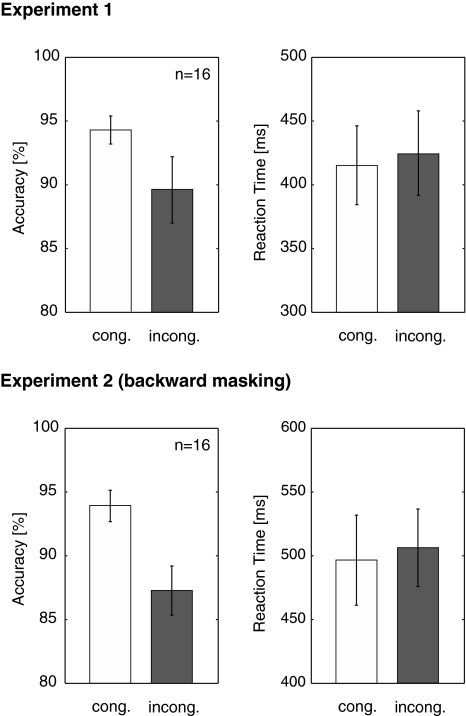
Observing an action activates action representations in the motor system. Moreover, the representations of manipulable objects are closely linked to the motor systems at a functional and neuroanatomical level. Here, we investigated whether action observation can facilitate object recognition using an action priming paradigm. As prime stimuli we presented short video movies showing hands performing an action in interaction with an object (where the object itself was always removed from the video). The prime movie was followed by a (briefly presented) target object affording motor interactions that are either similar (congruent condition) or dissimilar (incongruent condition) to the prime action. Participants had to decide whether an object name shown after the target picture corresponds with the picture or not (picture-word matching task). We found superior accuracy for prime-target pairs with congruent as compared to incongruent actions across two experiments. Thus, action observation can facilitate recognition of a manipulable object typically involving a similar action. This action priming effect supports the notion that action representations play a functional role in object recognition.
观察动作会激活运动系统中的动作表征。此外,可操作性物体的表征在功能和神经解剖学水平上与运动系统密切相关。在这里,我们使用动作启动范式研究了动作观察是否可以促进物体识别。作为启动刺激,我们展示了短的视频电影,展示了手与物体(视频中总是将物体本身移除)交互执行动作。在启动电影之后,呈现一个(短暂呈现)目标物体,提供与启动动作相似(一致条件)或不同(不一致条件)的运动相互作用。参与者必须决定在目标图片之后显示的物体名称是否与图片相对应(图片-单词匹配任务)。我们在两个实验中发现,与不一致的动作相比,具有一致动作的启动-目标对具有更高的准确性。因此,动作观察可以促进可操作性物体的识别,通常涉及类似的动作。这种动作启动效应支持了动作表征在物体识别中起作用的观点。