Stanley Ho Center for Emerging Infectious Diseases, School of Public Health and Primary Care, The Chinese University of Hong Kong, Hong Kong, China.
Mol Cell Proteomics. 2009 Nov;8(11):2582-94. doi: 10.1074/mcp.M900180-MCP200. Epub 2009 Aug 11.
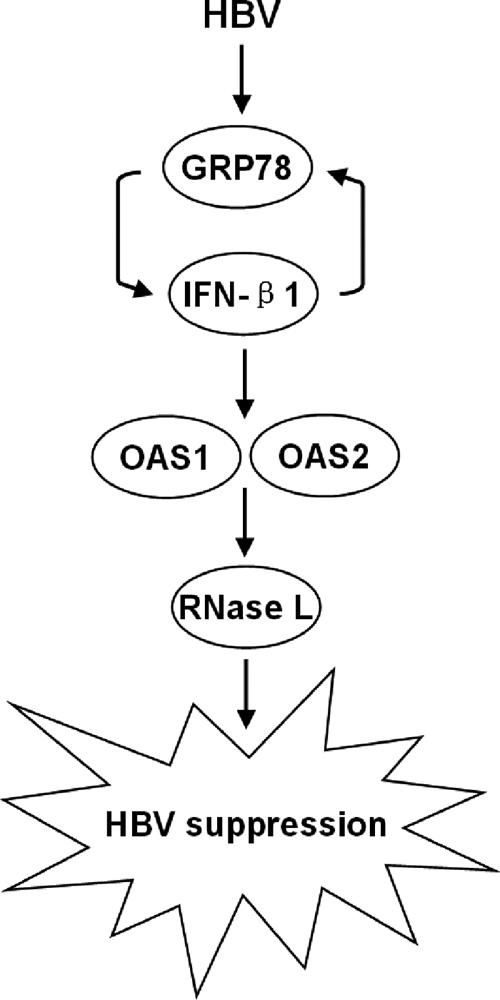
Hepatitis B virus (HBV) infection is a global public health problem that plays a crucial role in the pathogenesis of chronic hepatitis, cirrhosis, and hepatocellular carcinoma. However, the pathogenesis of HBV infection and the mechanisms of host-virus interactions are still elusive. In this study, two-dimensional gel electrophoresis and mass spectrometry-based comparative proteomics were applied to analyze the host response to HBV using an inducible HBV-producing cell line, HepAD38. Twenty-three proteins were identified as differentially expressed with glucose-regulated protein 78 (GRP78) as one of the most significantly up-regulated proteins induced by HBV replication. This induction was further confirmed in both HepAD38 and HepG2 cells transfected with HBV-producing plasmids by real time RT-PCR and Western blotting as well as in HBV-infected human liver biopsies by immunohistochemistry. Knockdown of GRP78 expression by RNA interference resulted in a significant increase of both intracellular and extracellular HBV virions in the transient HBV-producing HepG2 cells concomitant with enhanced levels of hepatitis B surface antigen and e antigen in the culture medium. Conversely overexpression of GRP78 in HepG2 cells led to HBV suppression concomitant with induction of the positive regulatory circuit of GRP78 and interferon-beta1 (IFN-beta1). In this connection, the IFN-beta1-mediated 2',5'-oligoadenylate synthetase and RNase L signaling pathway was noted to be activated in GRP78-overexpressing HepG2 cells. Moreover GRP78 was significantly down-regulated in the livers of chronic hepatitis B patients after effective anti-HBV treatment (p = 0.019) as compared with their counterpart pretreatment liver biopsies. In conclusion, the present study demonstrates for the first time that GRP78 functions as an endogenous anti-HBV factor via the IFN-beta1-2',5'-oligoadenylate synthetase-RNase L pathway in hepatocytes. Induction of hepatic GRP78 may provide a novel therapeutic approach in treating HBV infection.
乙型肝炎病毒(HBV)感染是一个全球性的公共卫生问题,在慢性肝炎、肝硬化和肝细胞癌的发病机制中起着至关重要的作用。然而,HBV 感染的发病机制和宿主-病毒相互作用的机制仍不清楚。在这项研究中,我们应用双向凝胶电泳和基于质谱的比较蛋白质组学技术,使用诱导型 HBV 产生细胞系 HepAD38 分析宿主对 HBV 的反应。鉴定出 23 种差异表达蛋白,其中葡萄糖调节蛋白 78(GRP78)是 HBV 复制诱导的最显著上调蛋白之一。通过实时 RT-PCR 和 Western blot 以及 HBV 感染的人肝活检的免疫组织化学,进一步证实了在 HepAD38 和 HepG2 细胞中转染 HBV 产生质粒以及在瞬时产生 HBV 的 HepG2 细胞中转录干扰 GRP78 表达后,细胞内和细胞外 HBV 病毒颗粒均显著增加,同时培养基中乙型肝炎表面抗原和 e 抗原水平升高。相反,在 HepG2 细胞中过表达 GRP78 可导致 HBV 抑制,同时诱导 GRP78 和干扰素-β1(IFN-β1)的正调控回路。在这方面,注意到 GRP78 过表达的 HepG2 细胞中激活了 IFN-β1 介导的 2',5'-寡聚腺苷酸合成酶和核糖核酸酶 L 信号通路。此外,与治疗前肝活检相比,慢性乙型肝炎患者经有效抗 HBV 治疗后(p = 0.019),GRP78 在肝脏中的表达明显下调。总之,本研究首次证明,GRP78 通过肝细胞中的 IFN-β1-2',5'-寡聚腺苷酸合成酶-RNase L 途径发挥内源性抗 HBV 作用。诱导肝 GRP78 可能为治疗 HBV 感染提供新的治疗方法。