Centre for Endocrinology, Diabetes and Metabolism, Institute of Biomedical Research, School of Clinical & Experimental Medicine, University of Birmingham, Birmingham, U.K.
Diabetes. 2009 Nov;58(11):2506-15. doi: 10.2337/db09-0525. Epub 2009 Aug 12.
Glucocorticoid excess is characterized by increased adiposity, skeletal myopathy, and insulin resistance, but the precise molecular mechanisms are unknown. Within skeletal muscle, 11beta-hydroxysteroid dehydrogenase type 1 (11beta-HSD1) converts cortisone (11-dehydrocorticosterone in rodents) to active cortisol (corticosterone in rodents). We aimed to determine the mechanisms underpinning glucocorticoid-induced insulin resistance in skeletal muscle and indentify how 11beta-HSD1 inhibitors improve insulin sensitivity.
Rodent and human cell cultures, whole-tissue explants, and animal models were used to determine the impact of glucocorticoids and selective 11beta-HSD1 inhibition upon insulin signaling and action.
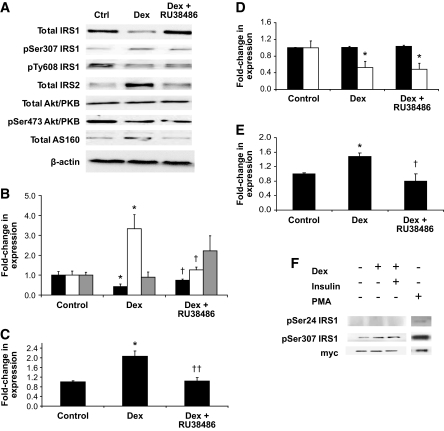
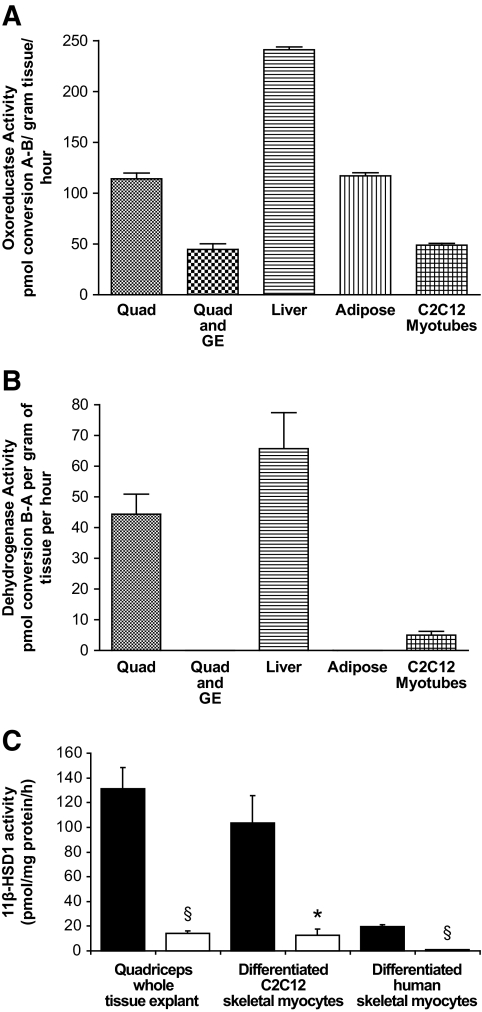
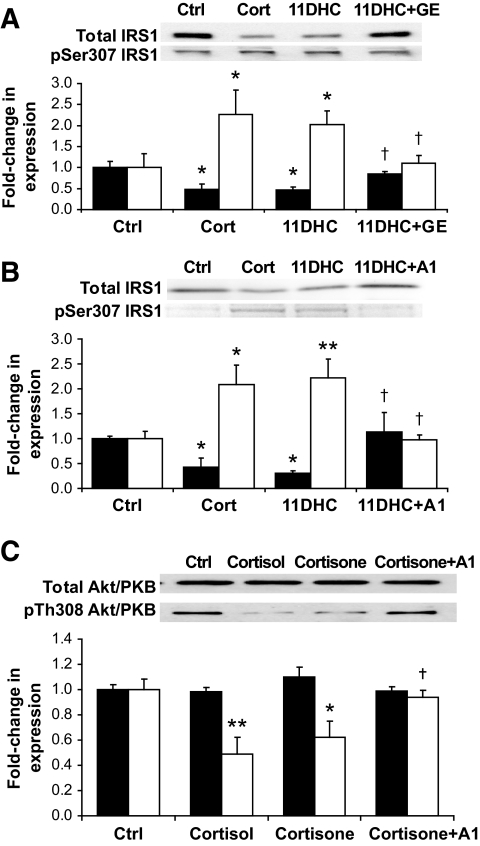
Dexamethasone decreased insulin-stimulated glucose uptake, decreased IRS1 mRNA and protein expression, and increased inactivating pSer(307) insulin receptor substrate (IRS)-1. 11beta-HSD1 activity and expression were observed in human and rodent myotubes and muscle explants. Activity was predominantly oxo-reductase, generating active glucocorticoid. A1 (selective 11beta-HSD1 inhibitor) abolished enzyme activity and blocked the increase in pSer(307) IRS1 and reduction in total IRS1 protein after treatment with 11DHC but not corticosterone. In C57Bl6/J mice, the selective 11beta-HSD1 inhibitor, A2, decreased fasting blood glucose levels and improved insulin sensitivity. In KK mice treated with A2, skeletal muscle pSer(307) IRS1 decreased and pThr(308) Akt/PKB increased. In addition, A2 decreased both lipogenic and lipolytic gene expression.
Prereceptor facilitation of glucocorticoid action via 11beta-HSD1 increases pSer(307) IRS1 and may be crucial in mediating insulin resistance in skeletal muscle. Selective 11beta-HSD1 inhibition decreases pSer(307) IRS1, increases pThr(308) Akt/PKB, and decreases lipogenic and lipolytic gene expression that may represent an important mechanism underpinning their insulin-sensitizing action.
糖皮质激素过多的特征是脂肪增多、骨骼肌病和胰岛素抵抗,但确切的分子机制尚不清楚。在骨骼肌中,11β-羟类固醇脱氢酶 1(11β-HSD1)将皮质酮(在啮齿动物中为 11-去氢皮质酮)转化为活性皮质醇(在啮齿动物中为皮质酮)。我们旨在确定糖皮质激素引起骨骼肌胰岛素抵抗的机制,并确定 11β-HSD1 抑制剂如何改善胰岛素敏感性。
使用啮齿动物和人类细胞培养物、全组织外植体和动物模型来确定糖皮质激素和选择性 11β-HSD1 抑制对胰岛素信号和作用的影响。
地塞米松降低了胰岛素刺激的葡萄糖摄取,降低了 IRS1mRNA 和蛋白表达,并增加了失活的 pSer(307)胰岛素受体底物(IRS)-1。在人类和啮齿动物肌管和肌肉外植体中观察到 11β-HSD1 活性和表达。活性主要是氧化还原酶,产生活性糖皮质激素。A1(选择性 11β-HSD1 抑制剂)消除了酶活性,并阻断了 11DHC 处理后 pSer(307)IRS1 的增加和总 IRS1 蛋白的减少,但不能阻断皮质酮。在 C57Bl6/J 小鼠中,选择性 11β-HSD1 抑制剂 A2 降低了空腹血糖水平并改善了胰岛素敏感性。在接受 A2 治疗的 KK 小鼠中,骨骼肌 pSer(307)IRS1 减少,pThr(308)Akt/PKB 增加。此外,A2 还降低了脂肪生成和脂肪分解基因的表达。
通过 11β-HSD1 促进糖皮质激素作用的前受体易化增加了 pSer(307)IRS1,这可能是介导骨骼肌胰岛素抵抗的关键因素。选择性 11β-HSD1 抑制降低了 pSer(307)IRS1,增加了 pThr(308)Akt/PKB,并降低了脂肪生成和脂肪分解基因的表达,这可能是其胰岛素增敏作用的重要机制。