Geersing G J, Janssen K J M, Oudega R, Bax L, Hoes A W, Reitsma J B, Moons K G M
Julius Center for Health Sciences and Primary Care, University Medical Center Utrecht, Utrecht, The Netherlands.
BMJ. 2009 Aug 14;339:b2990. doi: 10.1136/bmj.b2990.
To review the evidence on the diagnostic accuracy of the currently available point of care D-dimer tests for excluding venous thromboembolism.
Systematic review of research on the accuracy of point of care D-dimer tests, using bivariate regression to examine sources of variation and to estimate sensitivity and specificity.
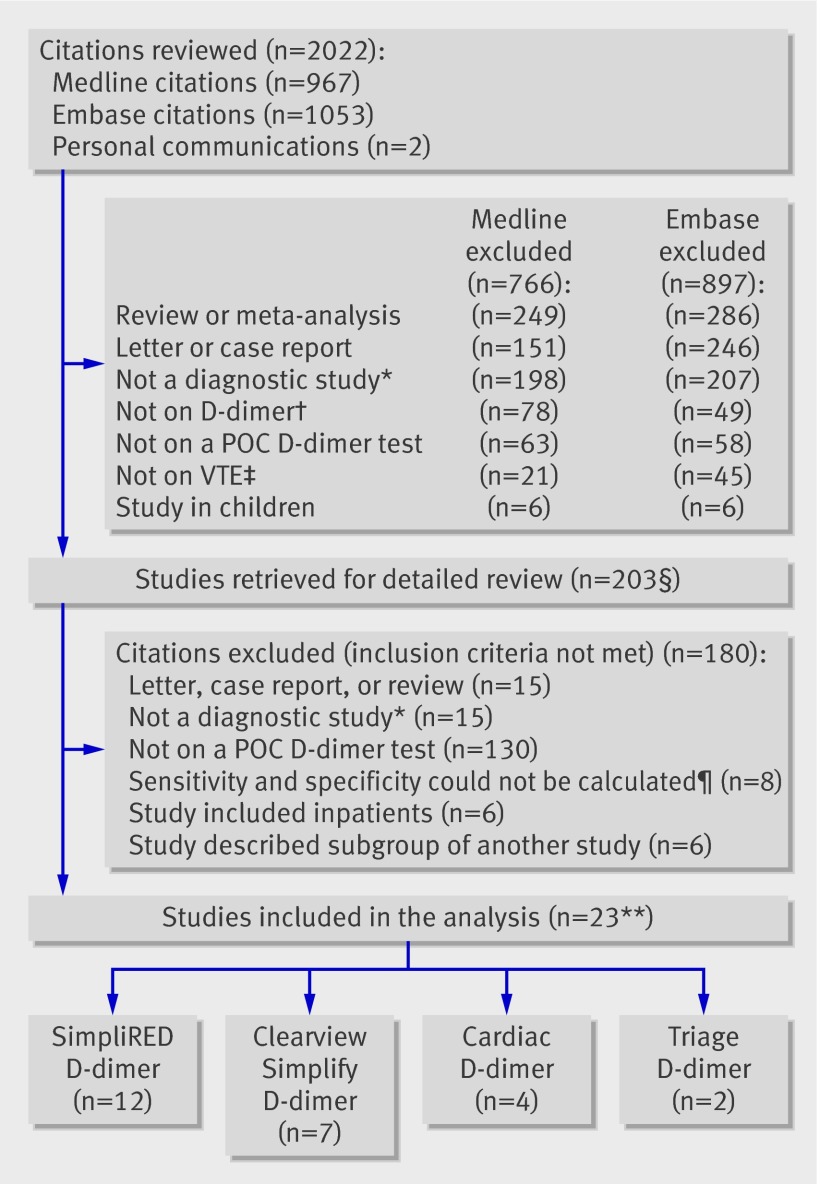
Studies on the diagnostic accuracy of point of care D-dimer tests published between January 1995 and September 2008 and available in either Medline or Embase. Review methods The analysis included studies that compared point of care D-dimer tests with predefined reference criteria for venous thromboembolism, enrolled consecutive outpatients, and allowed for construction of a 2x2 table.
23 studies (total number of patients 13 959, range in mean age 38-65 years, range of venous thromboembolism prevalence 4-51%) were included in the meta-analysis. The studies reported two qualitative point of care D-dimer tests (SimpliRED D-dimer (n=12) and Clearview Simplify D-dimer (n=7)) and two quantitative point of care D-dimer tests (Cardiac D-dimer (n=4) and Triage D-dimer (n=2)). Overall sensitivity ranged from 0.85 (95% confidence interval 0.78 to 0.90) to 0.96 (0.91 to 0.98) and overall specificity from 0.48 (0.33 to 0.62) to 0.74 (0.69 to 0.78). The two quantitative tests Cardiac D-dimer and Triage D-dimer scored most favourably.
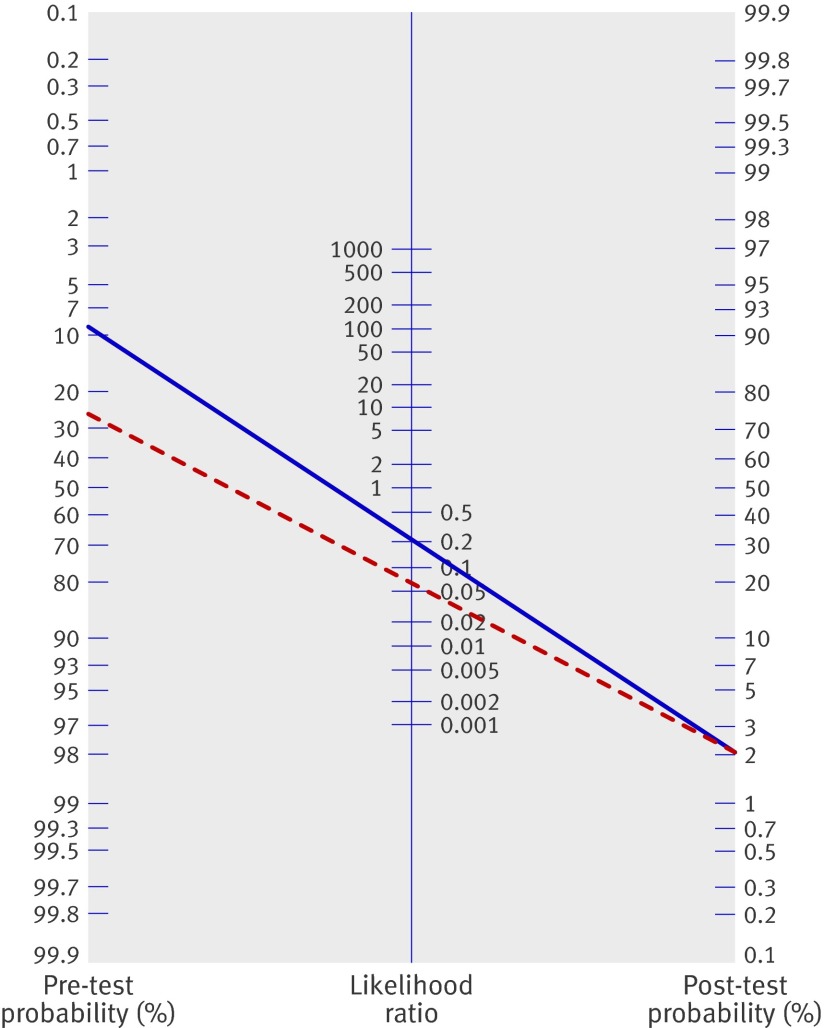
In outpatients suspected of venous thromboembolism, point of care D-dimer tests can contribute important information and guide patient management, notably in low risk patients (that is, those patients with a low score on a clinical decision rule).
回顾目前可用的即时检测D - 二聚体试验用于排除静脉血栓栓塞症诊断准确性的证据。
对即时检测D - 二聚体试验准确性的研究进行系统评价,使用双变量回归分析变异来源并估计敏感性和特异性。
1995年1月至2008年9月发表的、可在Medline或Embase中获取的关于即时检测D - 二聚体试验诊断准确性的研究。综述方法分析包括将即时检测D - 二聚体试验与静脉血栓栓塞症的预定义参考标准进行比较、纳入连续门诊患者并允许构建2×2表格的研究。
23项研究(患者总数13959例,平均年龄范围38 - 65岁,静脉血栓栓塞症患病率范围4% - 51%)纳入荟萃分析。这些研究报告了两种定性即时检测D - 二聚体试验(SimpliRED D - 二聚体(n = 12)和Clearview Simplify D - 二聚体(n = 7))以及两种定量即时检测D - 二聚体试验(心脏D - 二聚体(n = 4)和Triage D - 二聚体(n = 2))。总体敏感性范围为0.85(95%置信区间0.78至0.90)至0.96(0.91至0.98),总体特异性范围为0.48(0.33至0.62)至0.74(0.69至0.78)。两种定量试验心脏D - 二聚体和Triage D - 二聚体得分最有利。
在疑似静脉血栓栓塞症的门诊患者中,即时检测D - 二聚体试验可提供重要信息并指导患者管理,尤其是在低风险患者(即临床决策规则评分低的患者)中。