Ecology and Theoretical Biology Research Group of the Hungarian Academy of Science and Eötvös University, Budapest, Hungary.
PLoS One. 2009 Aug 17;4(8):e6655. doi: 10.1371/journal.pone.0006655.
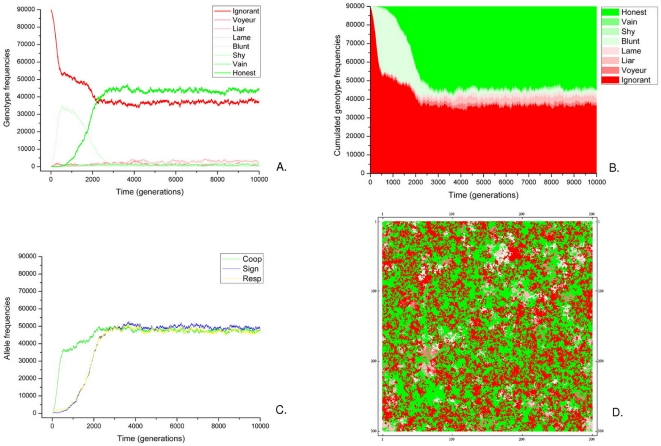
An increasing body of empirical evidence suggests that cooperation among clone-mates is common in bacteria. Bacterial cooperation may take the form of the excretion of "public goods": exoproducts such as virulence factors, exoenzymes or components of the matrix in biofilms, to yield significant benefit for individuals joining in the common effort of producing them. Supposedly in order to spare unnecessary costs when the population is too sparse to supply the sufficient exoproduct level, many bacteria have evolved a simple chemical communication system called quorum sensing (QS), to "measure" the population density of clone-mates in their close neighborhood. Cooperation genes are expressed only above a threshold rate of QS signal molecule re-capture, i.e., above the local quorum of cooperators. The cooperative population is exposed to exploitation by cheaters, i.e., mutants who contribute less or nil to the effort but fully enjoy the benefits of cooperation. The communication system is also vulnerable to a different type of cheaters ("Liars") who may produce the QS signal but not the exoproduct, thus ruining the reliability of the signal. Since there is no reason to assume that such cheaters cannot evolve and invade the populations of honestly signaling cooperators, the empirical fact of the existence of both bacterial cooperation and the associated QS communication system seems puzzling. Using a stochastic cellular automaton approach and allowing mutations in an initially non-cooperating, non-communicating strain we show that both cooperation and the associated communication system can evolve, spread and remain persistent. The QS genes help cooperative behavior to invade the population, and vice versa; cooperation and communication might have evolved synergistically in bacteria. Moreover, in good agreement with the empirical data recently available, this synergism opens up a remarkably rich repertoire of social interactions in which cheating and exploitation are commonplace.
越来越多的经验证据表明,细菌之间的合作是很常见的。细菌合作可能采取分泌“公共物品”的形式:外产物,如毒力因子、外酶或生物膜基质的成分,为共同努力生产这些物质的个体带来显著的好处。据称,为了避免在种群过于稀疏而无法提供足够的外产物水平时产生不必要的成本,许多细菌已经进化出一种简单的化学通讯系统,称为群体感应 (QS),以“测量”其近亲邻克隆群体的种群密度。只有在 QS 信号分子再捕获的阈值速率以上,即合作群体的局部群体水平以上,合作基因才会表达。合作群体容易受到搭便车者(即那些对合作努力贡献较少或没有贡献但充分享受合作收益的突变体)的剥削。通讯系统也容易受到另一种类型的搭便车者(“骗子”)的攻击,他们可能会产生 QS 信号但不产生外产物,从而破坏信号的可靠性。由于没有理由假设这些骗子不能进化并入侵诚实发出信号的合作群体,因此,细菌合作和相关的 QS 通讯系统的存在这一经验事实似乎令人费解。我们使用随机细胞自动机方法,并允许在最初不合作、不通讯的菌株中发生突变,结果表明合作和相关的通讯系统都可以进化、传播并保持持续存在。QS 基因有助于合作行为入侵种群,反之亦然;合作和通讯可能在细菌中协同进化。此外,与最近可用的经验数据非常吻合的是,这种协同作用开辟了一个非常丰富的社交互动 repertoire,其中欺骗和剥削是很常见的。