Department of Sports Medicine and Sports Nutrition, Ruhr-University Bochum, 44780 Bochum, Germany.
BMC Geriatr. 2009 Aug 17;9:37. doi: 10.1186/1471-2318-9-37.
Physical activity programmes can help to prevent functional decline in the elderly. Until now, such programmes use to target either on healthy community-dwelling seniors or on elderly living in special residences or care institutions. Sedentary or frail people, however, are difficult to reach when they live in their own homes. The general practitioner's (GP) practice offers a unique opportunity to acquire these people for participation in activity programmes. We conceptualised a multidimensional home-based exercise programme that shall be delivered to the target group through cooperation between GPs and exercise therapists. In order to prepare a randomised controlled trial (RCT), a feasibility study is being conducted.
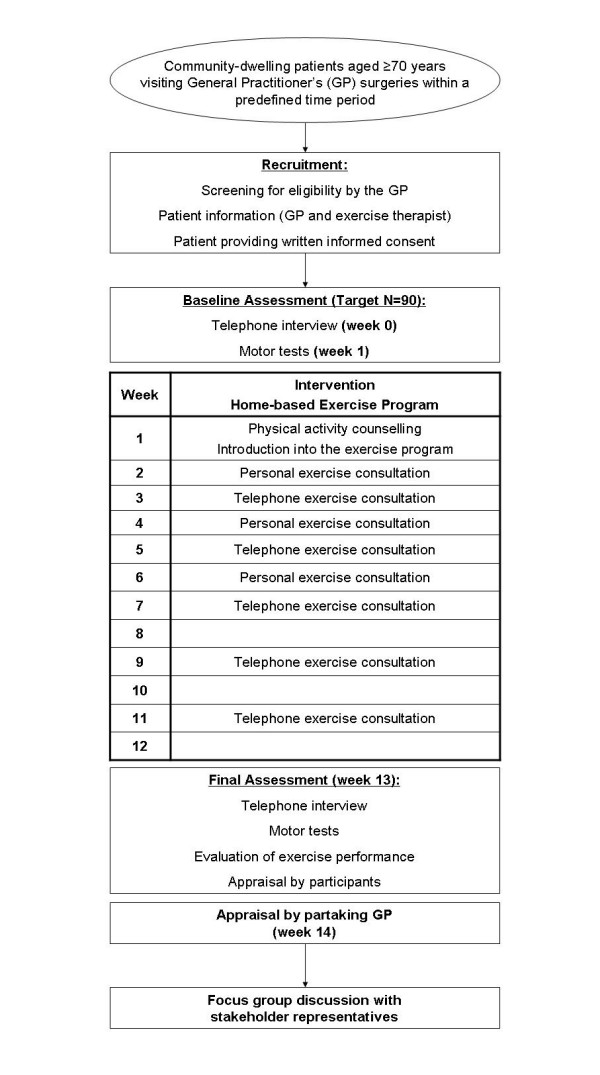
The study is designed as a single arm interventional trial. We plan to recruit 90 patients aged 70 years and above through their GPs. The intervention lasts 12 weeks and consists of physical activity counselling, a home-exercise programme, and exercise consultations provided by an exercise therapist in the GP's practice and via telephone. The exercise programme consists of two main components: 1. a combination of home-exercises to improve strength, flexibility and balance, 2. walking for exercise to improve aerobic capacity. Primary outcome measures are: appraisal by GP, undesirable events, drop-outs, adherence. Secondary outcome measures are: effects (a. motor tests: timed-up-and-go, chair rising, grip strength, tandem stand, tandem walk, sit-and-reach; b. telephone interview: PRISCUS-Physical Activity Questionnaire, Short Form-8 Health Survey, three month recall of frequency of falls, Falls Efficacy Scale), appraisal by participant, exercise performance, focus group discussion. Data analyses will focus on: 1. decision-making concerning the conduction of a RCT, 2. estimation of the effects of the programme, detection of shortcomings and identification of subgroups with contrary results, 3. feedback to participants and to GPs.
A new cooperation between GPs and exercise therapists to approach community-dwelling seniors and to deliver a home-exercise programme is object of research with regard to feasibility and acceptance. In case of success, an RCT should examine the effects of the programme. A future implementation within primary medical care may take advantage from the flexibility of the programme.
Current Controlled Trials ISRCTN58562962.
体育活动方案有助于预防老年人身体机能衰退。到目前为止,这些方案通常针对的是居住在社区的健康老年人,或者是居住在特殊住所或护理机构的老年人。然而,对于那些久坐不动或体弱的老年人,当他们居住在自己的家中时,很难让他们参与到活动方案中。全科医生的诊所为吸引这些人参加活动方案提供了一个独特的机会。我们设计了一个多维的基于家庭的锻炼方案,该方案将通过全科医生和运动治疗师的合作,提供给目标人群。为了准备一项随机对照试验(RCT),正在进行一项可行性研究。
该研究设计为单臂干预试验。我们计划通过全科医生招募 90 名 70 岁及以上的患者。干预持续 12 周,包括身体活动咨询、家庭锻炼计划以及由运动治疗师在全科医生诊所和通过电话提供的运动咨询。锻炼方案包括两个主要部分:1. 改善力量、灵活性和平衡的家庭锻炼组合;2. 步行锻炼以提高有氧运动能力。主要观察指标为:全科医生评估、不良事件、脱落、依从性。次要观察指标为:效果(a. 运动测试:计时起立行走测试、坐起测试、握力测试、并足站立测试、并足行走测试、坐立前伸测试;b. 电话访谈:PRISCUS-体力活动问卷、健康调查短表 8 项、3 个月内跌倒频率回忆、跌倒效能量表)、参与者评估、运动表现、焦点小组讨论。数据分析将重点关注:1. 关于进行 RCT 的决策,2. 方案效果的估计,发现方案的不足之处,并确定结果相反的亚组,3. 反馈给参与者和全科医生。
全科医生和运动治疗师之间的新合作,旨在为居住在社区的老年人提供服务并开展家庭锻炼方案,这是可行性和可接受性研究的对象。如果成功,一项 RCT 应该检验该方案的效果。未来在初级医疗保健中的实施可能会受益于该方案的灵活性。
当前对照试验 ISRCTN58562962。