Phillips Ruth B, Keatley Kimberly A, Morasch Matthew R, Ventura Abigail B, Lubieniecki Krzysztof P, Koop Ben F, Danzmann Roy G, Davidson William S
Department of Molecular Biology and Biochemistry, Simon Fraser University, Burnaby, British Columbia V5A 1S6, Canada.
BMC Genet. 2009 Aug 18;10:46. doi: 10.1186/1471-2156-10-46.
Most teleost species, especially freshwater groups such as the Esocidae which are the closest relatives of salmonids, have a karyotype comprising 25 pairs of acrocentric chromosomes and 48-52 chromosome arms. After the common ancestor of salmonids underwent a whole genome duplication, its karyotype would have 100 chromosome arms, and this is reflected in the modal range of 96-104 seen in extant salmonids (e.g., rainbow trout). The Atlantic salmon is an exception among the salmonids as it has 72-74 chromosome arms and its karyotype includes 12 pairs of large acrocentric chromosomes, which appear to be the result of tandem fusions. The purpose of this study was to integrate the Atlantic salmon's linkage map and karyotype and to compare the chromosome map with that of rainbow trout.
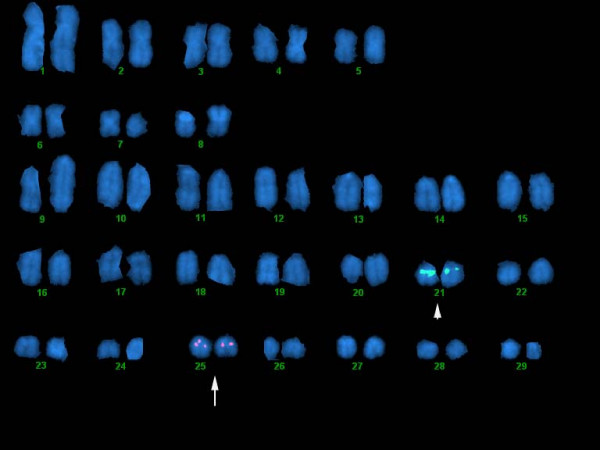
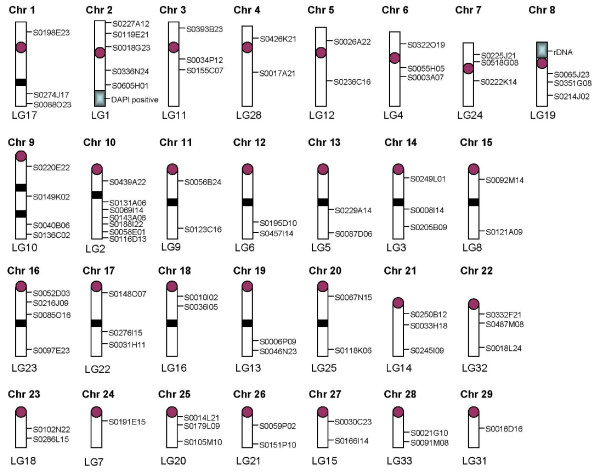
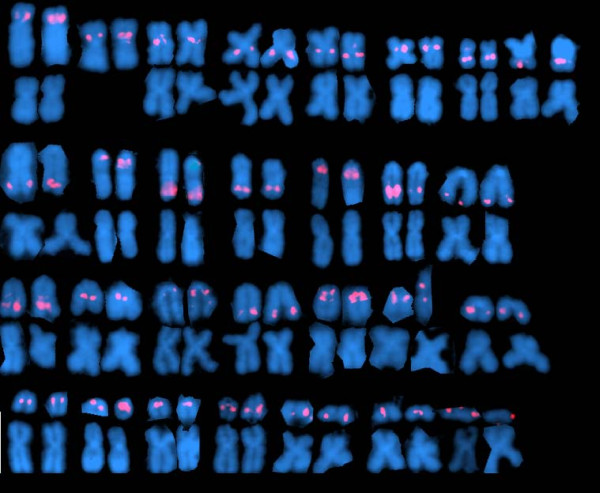
The Atlantic salmon genetic linkage groups were assigned to specific chromosomes in the European subspecies using fluorescence in situ hybridization with BAC probes containing genetic markers mapped to each linkage group. The genetic linkage groups were larger for metacentric chromosomes compared to acrocentric chromosomes of similar size. Comparison of the Atlantic salmon chromosome map with that of rainbow trout provides strong evidence for conservation of large syntenic blocks in these species, corresponding to entire chromosome arms in the rainbow trout.
It had been suggested that some of the large acrocentric chromosomes in Atlantic salmon are the result of tandem fusions, and that the small blocks of repetitive DNA in the middle of the arms represent the sites of chromosome fusions. The finding that the chromosomal regions on either side of the blocks of repetitive DNA within the larger acrocentric chromosomes correspond to different rainbow trout chromosome arms provides support for this hypothesis.
大多数硬骨鱼物种,尤其是像狗鱼科这样与鲑科关系最为密切的淡水类群,其核型由25对近端着丝粒染色体和48 - 52条染色体臂组成。鲑科的共同祖先经历了一次全基因组复制后,其核型会有100条染色体臂,这在现存鲑科鱼类(如虹鳟)所见的96 - 104条染色体臂的模式范围内得以体现。大西洋鲑在鲑科中是个例外,因为它有72 - 74条染色体臂,其核型包括12对大型近端着丝粒染色体,这似乎是串联融合的结果。本研究的目的是整合大西洋鲑的连锁图谱和核型,并将染色体图谱与虹鳟的进行比较。
利用含有定位到每个连锁群的遗传标记的BAC探针进行荧光原位杂交,将大西洋鲑的遗传连锁群分配到欧洲亚种的特定染色体上。与大小相似的近端着丝粒染色体相比,中着丝粒染色体的遗传连锁群更大。将大西洋鲑的染色体图谱与虹鳟的进行比较,为这些物种中大型同线基因块的保守性提供了有力证据,这些同线基因块与虹鳟的整条染色体臂相对应。
有人提出大西洋鲑的一些大型近端着丝粒染色体是串联融合的结果,并且染色体臂中间的小重复DNA块代表染色体融合位点。在较大的近端着丝粒染色体中,重复DNA块两侧的染色体区域对应于不同的虹鳟染色体臂这一发现为该假说提供了支持。