Devault A, Gros P
Department of Biochemistry, McGill University, Montreal, Quebec, Canada.
Mol Cell Biol. 1990 Apr;10(4):1652-63. doi: 10.1128/mcb.10.4.1652-1663.1990.
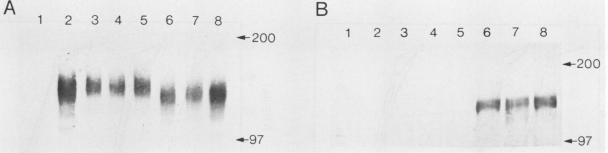
We report the cloning and functional analysis of a complete clone for the third member of the mouse mdr gene family, mdr3. Nucleotide and predicted amino acid sequence analyses showed that the three mouse mdr genes encode highly homologous membrane glycoproteins, which share the same length (1,276 residues), the same predicted functional domains, and overall structural arrangement. Regions of divergence among the three proteins are concentrated in discrete segments of the predicted polypeptides. Sequence comparison indicated that the three mouse mdr genes were created from a common ancestor by two independent gene duplication events, the most recent one producing mdr1 and mdr3. When transfected and overexpressed in otherwise drug-sensitive cells, the mdr3 gene, like mdr1 and unlike mdr2, conferred multidrug resistance to these cells. In independently derived transfected cell clones expressing similar amounts of either MDR1 or MDR3 protein, the drug resistance profile conferred by mdr3 was distinct from that conferred by mdr1. Cells transfected with and expressing MDR1 showed a marked 7- to 10-fold preferential resistance to colchicine and Adriamycin compared with cells expressing equivalent amounts of MDR3. Conversely, cells transfected with and expressing MDR3 showed a two- to threefold preferential resistance to actinomycin D over their cellular counterpart expressing MDR1. These results suggest that MDR1 and MDR3 are membrane-associated efflux pumps which, in multidrug-resistant cells and perhaps normal tissues, have overlapping but distinct substrate specificities.
我们报道了小鼠mdr基因家族第三个成员mdr3完整克隆的克隆及功能分析。核苷酸和预测的氨基酸序列分析表明,三个小鼠mdr基因编码高度同源的膜糖蛋白,它们具有相同的长度(1276个残基)、相同的预测功能域和整体结构排列。这三种蛋白质的差异区域集中在预测多肽的离散片段中。序列比较表明,三个小鼠mdr基因是由一个共同祖先通过两次独立的基因复制事件产生的,最近一次产生了mdr1和mdr3。当在其他对药物敏感的细胞中进行转染并过表达时,mdr3基因与mdr1一样,与mdr2不同,赋予这些细胞多药耐药性。在独立衍生的表达相似量的MDR1或MDR3蛋白的转染细胞克隆中,mdr3赋予的耐药谱与mdr1赋予的不同。与表达等量MDR3的细胞相比,转染并表达MDR1的细胞对秋水仙碱和阿霉素表现出明显的7至10倍的优先耐药性。相反,转染并表达MDR3的细胞对放线菌素D的优先耐药性比表达MDR1的对应细胞高两到三倍。这些结果表明,MDR1和MDR3是与膜相关的外排泵,在多药耐药细胞以及可能的正常组织中,它们具有重叠但不同的底物特异性。