Department of Anesthesia and Critical Care, Hôpital Saint-Louis, Assistance Publique-Hôpitaux de Paris, Université Paris-7 Diderot, 1 Avenue Claude Vellefaux, 75010 Paris, France.
Crit Care. 2009;13(4):R141. doi: 10.1186/cc8022. Epub 2009 Aug 28.
To counter the shortage of kidney grafts in France, a non heart beating donor (NHBD) program has recently been implemented. The aim of this study was to describe this pilot program for kidney retrieval from "uncontrolled" NHBD meaning those for whom attempts of resuscitation after a witnessed out-of-hospital cardiac arrest (CA) have failed (Maastricht 1 and 2), in a centre previously trained for retrieval from brain dead donors.
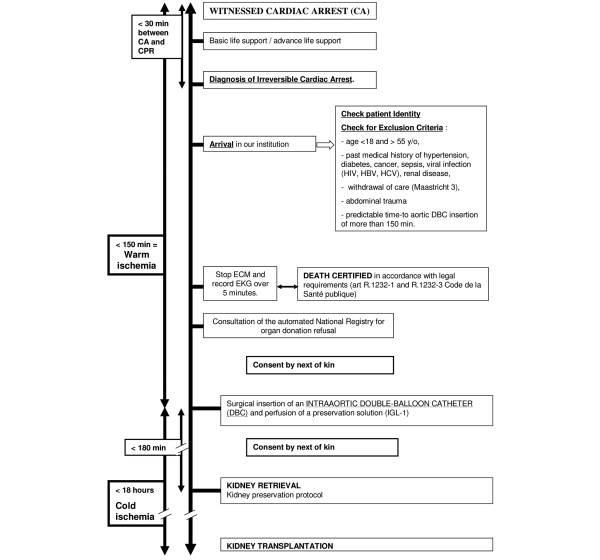
A prospective, monocentric, descriptive study concerning NHBD referred to our institution from February 2007 to June 2008. The protocol includes medical transport of refractory CA under mechanical ventilation and external cardiac massage, kidney protection by insertion of an intraaortic double-balloon catheter (DBC) with perfusion of a hypothermic solution, kidney retrieval and kidney preservation in a hypothermic pulsatile perfusion machine.
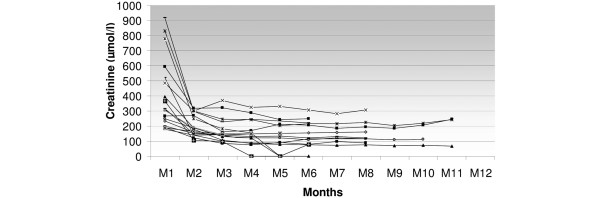
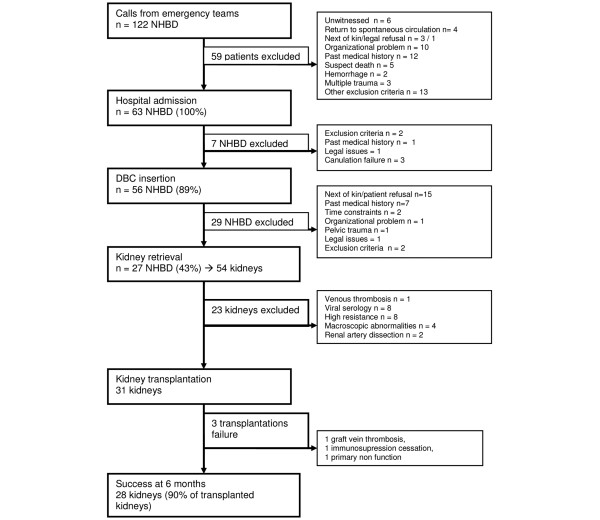
122 potential NHBD were referred to our institution after a mean resuscitation attempt of 35 minutes (20-95). Regarding the contraindications, 63 were finally accepted and 56 had the DBC inserted. Organ retrieval was performed in 27 patients (43%) and 31 kidneys out of the 54 procured (57%) have been transplanted. Kidney transplantation exclusion was related to family refusal (n = 15), past medical history, time constraints, viral serology, high vascular ex vivo resistance of the graft and macroscopic abnormalities. The 31 kidneys exhibited an expected high delayed graft function rate (92%). Despite these initial results transplanted kidney had good creatinine clearance at six months (66 +/- 24 ml/min) with a 89% graft survival rate at six months.
This study shows the feasibility and efficacy of an organ procurement program targeting NHBD allowing a 10% increase in the kidney transplantation rate over 17 months. With a six months follow-up period, the results of transplanted kidney function were excellent.
为了解决法国肾源短缺的问题,最近实施了一项非心脏死亡供体(NHBD)计划。本研究的目的是描述该中心从“不可控”NHBD 中获取肾脏的试点项目,这些供体在目击院外心脏骤停(CA)后复苏尝试失败(Maastricht 1 和 2),该中心此前曾接受过从脑死亡供体中获取肾脏的培训。
这是一项前瞻性、单中心、描述性研究,涉及 2007 年 2 月至 2008 年 6 月期间我院收治的 NHBD。该方案包括对难治性 CA 进行机械通气和体外心脏按摩的医疗转运,通过插入主动脉内双球囊导管(DBC)和低温溶液灌注进行肾脏保护,低温搏动灌注机中进行肾脏获取和保存。
在平均 35 分钟(20-95 分钟)的复苏尝试后,共有 122 名潜在 NHBD 被转诊至我院。关于禁忌症,最终有 63 人被接受,56 人插入了 DBC。在 27 名患者(43%)中进行了器官获取,在 54 个获取的肾脏中(57%)有 31 个进行了移植。肾脏移植的排除与家庭拒绝(n=15)、既往病史、时间限制、病毒血清学、移植肾的高血管体外阻力和宏观异常有关。31 个肾脏表现出预期的高延迟移植物功能障碍率(92%)。尽管存在这些初始结果,移植肾脏在六个月时的肌酐清除率良好(66±24ml/min),六个月时的移植物存活率为 89%。
本研究表明,针对 NHBD 的器官获取计划具有可行性和有效性,可在 17 个月内将肾脏移植率提高 10%。在六个月的随访期内,移植肾脏的功能结果非常出色。