Llewellyn Martin S, Lewis Michael D, Acosta Nidia, Yeo Matthew, Carrasco Hernan J, Segovia Maikell, Vargas Jorge, Torrico Faustino, Miles Michael A, Gaunt Michael W
London School of Hygiene and Tropical Medicine, London, United Kingdom.
PLoS Negl Trop Dis. 2009 Sep 1;3(9):e510. doi: 10.1371/journal.pntd.0000510.
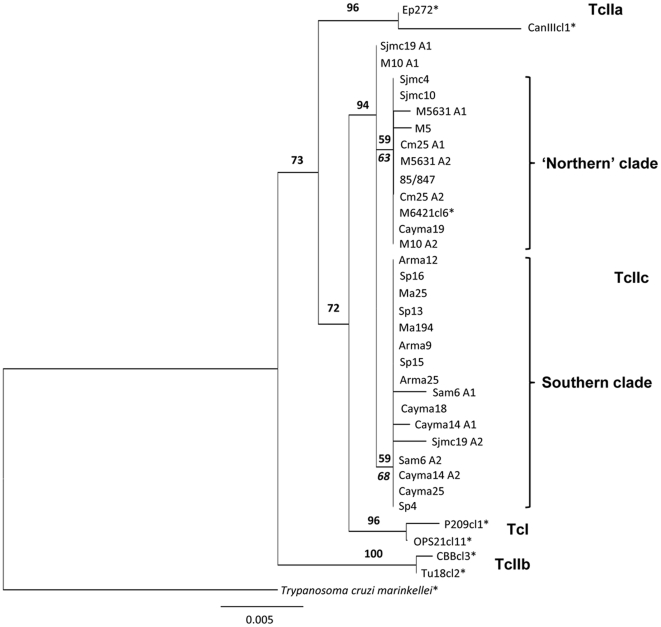
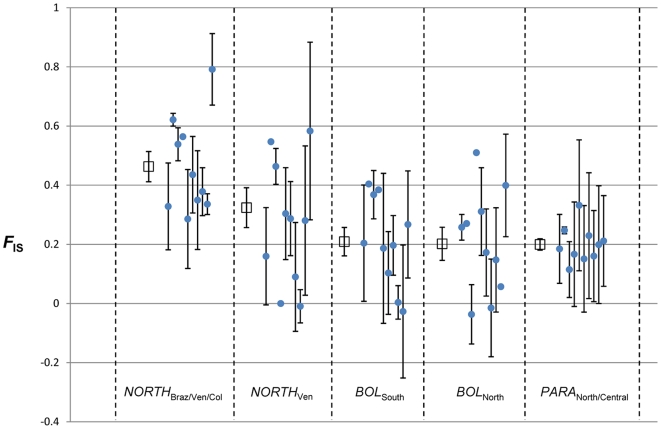
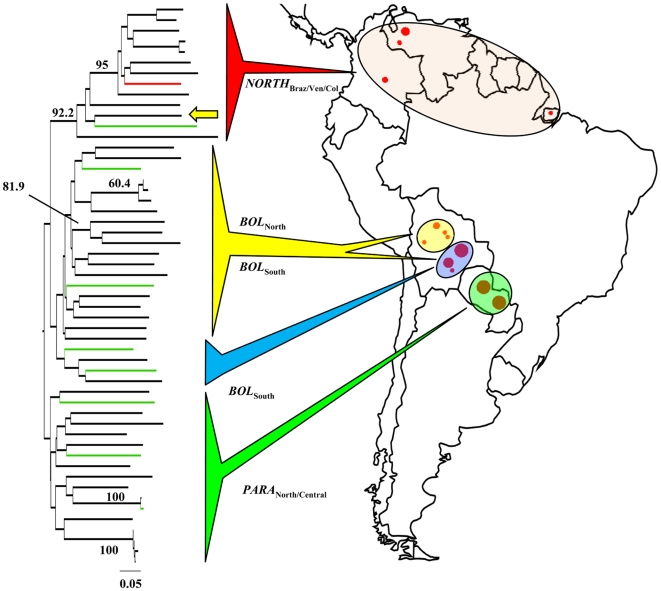
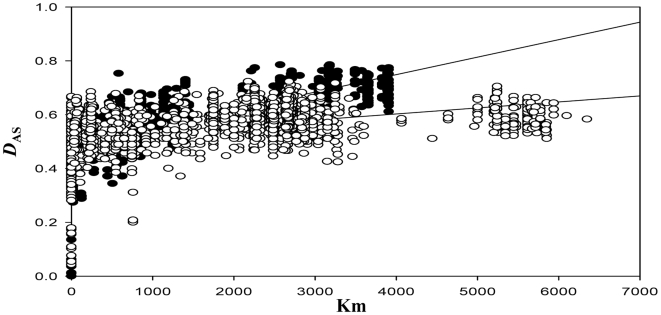
Trypanosoma cruzi, the etiological agent of Chagas disease, is highly genetically diverse. Numerous lines of evidence point to the existence of six stable genetic lineages or DTUs: TcI, TcIIa, TcIIb, TcIIc, TcIId, and TcIIe. Molecular dating suggests that T. cruzi is likely to have been an endemic infection of neotropical mammalian fauna for many millions of years. Here we have applied a panel of 49 polymorphic microsatellite markers developed from the online T. cruzi genome to document genetic diversity among 53 isolates belonging to TcIIc, a lineage so far recorded almost exclusively in silvatic transmission cycles but increasingly a potential source of human infection. These data are complemented by parallel analysis of sequence variation in a fragment of the glucose-6-phosphate isomerase gene. New isolates confirm that TcIIc is associated with terrestrial transmission cycles and armadillo reservoir hosts, and demonstrate that TcIIc is far more widespread than previously thought, with a distribution at least from Western Venezuela to the Argentine Chaco. We show that TcIIc is truly a discrete T. cruzi lineage, that it could have an ancient origin and that diversity occurs within the terrestrial niche independently of the host species. We also show that spatial structure among TcIIc isolates from its principal host, the armadillo Dasypus novemcinctus, is greater than that among TcI from Didelphis spp. opossums and link this observation to differences in ecology of their respective niches. Homozygosity in TcIIc populations and some linkage indices indicate the possibility of recombination but cannot yet be effectively discriminated from a high genome-wide frequency of gene conversion. Finally, we suggest that the derived TcIIc population genetic data have a vital role in determining the origin of the epidemiologically important hybrid lineages TcIId and TcIIe.
克氏锥虫是恰加斯病的病原体,其基因具有高度多样性。大量证据表明存在六个稳定的遗传谱系或离散型单元(DTUs):TcI、TcIIa、TcIIb、TcIIc、TcIId和TcIIe。分子年代测定表明,克氏锥虫可能在数百万年里一直是新热带区哺乳动物群的地方性感染源。在此,我们应用了一组从在线克氏锥虫基因组开发的49个多态性微卫星标记,来记录属于TcIIc谱系的53个分离株的遗传多样性,该谱系迄今为止几乎仅在野生传播循环中被记录到,但越来越成为人类感染的潜在来源。这些数据通过对葡萄糖-6-磷酸异构酶基因片段序列变异的平行分析得到补充。新的分离株证实TcIIc与陆地传播循环和犰狳储存宿主相关,并表明TcIIc的分布比以前认为的要广泛得多,至少从委内瑞拉西部到阿根廷查科地区都有分布。我们表明,TcIIc确实是一个离散的克氏锥虫谱系,它可能有古老的起源,并且在陆地生态位内的多样性独立于宿主物种而发生。我们还表明,来自其主要宿主九带犰狳的TcIIc分离株之间的空间结构比来自负鼠属负鼠的TcI之间的空间结构更大,并将这一观察结果与它们各自生态位的生态差异联系起来。TcIIc群体中的纯合性和一些连锁指数表明存在重组的可能性,但尚未能有效地与全基因组范围内高频率的基因转换区分开来。最后,我们认为所获得的TcIIc群体遗传数据在确定具有重要流行病学意义的杂交谱系TcIId和TcIIe的起源方面具有至关重要的作用。