Faust Katharina, Gehrke Stephan, Yang Yufeng, Yang Lichuan, Beal M Flint, Lu Bingwei
Department of Pathology, Stanford University School of Medicine, Stanford, CA 94305, USA.
BMC Neurosci. 2009 Sep 1;10:109. doi: 10.1186/1471-2202-10-109.
Parkinson's disease (PD) is the most common movement disorder. Extrapyramidal motor symptoms stem from the degeneration of the dopaminergic pathways in patient brain. Current treatments for PD are symptomatic, alleviating disease symptoms without reversing or retarding disease progression. Although the cause of PD remains unknown, several pathogenic factors have been identified, which cause dopaminergic neuron (DN) death in the substantia nigra (SN). These include oxidative stress, mitochondrial dysfunction, inflammation and excitotoxicity. Manipulation of these factors may allow the development of disease-modifying treatment strategies to slow neuronal death. Inhibition of DJ-1A, the Drosophila homologue of the familial PD gene DJ-1, leads to oxidative stress, mitochondrial dysfunction, and DN loss, making fly DJ-1A model an excellent in vivo system to test for compounds with therapeutic potential.
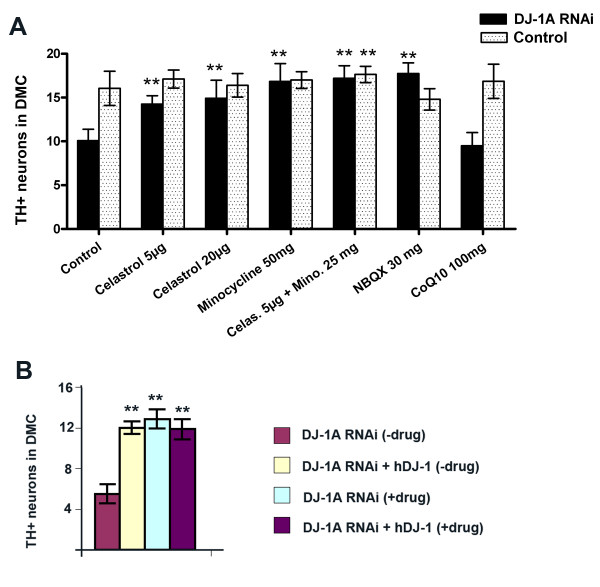
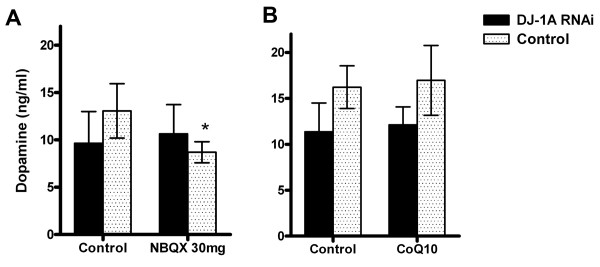
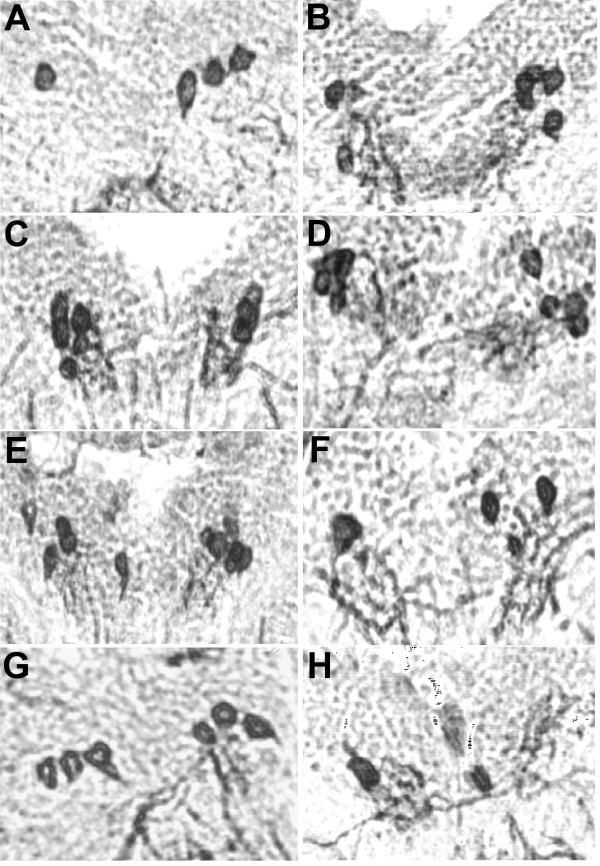
In the present study, a Drosophila DJ-1A model of PD was used to test potential neuroprotective drugs. The drugs applied are the Chinese herb celastrol, the antibiotic minocycline, the bioenergetic amine coenzyme Q10 (coQ10), and the glutamate antagonist 2,3-dihydroxy-6-nitro-7-sulphamoylbenzo[f]-quinoxaline (NBQX). All of these drugs target pathogenic processes implicated in PD, thus constitute mechanism-based treatment strategies. We show that celastrol and minocycline, both having antioxidant and anti-inflammatory properties, confer potent dopaminergic neuroprotection in Drosophila DJ-1A model, while coQ10 shows no protective effect. NBQX exerts differential effects on cell survival and brain dopamine content: it protects against DN loss but fails to restore brain dopamine level.
The present study further validates Drosophila as a valuable model for preclinical testing of drugs with therapeutic potential for neurodegenerative diseases. The lower cost and amenability to high throughput testing make Drosophila PD models effective in vivo tools for screening novel therapeutic compounds. If our findings can be further validated in mammalian PD models, they would implicate drugs combining antioxidant and anti-inflammatory properties as strong therapeutic candidates for mechanism-based PD treatment.
帕金森病(PD)是最常见的运动障碍性疾病。锥体外系运动症状源于患者大脑中多巴胺能通路的退化。目前针对PD的治疗是对症治疗,可缓解疾病症状,但无法逆转或延缓疾病进展。尽管PD的病因尚不清楚,但已确定了几种致病因素,这些因素会导致黑质(SN)中的多巴胺能神经元(DN)死亡。这些因素包括氧化应激、线粒体功能障碍、炎症和兴奋性毒性。对这些因素进行调控可能会开发出改变疾病进程的治疗策略,以减缓神经元死亡。抑制果蝇中家族性PD基因DJ-1的同源物DJ-1A会导致氧化应激、线粒体功能障碍和DN损失,这使得果蝇DJ-1A模型成为测试具有治疗潜力化合物的优秀体内系统。
在本研究中,使用果蝇DJ-1A PD模型来测试潜在的神经保护药物。所应用的药物有中药雷公藤红素、抗生素米诺环素、生物能胺辅酶Q10(coQ10)以及谷氨酸拮抗剂2,3-二羟基-6-硝基-7-氨磺酰基苯并[f]喹喔啉(NBQX)。所有这些药物都针对与PD相关的致病过程,因此构成了基于机制的治疗策略。我们发现,雷公藤红素和米诺环素都具有抗氧化和抗炎特性,在果蝇DJ-1A模型中能赋予强大的多巴胺能神经保护作用,而coQ10则没有保护作用。NBQX对细胞存活和脑多巴胺含量有不同影响:它能防止DN损失,但未能恢复脑多巴胺水平。
本研究进一步验证了果蝇作为一种有价值的模型,可用于对具有神经退行性疾病治疗潜力的药物进行临床前测试。较低的成本和高通量测试的便利性使果蝇PD模型成为筛选新型治疗化合物的有效体内工具。如果我们的发现能够在哺乳动物PD模型中得到进一步验证,那么它们将表明具有抗氧化和抗炎特性的药物是基于机制的PD治疗的有力候选药物。