Erdemir Ahmet, Sirimamilla Pavana A, Halloran Jason P, van den Bogert Antonie J
Department of Biomedical Engineering, Cleveland Clinic, Cleveland, OH 44195, USA.
J Biomech Eng. 2009 Sep;131(9):094502. doi: 10.1115/1.3148474.
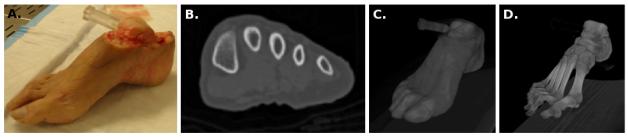
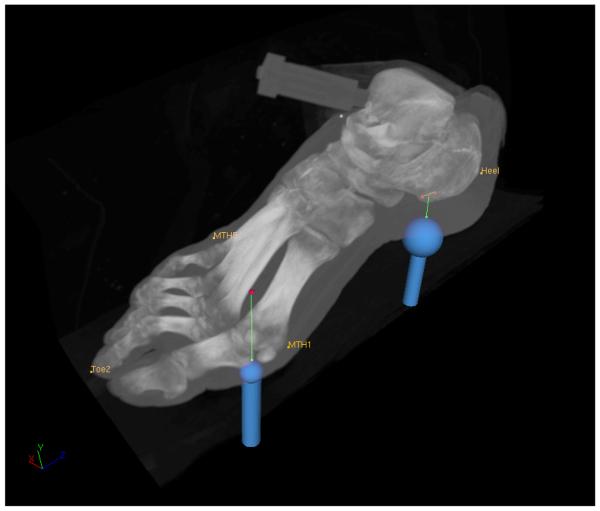
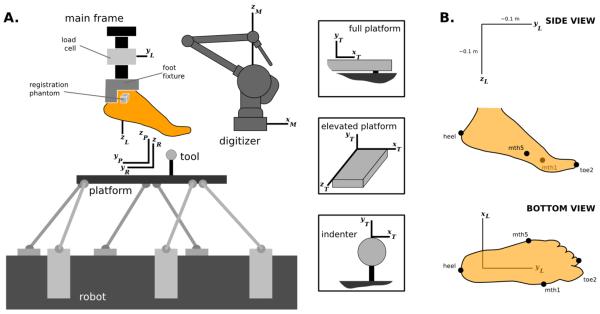
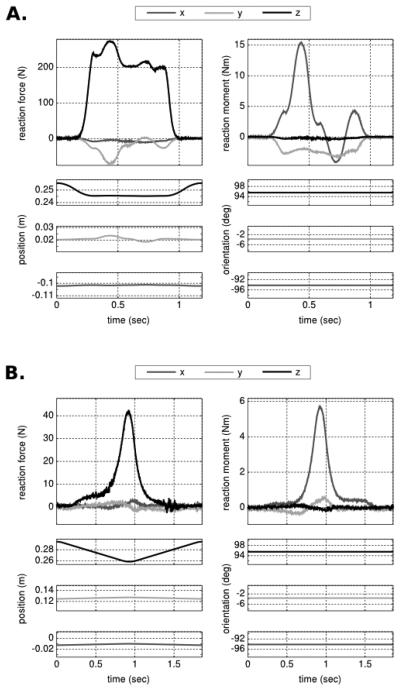
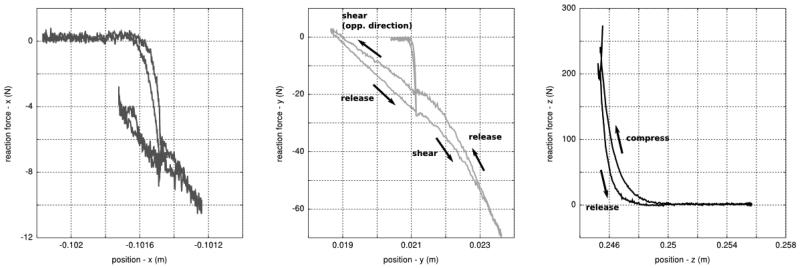
Mechanical properties of the foot are responsible for its normal function and play a role in various clinical problems. Specifically, we are interested in quantification of foot mechanical properties to assist the development of computational models for movement analysis and detailed simulations of tissue deformation. Current available data are specific to a foot region and the loading scenarios are limited to a single direction. A data set that incorporates regional response, to quantify individual function of foot components, as well as the overall response, to illustrate their combined operation, does not exist. Furthermore, the combined three-dimensional loading scenarios while measuring the complete three-dimensional deformation response are lacking. When combined with an anatomical image data set, development of anatomically realistic and mechanically validated models becomes possible. Therefore, the goal of this study was to record and disseminate the mechanical response of a foot specimen, supported by imaging data. Robotic testing was conducted at the rear foot, forefoot, metatarsal heads, and the foot as a whole. Complex foot deformations were induced by single mode loading, e.g., compression, and combined loading, e.g., compression and shear. Small and large indenters were used for heel and metatarsal head loading, an elevated platform was utilized to isolate the rear foot and forefoot, and a full platform compressed the whole foot. Three-dimensional tool movements and reaction loads were recorded simultaneously. Computed tomography scans of the same specimen were collected for anatomical reconstruction a priori. The three-dimensional mechanical response of the specimen was nonlinear and viscoelastic. A low stiffness region was observed starting with contact between the tool and foot regions, increasing with loading. Loading and unloading responses portrayed hysteresis. Loading range ensured capturing the toe and linear regions of the load deformation curves for the dominant loading direction, with the rates approximating those of walking. A large data set was successfully obtained to characterize the overall and the regional mechanical responses of an intact foot specimen under single and combined loads. Medical imaging complemented the mechanical testing data to establish the potential relationship between the anatomical architecture and mechanical responses and to further develop foot models that are mechanically realistic and anatomically consistent. This combined data set has been documented and disseminated in the public domain to promote future development in foot biomechanics.
足部的力学特性决定其正常功能,并在各种临床问题中发挥作用。具体而言,我们感兴趣的是量化足部力学特性,以辅助开发用于运动分析和组织变形详细模拟的计算模型。当前可用数据特定于足部区域,且加载场景仅限于单一方向。不存在一个数据集,它既包含区域响应以量化足部各组成部分的个体功能,又包含整体响应以说明它们的联合运作。此外,在测量完整三维变形响应时缺乏组合的三维加载场景。当与解剖图像数据集相结合时,就有可能开发出解剖学上逼真且经过力学验证的模型。因此,本研究的目的是记录并传播在成像数据支持下足部标本的力学响应。在后足、前足、跖骨头以及整个足部进行了机器人测试。通过单模式加载(例如压缩)和组合加载(例如压缩和剪切)诱导复杂的足部变形。使用小和大的压头分别对足跟和跖骨头进行加载,利用一个升高的平台来分离后足和前足,并用一个完整的平台压缩整个足部。同时记录三维工具运动和反应载荷。先对同一标本进行计算机断层扫描以进行解剖重建。标本的三维力学响应是非线性和粘弹性的。从工具与足部区域接触开始观察到一个低刚度区域,该区域随加载而增加。加载和卸载响应呈现滞后现象。加载范围确保捕获主导加载方向的载荷 - 变形曲线的趾部和线性区域,加载速率近似于行走速率。成功获得了一个大数据集,以表征完整足部标本在单载荷和组合载荷下的整体和区域力学响应。医学成像补充了力学测试数据,以建立解剖结构与力学响应之间的潜在关系,并进一步开发在力学上逼真且在解剖学上一致的足部模型。这个组合数据集已记录在案并在公共领域传播,以促进足部生物力学的未来发展。