Vanderbilt Eye Institute, 2311 Pierce Ave, Nashville, TN 37232-8808, USA.
Br J Ophthalmol. 2010 Jan;94(1):74-9. doi: 10.1136/bjo.2009.158071. Epub 2009 Sep 1.
To evaluate the efficacy and safety of replacing latanoprost with another prostaglandin analogue (PGA) in patients with glaucoma or ocular hypertension requiring additional intraocular pressure (IOP) lowering while on latanoprost.
Prospective, randomised, investigator-masked, multicentre clinical trial. Patients on latanoprost 0.005% monotherapy requiring additional IOP lowering discontinued latanoprost and were randomised to bimatoprost 0.03% (n = 131) or travoprost 0.004% (n = 135). IOP was measured at latanoprost-treated baseline and after 1 month and 3 months of replacement therapy.
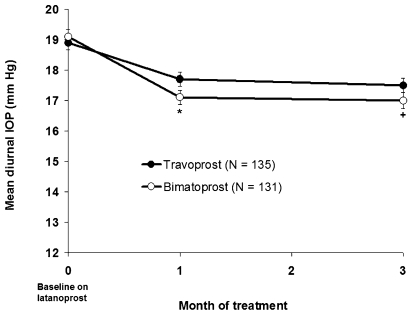
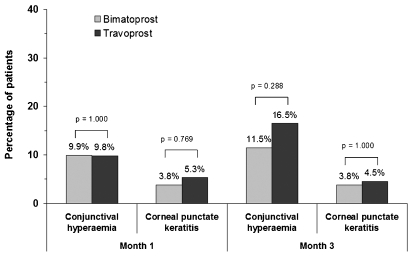
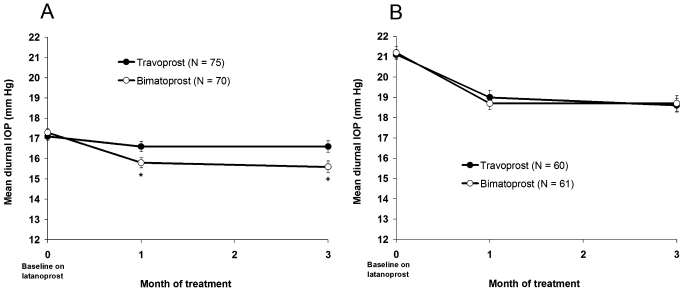
Baseline mean diurnal IOP on latanoprost was similar between groups. The mean diurnal IOP was significantly lower with bimatoprost than with travoprost at 1 month (p = 0.009) and 3 months (p = 0.024). Overall, 22.0% of bimatoprost patients versus 12.1% of travoprost patients achieved a > or =15% reduction in diurnal IOP from latanoprost-treated baseline at both months 1 and 3 (p = 0.033). At month 3, the additional mean diurnal IOP reduction from latanoprost-treated baseline was 2.1 (95% CI 1.7 to 2.5) mm Hg (11.0%) with bimatoprost and 1.4 (95% CI 0.9 to 1.8) mm Hg (7.4%) with travoprost (p = 0.024). At 3 months, 11.5% of bimatoprost and 16.5% of travoprost patients demonstrated a > or =1-grade increase in physician-graded conjunctival hyperaemia (p = 0.288). Hyperaemia was reported as a treatment-related adverse event in 3.1% of bimatoprost and 1.5% of travoprost patients (p = 0.445).
Patients on latanoprost requiring lower IOP achieved a greater additional short-term diurnal IOP reduction when latanoprost was replaced by bimatoprost compared with travoprost. Low rates of hyperaemia were observed in patients treated with bimatoprost or travoprost after switching from latanoprost.
评估在需要进一步降低眼内压(IOP)的青光眼或高眼压患者中,将拉坦前列素替换为另一种前列腺素类似物(PGA)的疗效和安全性。
前瞻性、随机、研究者设盲、多中心临床试验。正在接受拉坦前列素 0.005%单药治疗且需要进一步降低 IOP 的患者停止使用拉坦前列素,并随机分为贝美前列素 0.03%(n=131)或曲伏前列素 0.004%(n=135)组。在拉坦前列素治疗的基线以及替代治疗 1 个月和 3 个月时测量 IOP。
两组基线时拉坦前列素的日间平均 IOP 相似。与曲伏前列素相比,贝美前列素在 1 个月(p=0.009)和 3 个月(p=0.024)时日间 IOP 显著降低。总体而言,在第 1 个月和第 3 个月,22.0%的贝美前列素患者和 12.1%的曲伏前列素患者的日间 IOP 从拉坦前列素治疗的基线水平降低了≥15%(p=0.033)。在第 3 个月时,与拉坦前列素治疗的基线相比,贝美前列素的额外平均日间 IOP 降低了 2.1(95%CI 1.7 至 2.5)mmHg(11.0%),而曲伏前列素降低了 1.4(95%CI 0.9 至 1.8)mmHg(7.4%)(p=0.024)。在 3 个月时,贝美前列素的 11.5%和曲伏前列素的 16.5%患者出现了医生分级的结膜充血增加≥1 级(p=0.288)。在 3.1%的贝美前列素和 1.5%的曲伏前列素患者中,结膜充血被报告为与治疗相关的不良事件(p=0.445)。
在需要进一步降低 IOP 的拉坦前列素治疗患者中,与曲伏前列素相比,用贝美前列素替代拉坦前列素可实现更大的短期日间 IOP 降低。在从拉坦前列素转换为贝美前列素或曲伏前列素治疗的患者中,观察到的结膜充血发生率较低。