Kerdelhué Carole, Zane Lorenzo, Simonato Mauro, Salvato Paola, Rousselet Jérôme, Roques Alain, Battisti Andrea
INRA, UMR1202 BIOGECO, F-33610 Cestas, France.
BMC Evol Biol. 2009 Sep 4;9:220. doi: 10.1186/1471-2148-9-220.
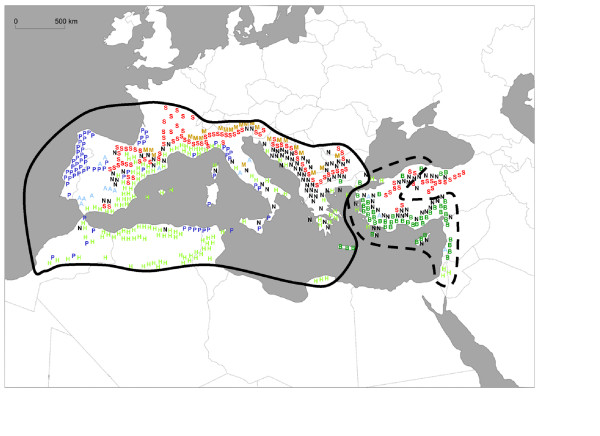
Quaternary climatic oscillations had dramatic effects on species evolution. In northern latitudes, populations had to survive the coldest periods in refugial areas and recurrently colonized northern regions during interglacials. Such a history usually results in a loss of genetic diversity. Populations that did not experience glaciations, in contrast, probably maintained most of their ancestral genetic diversity. These characteristics dramatically affected the present-day distribution of genetic diversity and may influence the ability of species to cope with the current global changes. We conducted a range-wide study of mitochondrial genetic diversity in the pine processionary moth (Thaumetopoea pityocampa/T. wilkinsoni complex, Notodontidae), a forest pest occurring around the Mediterranean Basin and in southern Europe. This species is responding to the current climate change by rapid natural range expansion and can also be accidentally transported by humans. Our aim was to assess if Quaternary climatic oscillations had a different effect across the species' range and to determine if genetic footprints of contemporary processes can be identified in areas of recent introduction.
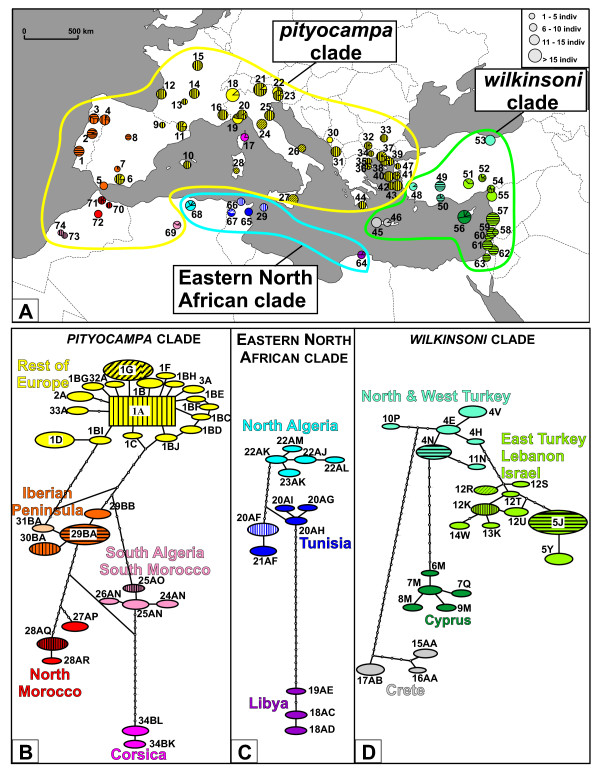
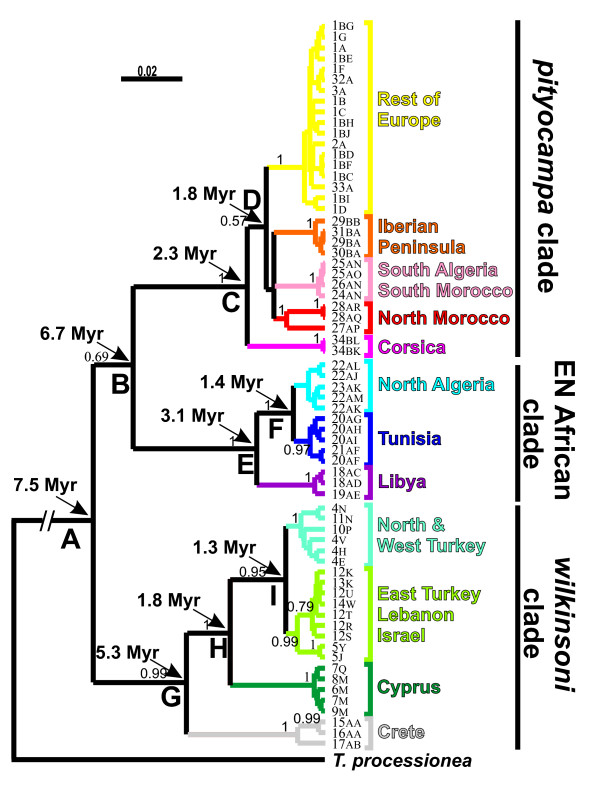
We identified three main clades that were spatially structured. In most of Europe, the genetic diversity pattern was typical for species that experienced marked glaciation cycles. Except in refugia, European populations were characterized by the occurrence of one main haplotype and by a strong reduction in genetic diversity, which is expected in regions that were rapidly re-colonized when climatic conditions improved. In contrast, all other sub-clades around the Mediterranean Basin occurred in limited parts of the range and were strongly structured in space, as is expected in regions in which the impact of glaciations was limited. In such places, genetic diversity was retained in most populations, and almost all haplotypes were endemic. This pattern was extreme on remote Mediterranean islands (Crete, Cyprus, Corsica) where highly differentiated, endemic haplotypes were found. Recent introductions were typified by the existence of closely-related haplotypes in geographically distant populations, which is difficult to detect in most of Europe because of a lack of overall genetic structure.
In regions that were not prone to marked glaciations, recent moth introductions/expansions could be detected due to the existence of a strong spatial genetic structure. In contrast, in regions that experienced the most intense Quaternary climatic oscillations, the natural populations are not genetically structured, and contemporary patterns of population expansion remain undetected.
第四纪气候振荡对物种进化产生了巨大影响。在北纬地区,种群必须在避难区域度过最寒冷的时期,并在间冰期反复向北方地区迁徙。这样的历史通常会导致遗传多样性的丧失。相比之下,未经历冰川作用的种群可能保留了大部分祖先的遗传多样性。这些特征极大地影响了当今遗传多样性的分布,并可能影响物种应对当前全球变化的能力。我们对松异舟蛾(Thaumetopoea pityocampa/T. wilkinsoni复合体,舟蛾科)的线粒体遗传多样性进行了全范围研究,该物种是一种在地中海盆地周围和南欧出现的森林害虫。该物种正在通过自然分布范围的迅速扩大来应对当前的气候变化,并且也可能被人类意外传播。我们的目的是评估第四纪气候振荡在整个物种分布范围内是否有不同的影响,并确定在最近引入的地区是否可以识别当代过程的遗传印记。
我们识别出三个主要的进化枝,它们在空间上有结构。在欧洲大部分地区,遗传多样性模式对于经历了显著冰川周期的物种来说是典型的。除了在避难所,欧洲种群的特征是出现一种主要单倍型,并且遗传多样性大幅降低,这在气候条件改善时迅速重新定殖的地区是可以预期的。相比之下,地中海盆地周围的所有其他亚进化枝出现在分布范围的有限区域,并且在空间上有很强的结构,这在冰川作用影响有限的地区是可以预期的。在这些地方,大多数种群保留了遗传多样性,并且几乎所有单倍型都是地方性的。这种模式在偏远的地中海岛屿(克里特岛、塞浦路斯、科西嘉岛)上最为极端,在那里发现了高度分化的地方性单倍型。最近的引入以地理上遥远的种群中存在密切相关的单倍型为特征,由于缺乏整体遗传结构,这在欧洲大部分地区很难检测到。
在不易发生显著冰川作用的地区,由于存在强烈的空间遗传结构,可以检测到最近的蛾类引入/扩张。相比之下,在经历了最强烈的第四纪气候振荡的地区,自然种群没有遗传结构,当代种群扩张模式仍然未被发现。