Pérez-Rodríguez Rodolfo, Domínguez-Domínguez Omar, Pérez Ponce de León Gerardo, Doadrio Ignacio
Posgrado en Ciencias Biológicas, Instituto de Biología, Universidad Nacional Autónoma de México, México, D.F., México.
BMC Evol Biol. 2009 Sep 7;9:223. doi: 10.1186/1471-2148-9-223.
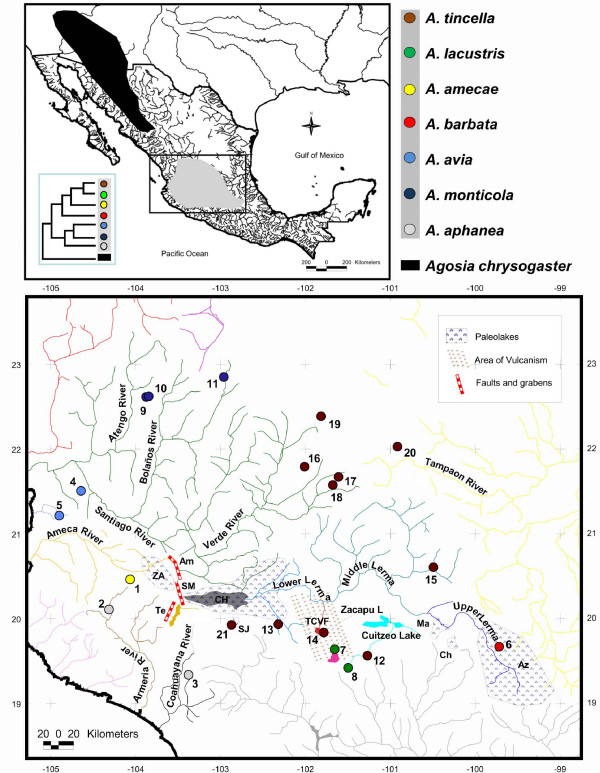
The genus Algansea is one of the most representative freshwater fish groups in central Mexico due to its wide geographic distribution and unusual level of endemicity. Despite the small number of species, this genus has had an unsettled taxonomic history due to high levels of intraspecific morphological variation. Moreover, several phylogenetic hypotheses among congeners have been proposed but have had the following shortcomings: the use of homoplasious morphological characters, the use of character codification and polarisation methods that lacked objectivity, and incomplete taxonomic sampling. In this study, a phylogenetic analysis among species of Algansea is presented. This analysis is based upon two molecular markers, the mitochondrial gene cytochrome b and the first intron of the ribosomal protein S7 gene.
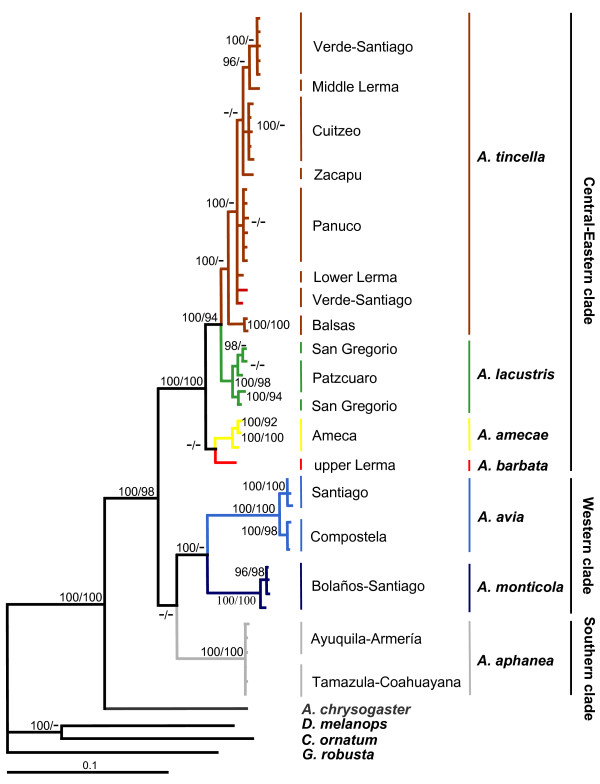
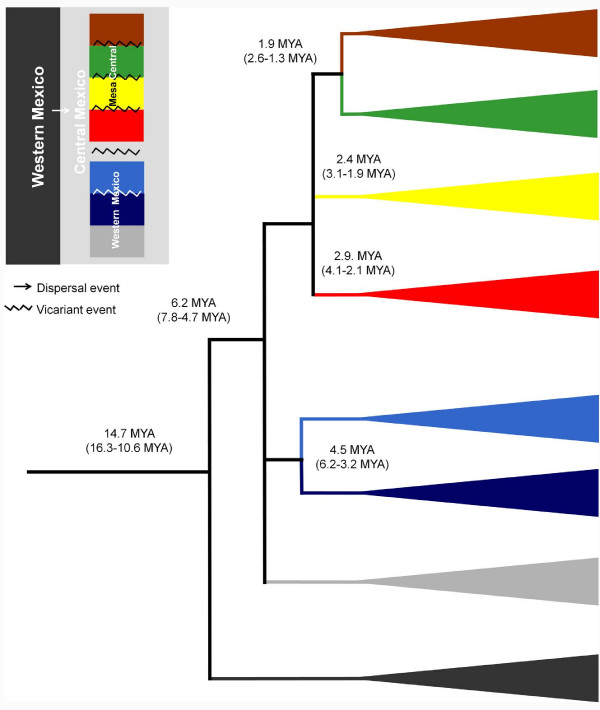
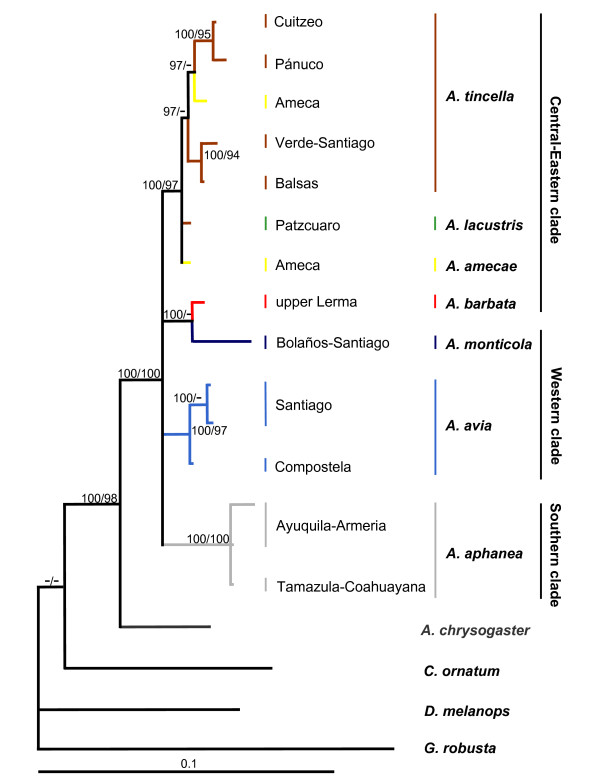
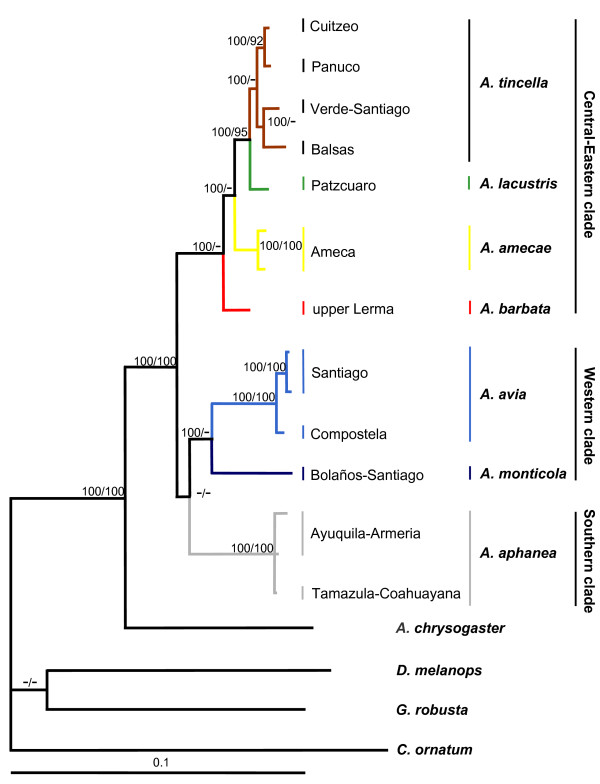
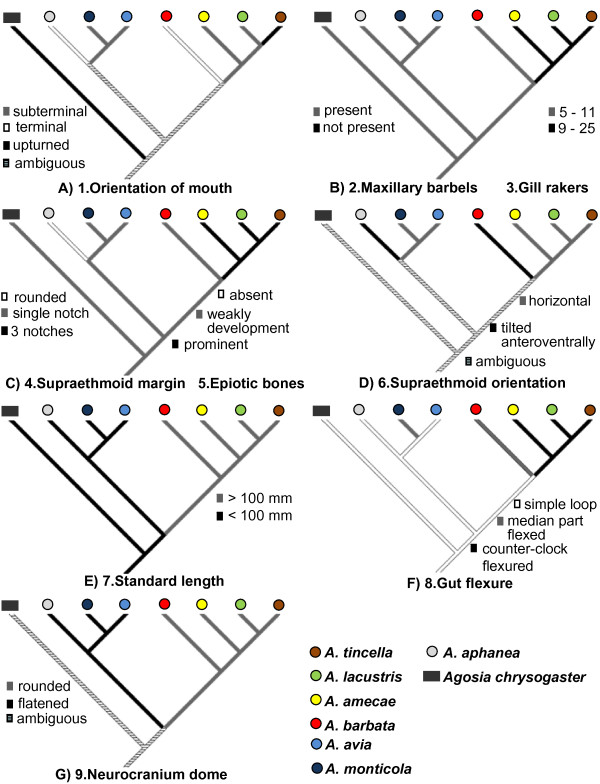
Bayesian analysis based on a combined matrix (cytochrome b and first intron S7) showed that Algansea is a monophyletic group and that Agosia chrysogaster is the sister group. Divergence times dated the origin of the genus around 16.6 MYA, with subsequent cladogenetic events occurring between 6.4 and 2.8 MYA. When mapped onto the molecular phylogenetic hypothesis, the character states of three morphological characters did not support previous hypotheses on the evolution of morphological traits in the genus Algansea, whereas the character states of the remaining six characters partially corroborated those hypotheses.
Monophyly of the genus Algansea was corroborated in this study. Tree topology shows the genus consists of three main lineages: Central-Eastern, Western, and Southern clades. However, the relationships among these clades remained unresolved. Congruence found between the available geological and climatic history and the divergence times made it possible to infer the biogeographical history of Algansea, which suggested that vicariance events were responsible for the evolutionary history of the genus. Interestingly, this pattern was shared with other members of the freshwater fish fauna of central Mexico. In addition, molecular data also show that some morphological traits alleged to represent synapomorphies in previous studies were actually homoplasies. Others traits were corroborated as synapomorphies, particularly in those species of a subgroup corresponding with the Central-Eastern clade within Algansea; this corroboration is interpreted as a result of evolutionary adaptations.
由于广泛的地理分布和独特的地方特有性水平,阿尔甘西属是墨西哥中部最具代表性的淡水鱼群体之一。尽管该属物种数量较少,但由于种内形态变异程度较高,其分类历史一直不稳定。此外,已经提出了几个关于同属物种间的系统发育假说,但存在以下缺点:使用了趋同的形态特征、使用了缺乏客观性的特征编码和极化方法,以及分类抽样不完整。在本研究中,对阿尔甘西属物种进行了系统发育分析。该分析基于两个分子标记,即线粒体细胞色素b基因和核糖体蛋白S7基因的第一个内含子。
基于组合矩阵(细胞色素b和第一个内含子S7)的贝叶斯分析表明,阿尔甘西属是一个单系类群,金色阿戈西亚鱼是其姊妹类群。分歧时间表明该属起源于约1660万年前,随后在640万至280万年前发生了分支形成事件。当映射到分子系统发育假说上时,三个形态特征的特征状态不支持先前关于阿尔甘西属形态特征进化的假说,而其余六个特征的特征状态部分证实了这些假说。
本研究证实了阿尔甘西属的单系性。树形拓扑结构表明该属由三个主要谱系组成:中东部、西部和南部支系。然而,这些支系之间的关系仍未解决。现有地质和气候历史与分歧时间之间的一致性使得推断阿尔甘西属的生物地理历史成为可能,这表明隔离事件是该属进化历史的原因。有趣的是,这种模式与墨西哥中部淡水鱼区系的其他成员相同。此外,分子数据还表明,先前研究中一些被认为代表共衍征的形态特征实际上是同形特征。其他特征被确认为共衍征,特别是在与阿尔甘西属中东部支系相对应的一个亚组的那些物种中;这种证实被解释为进化适应的结果。