Chesnokov Viktor, Sun Chao, Itakura Keiichi
Department of Molecular Biology, Beckman Research Institute of the City of Hope, 1450 East Duarte road, Duarte, California 91010, USA.
Cancer Cell Int. 2009 Sep 10;9:25. doi: 10.1186/1475-2867-9-25.
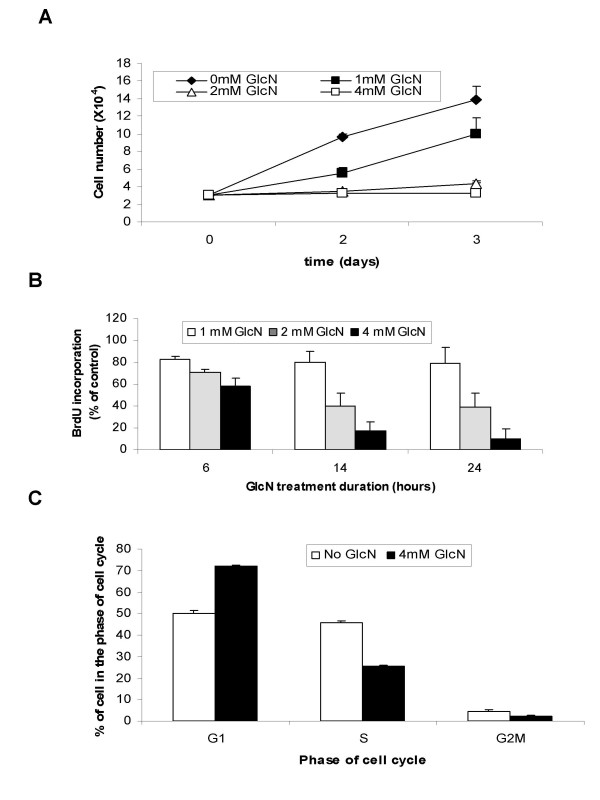
Glucosamine is known as a toxic agent for several malignant cell lines and transplanted tumors with little toxicity to normal host tissues. However, the mechanisms underlying anticancer activity of glucosamine are poorly understood. To study the mechanisms, the human prostate cancer DU145 cells were used for the model.
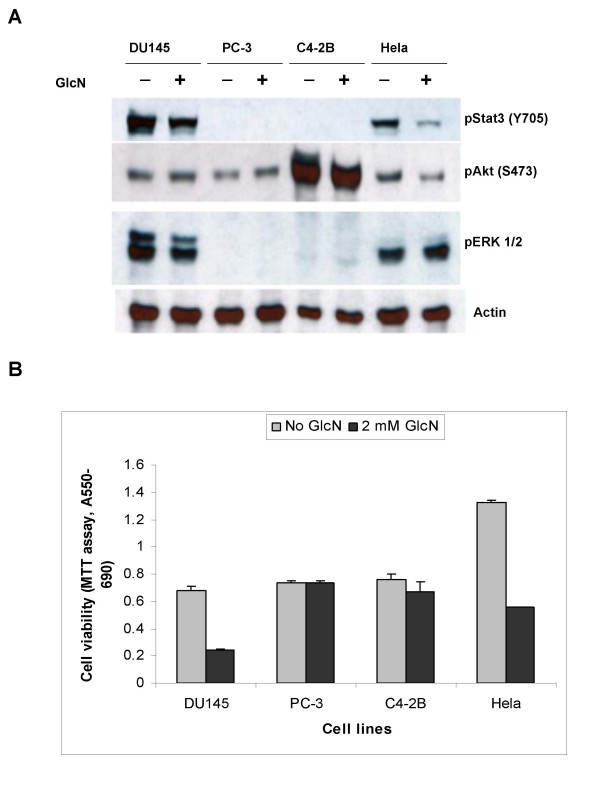
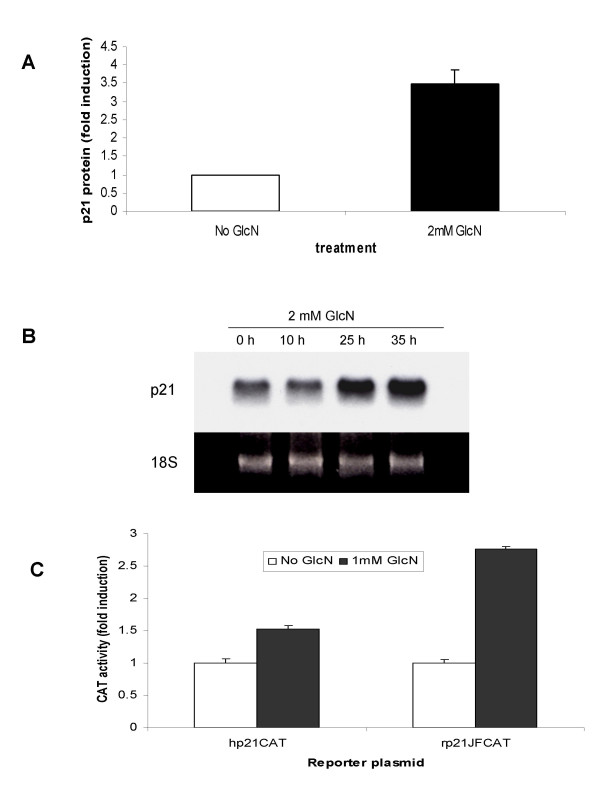
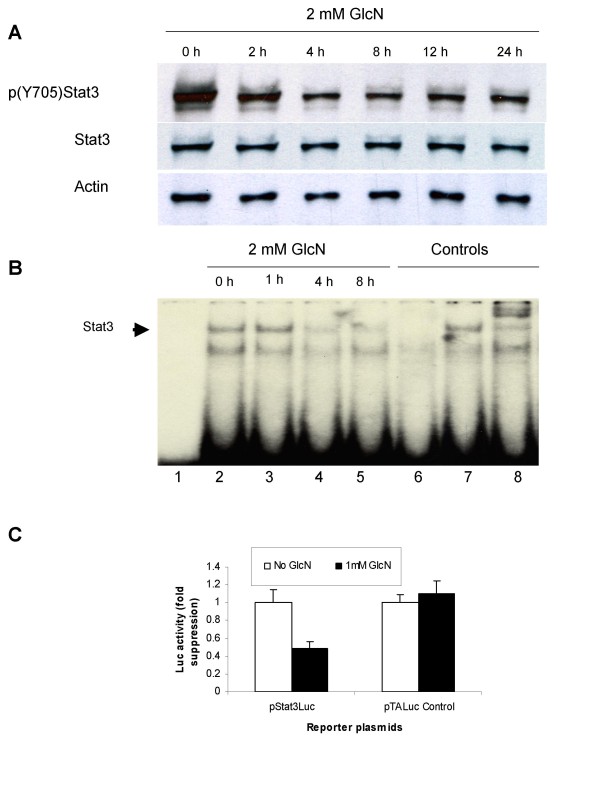
Glucosamine at concentration 2 mM suppressed proliferation and induced death of DU145 cells. Detailed analysis showed that glucosamine decreased DNA synthesis, arrested cell cycle at G1 phase and induced apoptosis. The effects of glucosamine were associated with up-regulation of p21waf1/cip, a CDK inhibitor. Our further studies identified glucosamine as an inhibitor of signal transducer and activator of transcription (STAT) 3 which is constitutively activated in many cancer cells including DU145 cells. Glucosamine inhibited phosphorylation of STAT3 at the Tyr705 residue and as a result, reduced STAT3 DNA binding and transcriptional activities. Indeed, the expression of apoptosis inhibitor survivin, which is well known target of STAT3, was suppressed. Contrary to DU145 cells, glucosamine did not affect proliferation of other human prostate cancer PC-3 and C4-2B cells, in which STAT 3 signal pathway is not constitutively active.
Our data identifies glucosamine as a suppressor of STAT3 signaling and suggests that anticancer activity of glucosamine may be attributed to the suppression of STAT3 activity. Potential application of glucosamine for the treatment of tumors with constitutively active STAT3 is proposed.
氨基葡萄糖被认为是几种恶性细胞系和移植肿瘤的毒性剂,对正常宿主组织毒性很小。然而,氨基葡萄糖抗癌活性的潜在机制仍知之甚少。为了研究这些机制,我们使用人前列腺癌DU145细胞作为模型。
2 mM浓度的氨基葡萄糖抑制DU145细胞的增殖并诱导其死亡。详细分析表明,氨基葡萄糖减少DNA合成,使细胞周期停滞在G1期并诱导细胞凋亡。氨基葡萄糖的作用与细胞周期蛋白依赖性激酶抑制剂p21waf1/cip的上调有关。我们进一步的研究确定氨基葡萄糖是信号转导子和转录激活子(STAT)3的抑制剂,STAT3在包括DU145细胞在内的许多癌细胞中持续激活。氨基葡萄糖抑制STAT3在Tyr705位点的磷酸化,结果降低了STAT3与DNA的结合及转录活性。事实上,凋亡抑制因子survivin(STAT3的一个已知靶点)的表达受到抑制。与DU145细胞相反,氨基葡萄糖不影响其他人类前列腺癌PC-3和C4-2B细胞的增殖,在这些细胞中STAT 3信号通路没有持续激活。
我们的数据确定氨基葡萄糖是STAT3信号的抑制剂,并表明氨基葡萄糖的抗癌活性可能归因于对STAT3活性的抑制。我们提出了氨基葡萄糖在治疗STAT3持续激活的肿瘤方面的潜在应用。