Xiao Xiaodong, Chen Weizao, Feng Yang, Zhu Zhongyu, Prabakaran Ponraj, Wang Yanping, Zhang Mei-Yun, Longo Nancy S, Dimitrov Dimiter S
Protein Interactions Group, CCRNP, NCI-Frederick, NIH, Frederick, MD 21702, USA.
Biochem Biophys Res Commun. 2009 Dec 18;390(3):404-9. doi: 10.1016/j.bbrc.2009.09.029. Epub 2009 Sep 11.
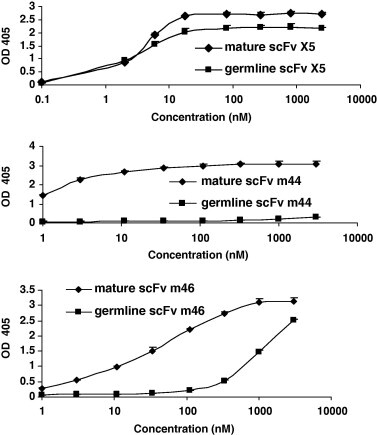
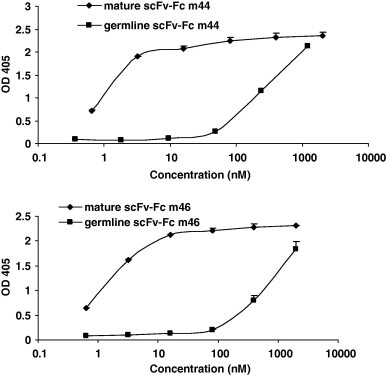
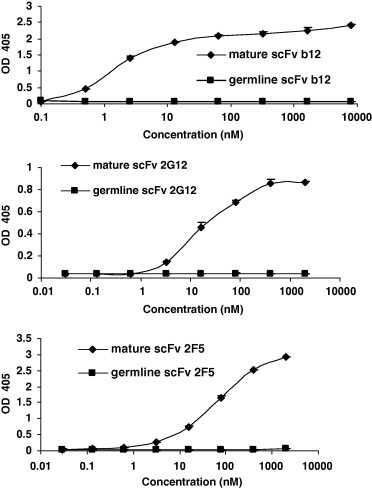
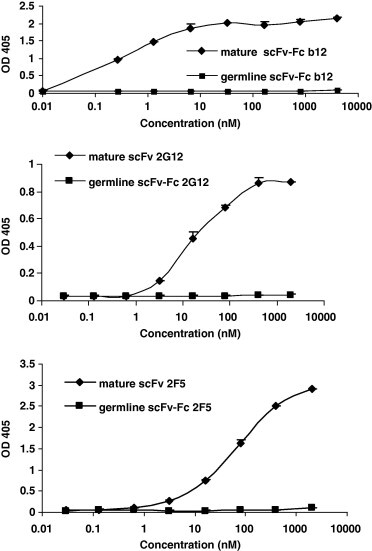
Several human monoclonal antibodies (hmAbs) including b12, 2G12, and 2F5 exhibit relatively potent and broad HIV-1-neutralizing activity. However, their elicitation in vivo by vaccine immunogens based on the HIV-1 envelope glycoprotein (Env) has not been successful. We have hypothesized that HIV-1 has evolved a strategy to reduce or eliminate the immunogenicity of the highly conserved epitopes of such antibodies by using "holes" (absence or very weak binding to these epitopes of germline antibodies that is not sufficient to initiate and/or maintain an efficient immune response) in the human germline B cell receptor (BCR) repertoire. To begin to test this hypothesis we have designed germline-like antibodies corresponding most closely to b12, 2G12, and 2F5 as well as to X5, m44, and m46 which are cross-reactive but with relatively modest neutralizing activity as natively occurring antibodies due to size and/or other effects. The germline-like X5, m44, and m46 bound with relatively high affinity to all tested Envs. In contrast, germline-like b12, 2G12, and 2F5 lacked measurable binding to Envs in an ELISA assay although the corresponding mature antibodies did. These results provide initial evidence that Env structures containing conserved vulnerable epitopes may not initiate humoral responses by binding to germline antibodies. Even if such responses are initiated by very weak binding undetectable in our assay it is likely that they will be outcompeted by responses to structures containing the epitopes of X5, m44, m46, and other antibodies that bind germline BCRs with much higher affinity/avidity. This hypothesis, if further supported by data, could contribute to our understanding of how HIV-1 evades immune responses and offer new concepts for design of effective vaccine immunogens.
包括b12、2G12和2F5在内的几种人源单克隆抗体(hmAbs)表现出相对较强且广泛的HIV-1中和活性。然而,基于HIV-1包膜糖蛋白(Env)的疫苗免疫原在体内诱导产生这些抗体的尝试尚未成功。我们推测,HIV-1已经进化出一种策略,通过利用人类种系B细胞受体(BCR)库中的“空洞”(即种系抗体对这些表位缺乏或仅有非常弱的结合,不足以启动和/或维持有效的免疫反应)来降低或消除此类抗体高度保守表位的免疫原性。为了开始验证这一假设,我们设计了与b12、2G12和2F5以及X5、m44和m46最接近的种系样抗体,X5、m44和m46具有交叉反应性,但作为天然存在的抗体,由于大小和/或其他效应,其中和活性相对较弱。种系样的X5、m44和m46与所有测试的Env具有相对较高的亲和力结合。相比之下,种系样的b12、2G12和2F5在ELISA检测中与Env缺乏可检测到的结合,尽管相应的成熟抗体能够结合。这些结果提供了初步证据,表明含有保守易损表位的Env结构可能不会通过与种系抗体结合来启动体液免疫反应。即使这种反应是由我们检测中无法检测到的非常弱的结合引发的,很可能它们会被对含有X5、m44、m46和其他与种系BCR具有更高亲和力/亲合力的抗体表位的结构的反应所竞争。如果这一假设得到进一步数据支持,可能有助于我们理解HIV-1如何逃避免疫反应,并为设计有效的疫苗免疫原提供新的概念。