Bölke E, Orth K, Gerber P A, Lammering G, Mota R, Peiper M, Matuschek C, Budach W, Rusnak E, Shaikh S, Dogan B, Prisack H B, Bojar Hans
Department of Radiation Therapy and Radiation Oncology, University of Düsseldorf, Düsseldorf, Germany.
Eur J Med Res. 2009 Sep 28;14(10):426-32. doi: 10.1186/2047-783x-14-10-426.
The diagnostic tools to predict the prognosis in patients suffering from breast cancer (BC) need further improvements. New technological achievements like the gene profiling of circulating tumour cells (CTC) could help identify new prognostic markers in the clinical setting. Furthermore, gene expression patterns of CTC might provide important informations on the mechanisms of tumour cell metastasation.
We performed realtime-PCR and multiplex-PCR analyses following immunomagnetic separation of CTC. Peripheral blood (PB) samples of 63 patients with breast cancer of various stages were analyzed and compared to a control group of 14 healthy individuals. After reverse-transcription, we performed multiplex PCR using primers for the genes ga733.3, muc-1 and c-erbB2. Mammaglobin1, spdef and c-erbB2 were analyzed applying realtime-PCR.
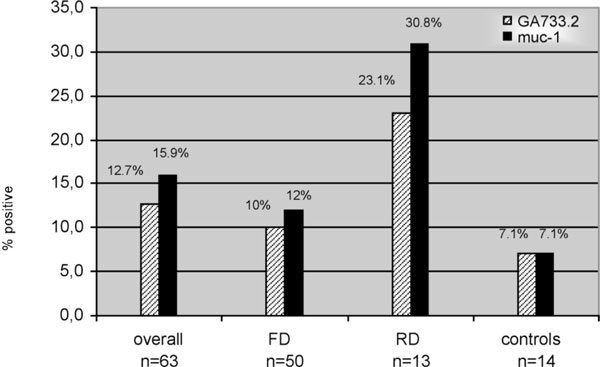
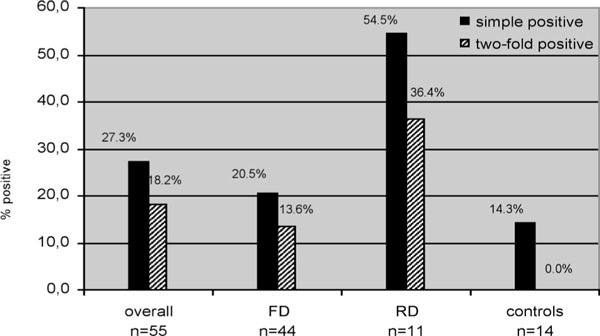
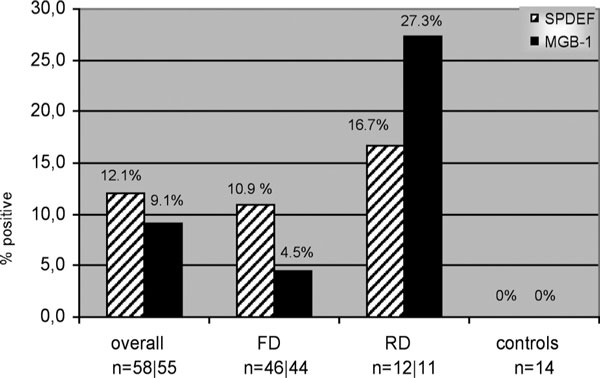
ga733.2 overexpression was found in 12.7% of breast cancer cases, muc-1 in 15.9%, mgb1 in 9.1% and spdef in 12.1%. In this study, c-erbB2 did not show any significant correlation to BC, possibly due to a highly ambient expression. Besides single gene analyses, gene profiles were additionally evaluated. Highly significant correlations to BC were found in single gene analyses of ga733.2 and muc-1 and in gene profile analyses of ga733.3muc-1 and GA7 ga733.3muc-1mgb1spdef.
Our study reveals that the single genes ga733.3, muc-1 and the gene profiles ga733.3muc-1 and ga733.33muc-1mgb1spdef can serve as markers for the detection of CTC in BC. The multigene analyses found highly positive levels in BC patients. Our study indicates that not single gene analyses but subtle patterns of multiple genes lead to rising accuracy and low loss of specificity in detection of breast cancer cases.
预测乳腺癌(BC)患者预后的诊断工具需要进一步改进。循环肿瘤细胞(CTC)基因谱分析等新技术成果有助于在临床环境中识别新的预后标志物。此外,CTC的基因表达模式可能为肿瘤细胞转移机制提供重要信息。
我们在对CTC进行免疫磁分离后进行了实时PCR和多重PCR分析。分析了63例不同分期乳腺癌患者的外周血(PB)样本,并与14名健康个体的对照组进行比较。逆转录后,我们使用针对基因ga733.3、muc-1和c-erbB2的引物进行多重PCR。应用实时PCR分析乳腺珠蛋白1、spdef和c-erbB2。
在12.7%的乳腺癌病例中发现ga733.2过表达,15.9%的病例中发现muc-1过表达,9.1%的病例中发现mgb1过表达,12.1%的病例中发现spdef过表达。在本研究中,c-erbB2与BC无显著相关性,可能是由于其表达高度普遍。除了单基因分析外,还对基因谱进行了评估。在ga733.2和muc-1的单基因分析以及ga733.3muc-1和GA7 ga733.3muc-1mgb1spdef的基因谱分析中发现与BC有高度显著相关性。
我们的研究表明,单基因ga733.3、muc-1以及基因谱ga733.3muc-1和ga733.33muc-1mgb1spdef可作为检测BC中CTC的标志物。多基因分析在BC患者中发现了高度阳性水平。我们的研究表明,在检测乳腺癌病例时,不是单基因分析而是多个基因的细微模式导致准确性提高和特异性损失降低。