La Merrill Michele, Kuruvilla Bittu S, Pomp Daniel, Birnbaum Linda S, Threadgill David W
Department of Genetics, Center for Environmental Health and Susceptibility, University of North Carolina at Chapel Hill, Chapel Hill, NC 27695, USA.
Environ Health Perspect. 2009 Sep;117(9):1414-9. doi: 10.1289/ehp.0800530. Epub 2009 May 18.
Increased fat intake is associated with obesity and may make obese individuals uniquely susceptible to the effects of lipophilic aryl hydrocarbon receptor (AHR) ligands.
We investigated the consequences of high-fat diet (HFD) and AHR ligands on body composition, mammary development, and hepatic P450 expression.
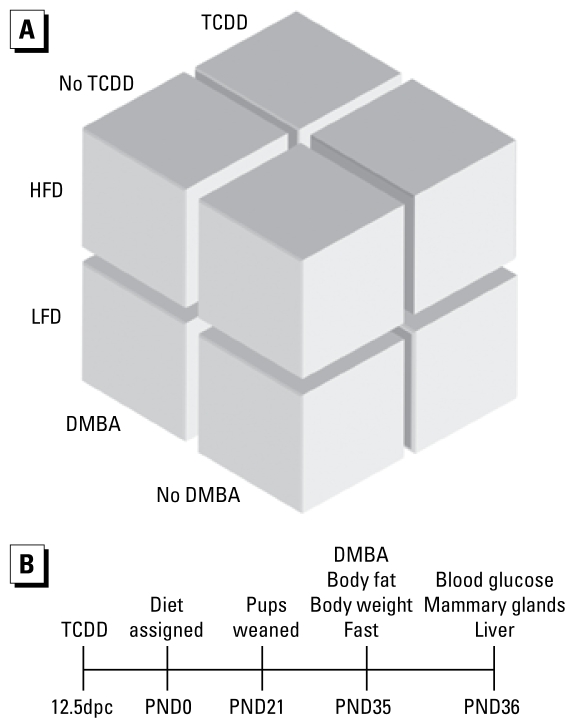
Pregnant C57BL/6J (B6) and DBA/2J (D2) dams, respectively expressing high- or low-responsive AHR, were dosed at mid-gestation with TCDD. At parturition, mice were placed on an HFD or a low-fat diet (LFD). Body fat of progeny was measured before dosing with 7,12-dimethylbenz[a]anthracene (DMBA). Fasting blood glucose was measured, and liver and mammary glands were analyzed.
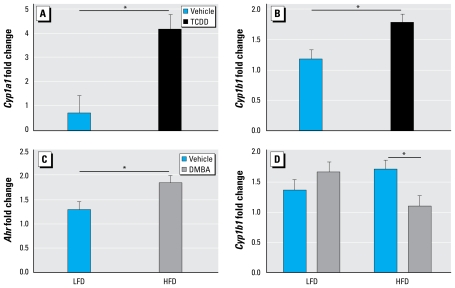
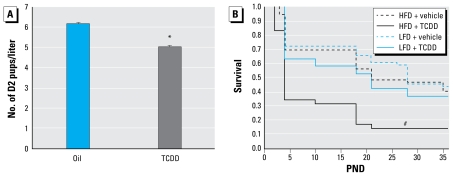
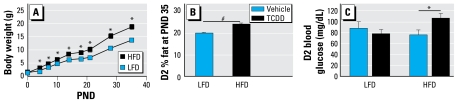
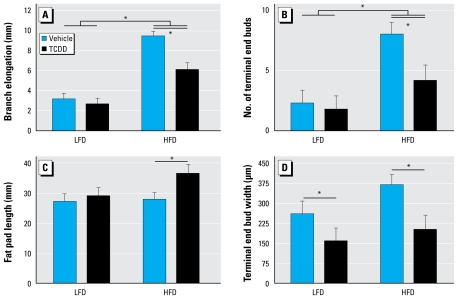
Maternal TCDD exposure resulted in reduced litter size in D2 mice and, on HFD, reduced postpartum survival in B6 mice. In D2 mice, HFD increased body mass and fat in off-spring, induced precocious mammary gland development, and increased AHR expression compared with mice given an LFD. Maternal TCDD exposure increased hepatic Cyp1a1 and Cyp1b1 expression in offspring on both diets, but DMBA depressed Cyp1b1 expression only in mice fed an HFD. In D2 progeny, TCDD exposure decreased mammary terminal end bud size, and DMBA exposure decreased the number of terminal end buds. Only in D2 progeny fed HFD did perinatal TCDD increase blood glucose and the size of mammary fat pads, while decreasing both branch elongation and the number of terminal end buds.
We conclude that despite having a low-responsive AHR, D2 progeny fed a diet similar to that consumed by most people are susceptible to TCDD and DMBA exposure effects blood glucose levels, mammary differentiation, and hepatic Cyp1 expression.
脂肪摄入量增加与肥胖相关,可能使肥胖个体对亲脂性芳烃受体(AHR)配体的影响格外敏感。
我们研究了高脂饮食(HFD)和AHR配体对身体组成、乳腺发育及肝脏P450表达的影响。
分别表达高反应性或低反应性AHR的妊娠C57BL/6J(B6)和DBA/2J(D2)母鼠在妊娠中期给予TCDD。分娩时,将小鼠置于高脂饮食或低脂饮食(LFD)中。在用7,12-二甲基苯并[a]蒽(DMBA)给药前测量子代的体脂。测量空腹血糖,并对肝脏和乳腺进行分析。
母体暴露于TCDD导致D2小鼠产仔数减少,且在高脂饮食条件下,B6小鼠产后存活率降低。在D2小鼠中,与给予低脂饮食的小鼠相比,高脂饮食增加了子代的体重和脂肪,诱导了乳腺早熟发育,并增加了AHR表达。母体暴露于TCDD使两种饮食条件下子代的肝脏Cyp1a1和Cyp1b1表达增加,但DMBA仅使高脂饮食喂养的小鼠Cyp1b1表达降低。在D2子代中,TCDD暴露减小了乳腺终末芽的大小,而DMBA暴露减少了终末芽的数量。仅在高脂饮食喂养的D2子代中,围产期TCDD增加了血糖和乳腺脂肪垫的大小,同时减少了分支伸长和终末芽的数量。
我们得出结论,尽管D2子代的AHR反应性较低,但喂食与大多数人相似饮食的D2子代易受TCDD和DMBA暴露的影响,从而影响血糖水平、乳腺分化和肝脏Cyp1表达。