Department of Genetics, Center for Environmental and Health Susceptibility, Lineberger Cancer Center, University of North Carolina-Chapel Hill, Chapel Hill, North Carolina, USA.
Environ Health Perspect. 2010 May;118(5):596-601. doi: 10.1289/ehp.0901047.
RESULTS from previous studies have suggested that breast cancer risk correlates with total lifetime exposure to estrogens and that early-life 2,3,7,8-tetrachlorodibenzo-p-dioxin (TCDD) exposure or diets high in fat can also increase cancer risk.
Because both TCDD and diet affect the estrogen pathway, we examined how TCDD and a high-fat diet (HFD) interact to alter breast cancer susceptibility.
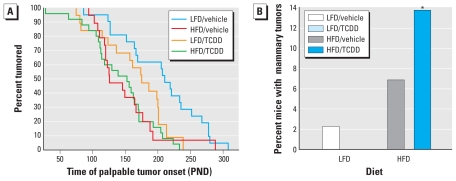
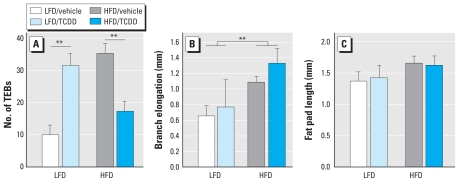
We exposed pregnant female FVB/NJ mice (12.5 days postcoitus) to 1 microg/kg TCDD or vehicle; at parturition, the dams were randomly assigned to a low-fat diet (LFD) or a high-fat diet (HFD). Female offspring were maintained on the same diets after weaning and were exposed to 7,12-dimethylbenz[a]anthracene on postnatal days (PNDs) 35, 49, and 63 to initiate mammary tumors. A second cohort of females was treated identically until PND35 or PND49, when mammary gland morphology was examined, or PND50, when mammary gland mRNA was analyzed.
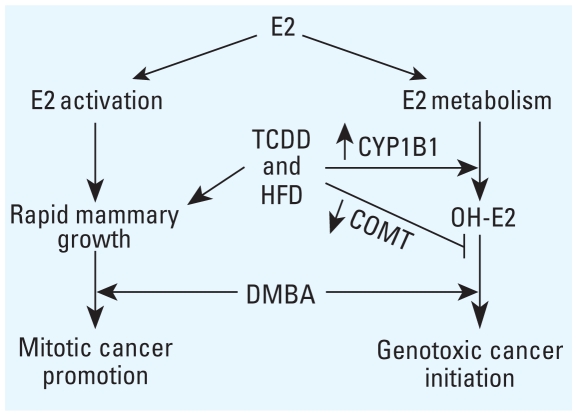
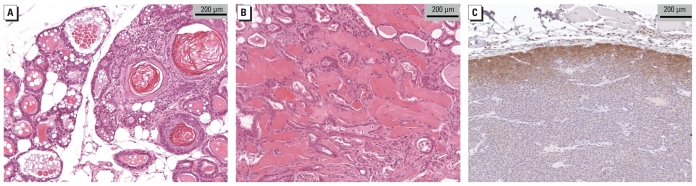
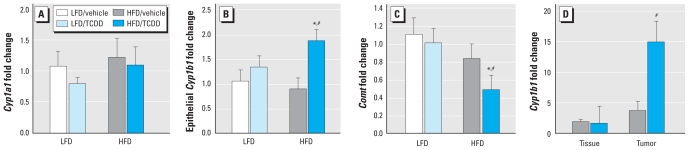
We found that maternal TCDD exposure doubled mammary tumor incidence only in mice fed the HFD. Among HFD-fed mice, maternal TCDD exposure caused rapid mammary development with increased Cyp1b1 (cytochrome P450 1B1) expression and decreased Comt (catechol-O-methyltransferase) expression in mammary tissue. Maternal TCDD exposure also increased mammary tumor Cyp1b1 expression.
Our data suggest that the HFD increases sensitivity to maternal TCDD exposure, resulting in increased breast cancer incidence, by changing metabolism capability. These results provide a mechanism to explain epidemiological data linking early-life TCDD exposure and diets high in fat to increased risk for breast cancer in humans.
先前的研究结果表明,乳腺癌风险与雌激素的终生总暴露量相关,而且,早期生活中接触 2,3,7,8-四氯二苯并对二恶英(TCDD)或高脂肪饮食也会增加癌症风险。
由于 TCDD 和饮食都会影响雌激素途径,我们研究了 TCDD 和高脂肪饮食(HFD)如何相互作用改变乳腺癌易感性。
我们用 1 微克/千克 TCDD 或载体处理怀孕的 FVB/NJ 小鼠(交配后 12.5 天);在分娩时,将母体随机分配到低脂饮食(LFD)或高脂肪饮食(HFD)。雌性后代在断奶后继续接受相同的饮食,并在产后第 35、49 和 63 天接受 7,12-二甲基苯并[a]蒽(DMBA)处理以启动乳腺肿瘤。第二组雌性动物接受相同的处理,直到产后第 35 天或第 49 天检查乳腺形态,或产后第 50 天分析乳腺组织的 mRNA。
我们发现,仅在接受 HFD 的小鼠中,母体 TCDD 暴露使乳腺肿瘤发生率增加了一倍。在接受 HFD 的小鼠中,母体 TCDD 暴露导致乳腺快速发育,乳腺组织中 Cyp1b1(细胞色素 P450 1B1)表达增加,Comt(儿茶酚-O-甲基转移酶)表达减少。母体 TCDD 暴露还增加了乳腺肿瘤的 Cyp1b1 表达。
我们的数据表明,HFD 通过改变代谢能力增加了对母体 TCDD 暴露的敏感性,从而增加了乳腺癌的发病率。这些结果提供了一种机制来解释将早期生活中 TCDD 暴露和高脂肪饮食与人类乳腺癌风险增加联系起来的流行病学数据。