Temple University, Philadelphia, PA 19122, USA.
Child Dev. 2009 Sep-Oct;80(5):1360-75. doi: 10.1111/j.1467-8624.2009.01338.x.
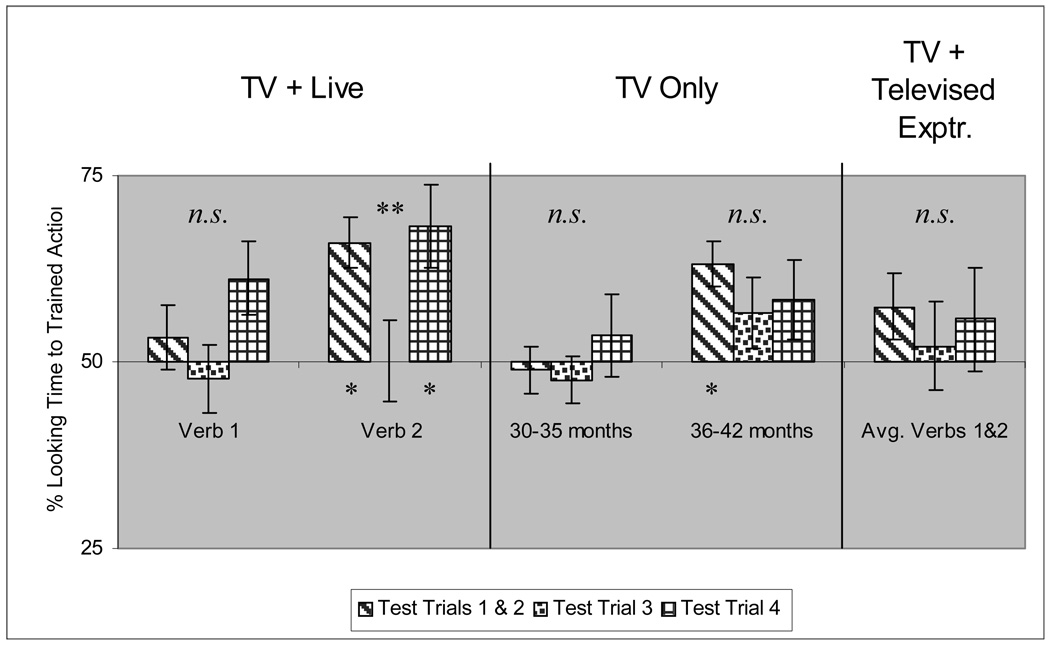
The availability of educational programming aimed at infants and toddlers is increasing, yet the effect of video on language acquisition remains unclear. Three studies of 96 children aged 30-42 months investigated their ability to learn verbs from video. Study 1 asked whether children could learn verbs from video when supported by live social interaction. Study 2 tested whether children could learn verbs from video alone. Study 3 clarified whether the benefits of social interaction remained when the experimenter was shown on a video screen rather than in person. Results suggest that younger children only learn verbs from video with live social interaction whereas older children can learn verbs from video alone. Implications for verb learning and educational media are discussed.
针对婴儿和幼儿的教育节目越来越多,但视频对语言习得的影响仍不清楚。有三项研究调查了 96 名 30-42 个月大的儿童从视频中学习动词的能力。研究 1 询问了在有现场社会互动支持的情况下,儿童是否可以从视频中学习动词。研究 2 测试了儿童是否可以仅通过视频学习动词。研究 3 澄清了当实验者出现在视频屏幕上而不是亲自出现时,社交互动的好处是否仍然存在。结果表明,年幼的孩子只有在有现场社会互动的情况下才能从视频中学到动词,而年龄较大的孩子可以仅通过视频学习动词。讨论了动词学习和教育媒体的含义。