EA 3620 MRT, Descartes University, Paris, France.
Retrovirology. 2009 Sep 19;6:85. doi: 10.1186/1742-4690-6-85.
Primary-HIV-1-infection in newborns that occurs under antiretroviral prophylaxis that is a high risk of drug-resistance acquisition. We examine the frequency and the mechanisms of resistance acquisition at the time of infection in newborns.
We studied HIV-1-infected infants born between 01 January 1997 and 31 December 2004 and enrolled in the ANRS-EPF cohort. HIV-1-RNA and HIV-1-DNA samples obtained perinatally from the newborn and mother were subjected to population-based and clonal analyses of drug resistance. If positive, serial samples were obtained from the child for resistance testing.
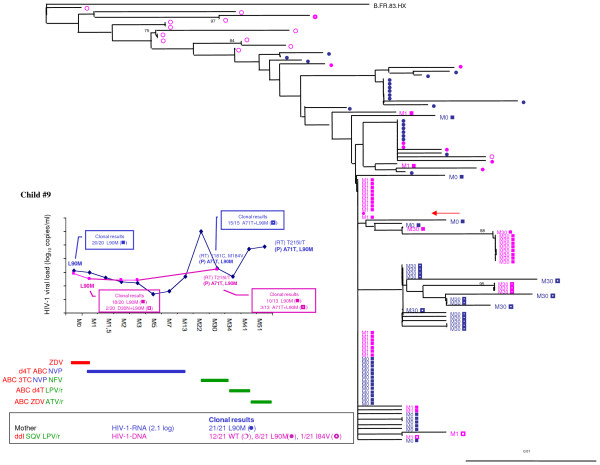
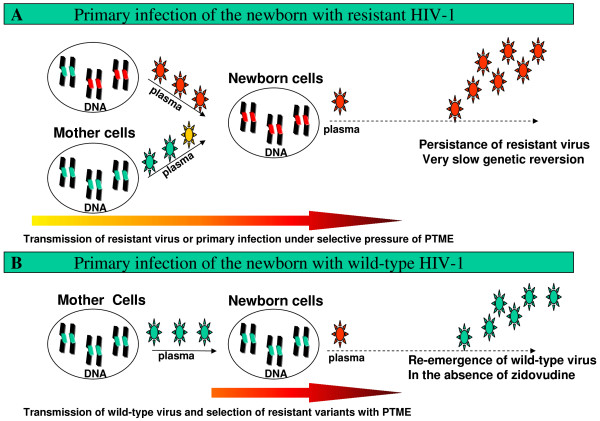
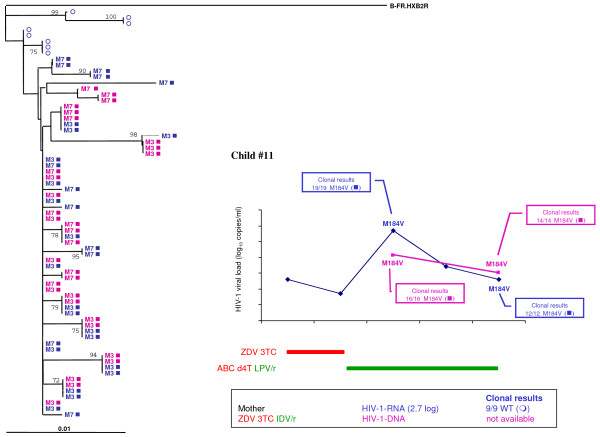
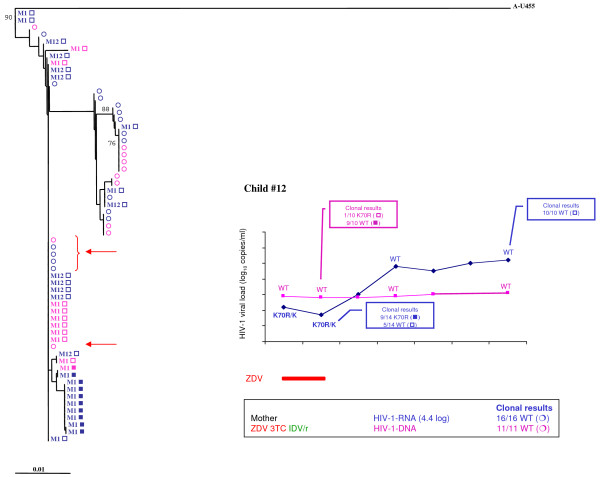
Ninety-two HIV-1-infected infants were born during the study period. Samples were obtained from 32 mother-child pairs and from another 28 newborns. Drug resistance was detected in 12 newborns (20%): drug resistance to nucleoside reverse transcriptase inhibitors was seen in 10 cases, non-nucleoside reverse transcriptase inhibitors in two cases, and protease inhibitors in one case. For 9 children, the detection of the same resistance mutations in mothers' samples (6 among 10 available) and in newborn lymphocytes (6/8) suggests that the newborn was initially infected by a drug-resistant strain. Resistance variants were either transmitted from mother-to-child or selected during subsequent temporal exposure under suboptimal perinatal prophylaxis. Follow-up studies of the infants showed that the resistance pattern remained stable over time, regardless of antiretroviral therapy, suggesting the early cellular archiving of resistant viruses. The absence of resistance in the mother of the other three children (3/10) and neonatal lymphocytes (2/8) suggests that the newborns were infected by a wild-type strain without long-term persistence of resistance when suboptimal prophylaxis was stopped.
This study confirms the importance of early resistance genotyping of HIV-1-infected newborns. In most cases (75%), drug resistance was archived in the cellular reservoir and persisted during infancy, with or without antiretroviral treatment. This finding stresses the need for effective antiretroviral treatment of pregnant women.
在接受抗逆转录病毒预防的情况下,新生儿原发性 HIV-1 感染具有很高的耐药风险。我们检查了新生儿感染时耐药获得的频率和机制。
我们研究了 1997 年 1 月 1 日至 2004 年 12 月 31 日期间出生的感染 HIV-1 的婴儿,并纳入了 ANRS-EPF 队列。从新生儿及其母亲获得的围产期 HIV-1-RNA 和 HIV-1-DNA 样本进行了耐药性的基于人群和克隆分析。如果阳性,从孩子身上获得了一系列用于耐药性检测的样本。
在研究期间,有 92 名 HIV-1 感染的婴儿出生。从 32 对母婴对和另外 28 名新生儿中获得了样本。在 12 名新生儿中检测到耐药性(20%):10 例存在核苷逆转录酶抑制剂耐药,2 例存在非核苷逆转录酶抑制剂耐药,1 例存在蛋白酶抑制剂耐药。对于 9 名儿童,在母亲样本(10 个中 6 个)和新生儿淋巴细胞(8 个中 6 个)中检测到相同的耐药突变表明,新生儿最初感染了耐药株。耐药变体要么是从母亲传给孩子的,要么是在随后的亚最佳围产期预防期间选择的。对婴儿的后续研究表明,无论是否接受抗逆转录病毒治疗,耐药模式随时间保持稳定,表明耐药病毒的早期细胞存档。在另外 3 名儿童的母亲(3/10)和新生儿淋巴细胞(2/8)中没有发现耐药性,这表明在停止亚最佳预防时,新生儿被野生型株感染,并且没有长期耐药性持续存在。
这项研究证实了对感染 HIV-1 的新生儿进行早期耐药基因分型的重要性。在大多数情况下(75%),耐药性被存档在细胞储库中,并在婴儿期持续存在,无论是否接受抗逆转录病毒治疗。这一发现强调了需要对孕妇进行有效的抗逆转录病毒治疗。