Hedström Erik, Engblom Henrik, Frogner Fredrik, Aström-Olsson Karin, Ohlin Hans, Jovinge Stefan, Arheden Håkan
Department of Clinical Physiology, Lund University Hospital, SE-221 85 Lund, Sweden.
J Cardiovasc Magn Reson. 2009 Sep 23;11(1):38. doi: 10.1186/1532-429X-11-38.
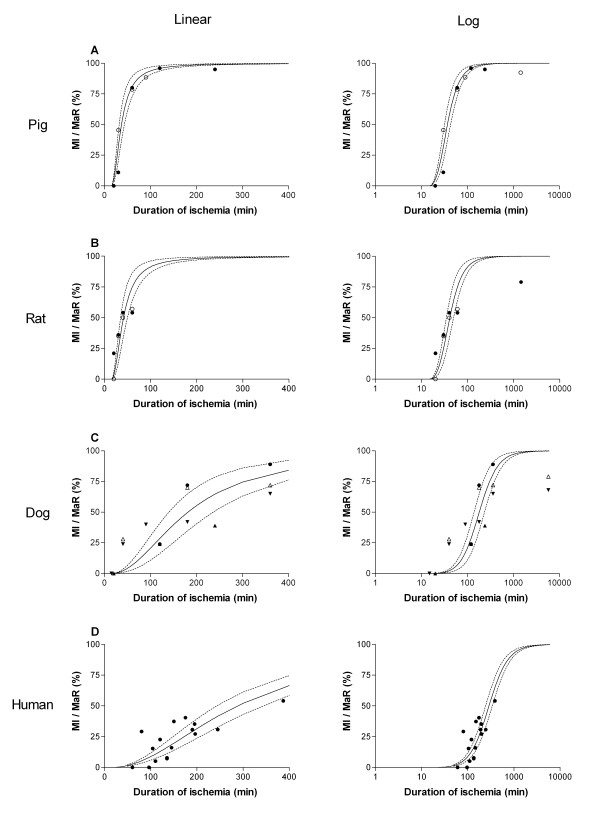
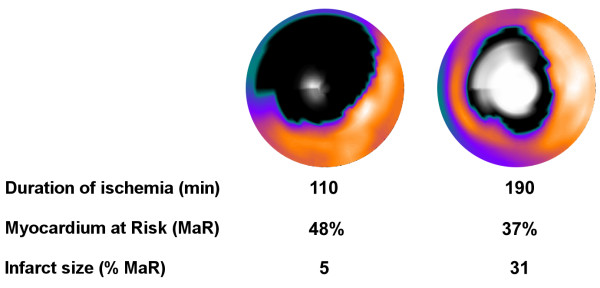
The time course of infarct evolution, i.e. how fast myocardial infarction (MI) develops during coronary artery occlusion, is well known for several species, whereas no direct evidence exists on the evolution of MI size normalized to myocardium at risk (MaR) in man. Despite the lack of direct evidence, current literature often refers to the "golden hour" as the time during which myocardial salvage can be accomplished by reperfusion therapy. Therefore, the aim of the present study was to investigate how duration of myocardial ischemia affects infarct evolution in man in relation to previous animal data. Consecutive patients with clinical signs of acute myocardial ischemia were screened and considered for enrollment. Particular care was taken to assure uniformity of the patients enrolled with regard to old MI, success of revascularization, collateral flow, release of biochemical markers prior to intervention etc. Sixteen patients were ultimately included in the study. Myocardium at risk was assessed acutely by acute myocardial perfusion single photon emission computed tomography (MPS) and by T2 imaging (T2-STIR) cardiovascular magnetic resonance (CMR) after one week in 10 of the 16 patients. Infarct size was measured by late gadolinium enhancement (LGE) at one week.
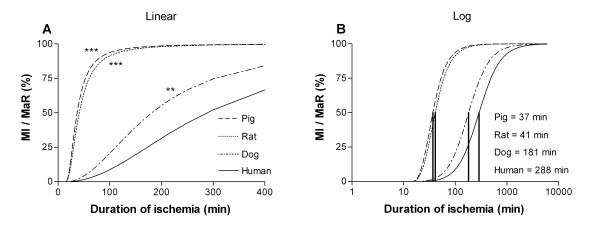
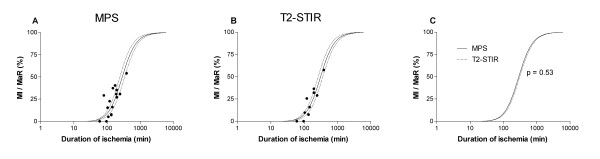
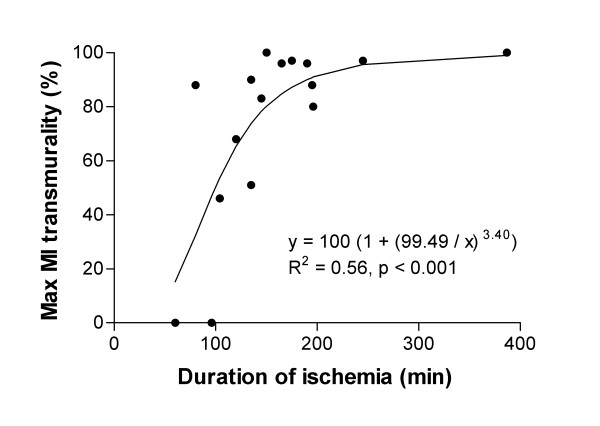
The time to reach 50% MI of the MaR (T50) was significantly shorter in pigs (37 min), rats (41 min) and dogs (181 min) compared to humans (288 min). There was no significant difference in T50 when using MPS compared to T2-STIR (p = 0.53) for assessment of MaR (288 +/- 23 min vs 310 +/- 22 min, T50 +/- standard error). The transmural extent of MI increased progressively as the duration of ischemia increased (R2 = 0.56, p < 0.001).
This is the first study to provide direct evidence of the time course of acute myocardial infarct evolution in relation to MaR in man with first-time MI. Infarct evolution in man is significantly slower than in pigs, rats and dogs. Furthermore, infarct evolution assessments in man are similar when using MPS acutely and T2-STIR one week later for determination of MaR, which significantly facilitates future clinical trials of cardioprotective therapies in acute coronary syndrome by the use of CMR.
梗死演变的时间进程,即冠状动脉闭塞期间心肌梗死(MI)发展的速度,在多个物种中已为人熟知,但目前尚无直接证据表明人类中梗死面积相对于危险心肌(MaR)的演变情况。尽管缺乏直接证据,但当前文献常将“黄金一小时”作为可通过再灌注治疗实现心肌挽救的时间段。因此,本研究的目的是根据先前的动物数据,研究心肌缺血持续时间如何影响人类梗死的演变。对有急性心肌缺血临床症状的连续患者进行筛查并考虑纳入研究。特别注意确保纳入患者在陈旧性心肌梗死、血管重建成功率、侧支血流、干预前生化标志物释放等方面的一致性。最终16例患者被纳入研究。16例患者中的10例在急性心肌灌注单光子发射计算机断层扫描(MPS)时急性评估危险心肌,并在一周后通过心血管磁共振(CMR)的T2成像(T2-STIR)进行评估。梗死面积在一周时通过延迟钆增强(LGE)测量。
与人类(288分钟)相比,猪(37分钟)、大鼠(41分钟)和狗(181分钟)达到MaR的50%梗死(T50)所需时间明显更短。使用MPS与T2-STIR评估MaR时,T50无显著差异(p = 0.53)(288±23分钟对310±22分钟,T50±标准误差)。随着缺血持续时间的增加,MI的透壁范围逐渐增加(R2 = 0.56,p < 0.001)。
这是第一项提供首次发生MI的人类急性心肌梗死演变时间进程与MaR相关直接证据的研究。人类梗死演变明显慢于猪、大鼠和狗。此外,在急性时使用MPS和一周后使用T2-STIR测定MaR时,人类梗死演变评估结果相似,这显著促进了未来通过CMR进行急性冠状动脉综合征心脏保护治疗的临床试验。