Institute of Cell and Molecular Biosciences (ICaMB), University of Newcastle, Newcastle upon Tyne, NE2 4HH, UK.
Nucleic Acids Res. 2009 Dec;37(22):7603-11. doi: 10.1093/nar/gkp800.
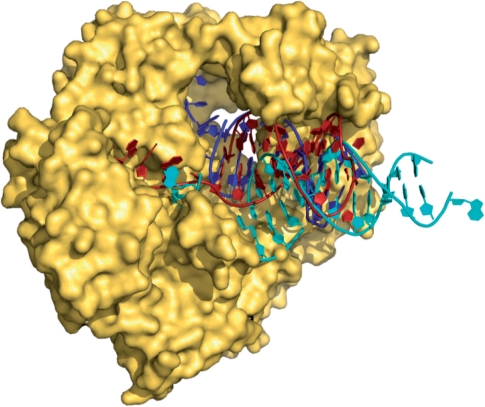
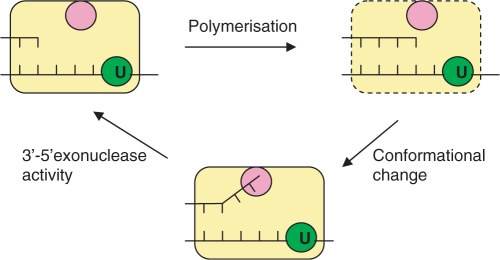
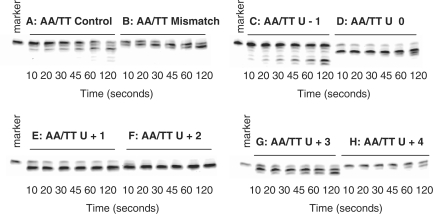
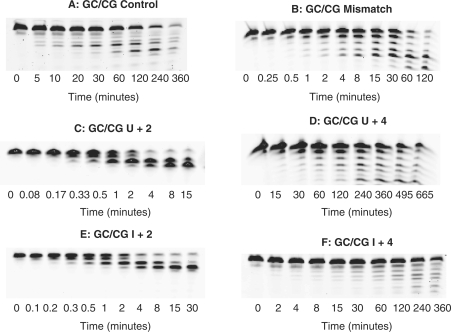
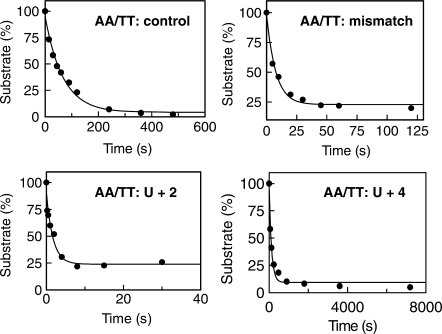
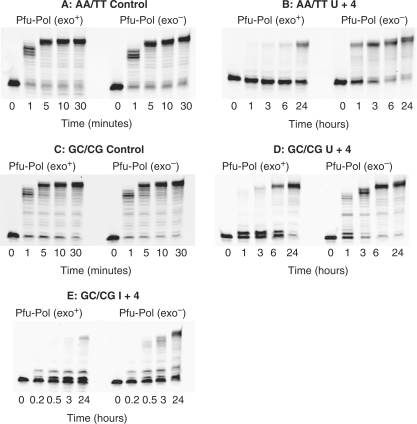
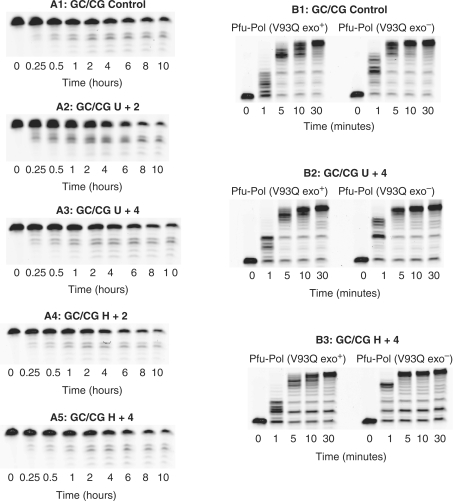
Archaeal family B polymerases bind tightly to the deaminated bases uracil and hypoxanthine in single-stranded DNA, stalling replication on encountering these pro-mutagenic deoxynucleosides four steps ahead of the primer-template junction. When uracil is specifically bound, the polymerase-DNA complex exists in the editing rather than the polymerization conformation, despite the duplex region of the primer-template being perfectly base-paired. In this article, the interplay between the 3'-5' proofreading exonuclease activity and binding of uracil/hypoxanthine is addressed, using the family-B DNA polymerase from Pyrococcus furiosus. When uracil/hypoxanthine is bound four bases ahead of the primer-template junction (+4 position), both the polymerase and the exonuclease are inhibited, profoundly for the polymerase activity. However, if the polymerase approaches closer to the deaminated bases, locating it at +3, +2, +1 or even 0 (paired with the extreme 3' base in the primer), the exonuclease activity is strongly stimulated. In these situations, the exonuclease activity is actually stronger than that seen with mismatched primer-templates, even though the deaminated base-containing primer-templates are correctly base-paired. The resulting exonucleolytic degradation of the primer serves to move the uracil/hypoxanthine away from the primer-template junction, restoring the stalling position to +4. Thus the 3'-5' proofreading exonuclease contributes to the inability of the polymerase to replicate beyond deaminated bases.
古菌 B 聚合酶紧密结合于单链 DNA 中的脱氨碱基尿嘧啶和次黄嘌呤,在遇到这些前突变性脱氧核苷时,会在引物-模板连接点前四个碱基处停止复制。当尿嘧啶被特异性结合时,尽管引物-模板的双链区域完全碱基配对,但聚合酶-DNA 复合物仍处于编辑而非聚合构象。在本文中,使用 Pyrococcus furiosus 的 B 族 DNA 聚合酶,研究了 3'-5'校对外切核酸酶活性与尿嘧啶/次黄嘌呤结合之间的相互作用。当尿嘧啶/次黄嘌呤在引物-模板连接点前四个碱基处结合(+4 位)时,聚合酶和外切核酸酶均受到抑制,尤其是聚合酶活性受到强烈抑制。然而,如果聚合酶更接近脱氨碱基,定位在+3、+2、+1 甚至 0 位(与引物的极端 3'碱基配对),则外切核酸酶活性会被强烈刺激。在这些情况下,外切核酸酶活性实际上比与错配的引物-模板更强,尽管含有脱氨碱基的引物-模板是正确配对的。由此产生的引物的外切核酸酶降解作用将尿嘧啶/次黄嘌呤从引物-模板连接点移动,将停滞位置恢复到+4。因此,3'-5'校对外切核酸酶有助于聚合酶无法在脱氨碱基之外进行复制。