• 文献检索
  • 文档翻译
  • 深度研究
  • 学术资讯
  • Suppr Zotero 插件Zotero 插件
  • 邀请有礼
  • 套餐&价格
  • 历史记录
应用&插件
Suppr Zotero 插件Zotero 插件浏览器插件Mac 客户端Windows 客户端微信小程序
定价
高级版会员购买积分包购买API积分包
服务
文献检索文档翻译深度研究API 文档MCP 服务
关于我们
关于 Suppr公司介绍联系我们用户协议隐私条款
关注我们

Suppr 超能文献

核心技术专利:CN118964589B侵权必究
粤ICP备2023148730 号-1Suppr @ 2026

文献检索

告别复杂PubMed语法,用中文像聊天一样搜索,搜遍4000万医学文献。AI智能推荐,让科研检索更轻松。

立即免费搜索

文件翻译

保留排版,准确专业,支持PDF/Word/PPT等文件格式,支持 12+语言互译。

免费翻译文档

深度研究

AI帮你快速写综述,25分钟生成高质量综述,智能提取关键信息,辅助科研写作。

立即免费体验

普遍胆红素筛查对严重高胆红素血症及光疗使用的影响。

Impact of universal bilirubin screening on severe hyperbilirubinemia and phototherapy use.

作者信息

Kuzniewicz Michael W, Escobar Gabriel J, Newman Thomas B

机构信息

Division of Neonatology, Department of Pediatrics, University of California, San Francisco, CA 94143-0748, USA.

出版信息

Pediatrics. 2009 Oct;124(4):1031-9. doi: 10.1542/peds.2008-2980. Epub 2009 Sep 28.

DOI:10.1542/peds.2008-2980
PMID:19786442
原文链接:https://pmc.ncbi.nlm.nih.gov/articles/PMC2858633/
Abstract

OBJECTIVE

The goal was to assess the impact of universal bilirubin screening on severe hyperbilirubinemia and phototherapy use.

METHODS

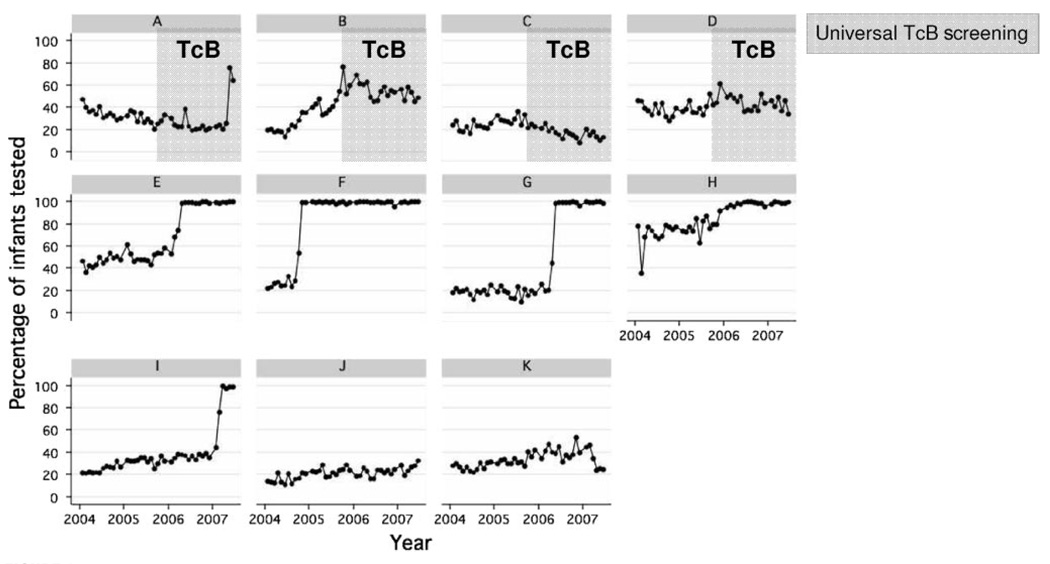
In this retrospective cohort study of 358086 infants of > or =35 weeks and > or =2000 g born between January 1, 1995, and June 30, 2007, we obtained demographic data, bilirubin levels, and codes for inpatient phototherapy from existing databases. We compared the incidence of high total serum bilirubin (TSB) levels and phototherapy before and after implementation of universal screening and examined risk factors for high TSB levels.

RESULTS

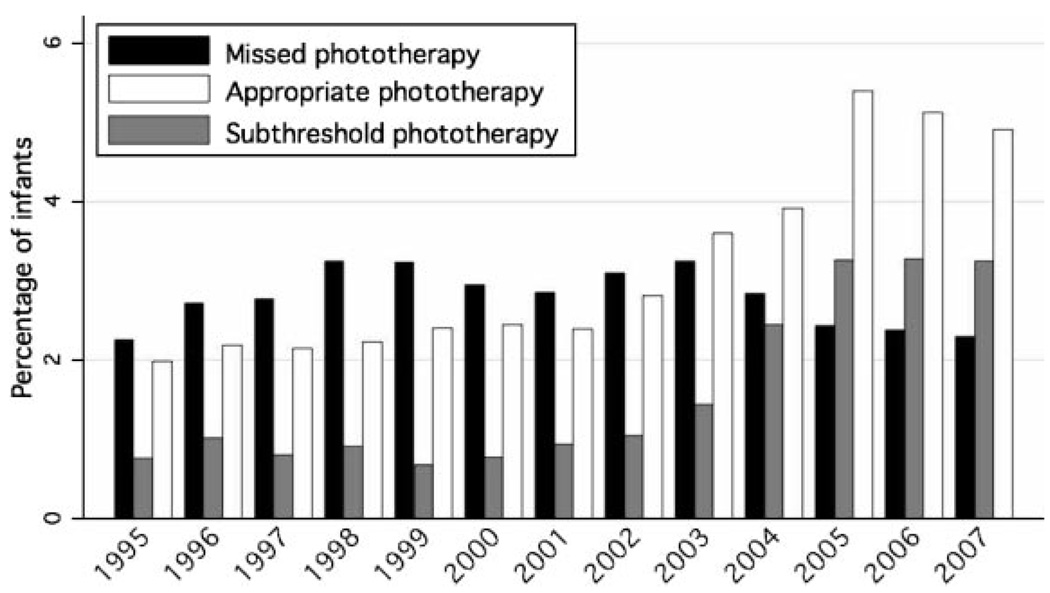
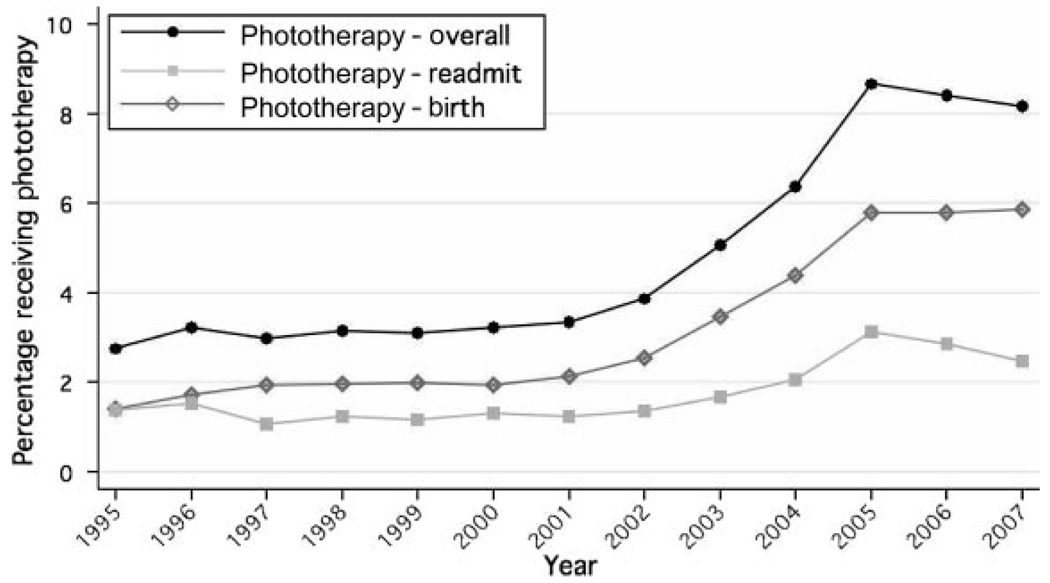
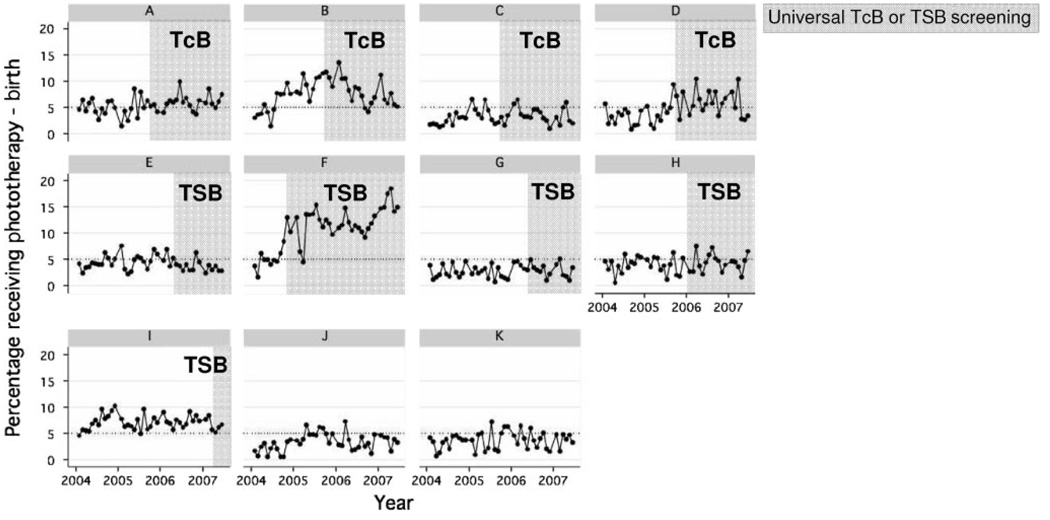
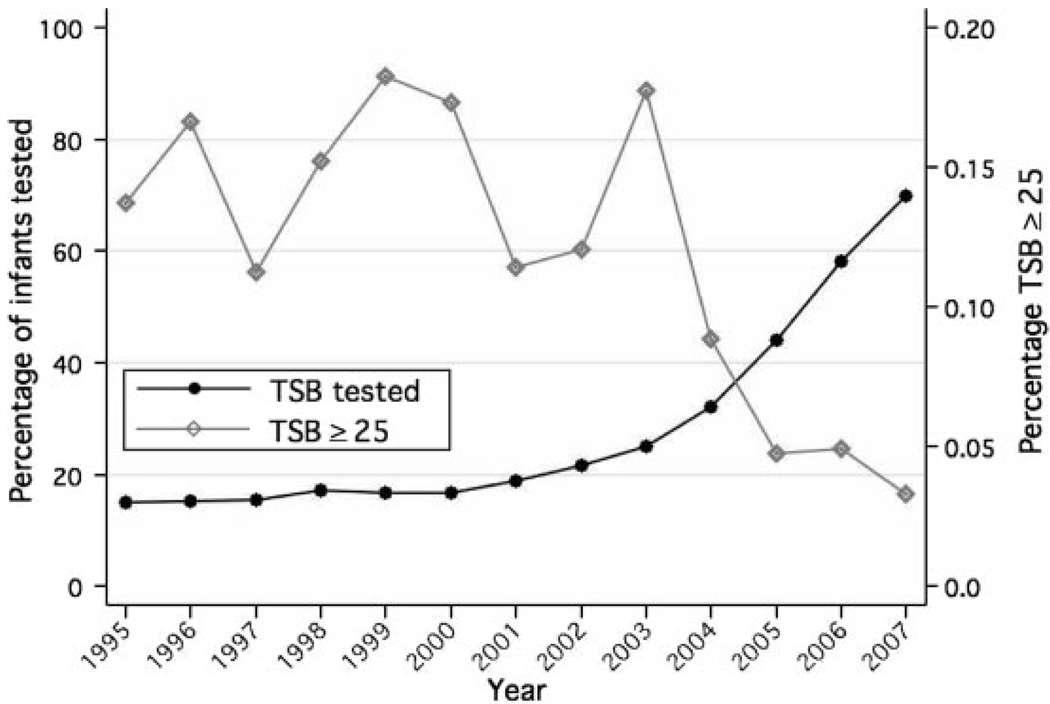
A total of 38182 infants (10.6%) were born at facilities that had implemented universal bilirubin screening. Compared with infants born at facilities that were not screening, these infants had a 62% lower incidence of TSB levels exceeding the American Academy of Pediatrics exchange guideline (0.17% vs 0.45%; P < .001), received twice the inpatient phototherapy (9.1% vs 4.2%; P < .001), and had slightly longer birth hospitalization lengths of stay (50.9 vs 48.7 hours; P < .001). Of those receiving phototherapy, 56% after initiation of universal screening had TSB levels at which phototherapy was recommended by the guideline, compared with 70% before screening. The adjusted odds ratio for developing TSB levels exceeding the guideline value was 0.28 (95% confidence interval: 0.20-0.40) for those born at a facility using TSB screening and 0.28 (95% confidence interval: 0.19-0.42) for those born at a facility using transcutaneous bilirubin screening.

CONCLUSIONS

Universal bilirubin screening was associated with a significantly lower incidence of severe hyperbilirubinemia but also with increased phototherapy use.

摘要

目的

评估普遍胆红素筛查对严重高胆红素血症及光疗使用情况的影响。

方法

在这项回顾性队列研究中,纳入了1995年1月1日至2007年6月30日期间出生的358086名孕周≥35周且出生体重≥2000克的婴儿,我们从现有数据库中获取了人口统计学数据、胆红素水平以及住院光疗编码。我们比较了普遍筛查实施前后总血清胆红素(TSB)高水平及光疗的发生率,并检查了TSB高水平的危险因素。

结果

共有38182名婴儿(10.6%)在已实施普遍胆红素筛查的机构出生。与未进行筛查机构出生的婴儿相比,这些婴儿TSB水平超过美国儿科学会换血指南的发生率低62%(0.17%对0.45%;P<.001),接受住院光疗的比例为未筛查机构出生婴儿的两倍(9.1%对4.2%;P<.001),且出生后住院时间略长(50.9小时对48.7小时;P<.001)。在接受光疗的婴儿中,普遍筛查开始后,56%的婴儿TSB水平处于指南推荐光疗的范围,而筛查前这一比例为70%。对于在使用TSB筛查的机构出生的婴儿,发生TSB水平超过指南值的校正比值比为0.28(95%置信区间:0.20 - 0.40),对于在使用经皮胆红素筛查的机构出生的婴儿,这一比值比为0.28(95%置信区间:0.19 - 0.42)。

结论

普遍胆红素筛查与严重高胆红素血症的发生率显著降低相关,但也与光疗使用的增加有关。
https://cdn.ncbi.nlm.nih.gov/pmc/blobs/af75/2858633/1be8194b93a0/nihms180921f5.jpg
https://cdn.ncbi.nlm.nih.gov/pmc/blobs/af75/2858633/34c45a6b5c60/nihms180921f1.jpg
https://cdn.ncbi.nlm.nih.gov/pmc/blobs/af75/2858633/0d0b13c3c358/nihms180921f2.jpg
https://cdn.ncbi.nlm.nih.gov/pmc/blobs/af75/2858633/843fb442d267/nihms180921f3.jpg
https://cdn.ncbi.nlm.nih.gov/pmc/blobs/af75/2858633/5d6110e1e458/nihms180921f4.jpg
https://cdn.ncbi.nlm.nih.gov/pmc/blobs/af75/2858633/1be8194b93a0/nihms180921f5.jpg
https://cdn.ncbi.nlm.nih.gov/pmc/blobs/af75/2858633/34c45a6b5c60/nihms180921f1.jpg
https://cdn.ncbi.nlm.nih.gov/pmc/blobs/af75/2858633/0d0b13c3c358/nihms180921f2.jpg
https://cdn.ncbi.nlm.nih.gov/pmc/blobs/af75/2858633/843fb442d267/nihms180921f3.jpg
https://cdn.ncbi.nlm.nih.gov/pmc/blobs/af75/2858633/5d6110e1e458/nihms180921f4.jpg
https://cdn.ncbi.nlm.nih.gov/pmc/blobs/af75/2858633/1be8194b93a0/nihms180921f5.jpg

相似文献

1
Impact of universal bilirubin screening on severe hyperbilirubinemia and phototherapy use.普遍胆红素筛查对严重高胆红素血症及光疗使用的影响。
Pediatrics. 2009 Oct;124(4):1031-9. doi: 10.1542/peds.2008-2980. Epub 2009 Sep 28.
2
Predischarge screening for severe neonatal hyperbilirubinemia identifies infants who need phototherapy.出院前筛查严重新生儿高胆红素血症可识别出需要光疗的婴儿。
J Pediatr. 2013 Mar;162(3):477-482.e1. doi: 10.1016/j.jpeds.2012.08.022. Epub 2012 Oct 5.
3
Risk factors for severe hyperbilirubinemia among infants with borderline bilirubin levels: a nested case-control study.临界胆红素水平婴儿发生重度高胆红素血症的危险因素:一项巢式病例对照研究。
J Pediatr. 2008 Aug;153(2):234-40. doi: 10.1016/j.jpeds.2008.01.028. Epub 2008 Mar 21.
4
Effect of universal neonatal transcutaneous bilirubin screening on blood draws for bilirubin analysis and phototherapy usage.新生儿经皮胆红素筛查普及对胆红素分析和光疗应用采血的影响。
J Perinatol. 2012 Nov;32(11):851-5. doi: 10.1038/jp.2012.10. Epub 2012 Feb 16.
5
Validity of transcutaneous bilirubin measurements during and after phototherapy in term and late preterm infants.经皮胆红素测量在足月和晚期早产儿光疗期间和之后的有效性。
Eur J Pediatr. 2024 Nov;183(11):5037-5041. doi: 10.1007/s00431-024-05724-y. Epub 2024 Sep 13.
6
Phototherapy use in jaundiced newborns in a large managed care organization: do clinicians adhere to the guideline?大型管理式医疗组织中黄疸新生儿的光疗使用情况:临床医生是否遵循指南?
Pediatrics. 2003 May;111(5 Pt 1):e555-61. doi: 10.1542/peds.111.5.e555.
7
A Clinical Prediction Rule for Rebound Hyperbilirubinemia Following Inpatient Phototherapy.住院光疗后反弹高胆红素血症的临床预测规则
Pediatrics. 2017 Mar;139(3). doi: 10.1542/peds.2016-2896. Epub 2017 Feb 14.
8
Hyperbilirubinemia screening and treatment in neonates born prior to 35 weeks of gestation.孕35周前出生新生儿的高胆红素血症筛查与治疗。
J Neonatal Perinatal Med. 2024;17(2):177-182. doi: 10.3233/NPM-230128.
9
Implementation of a neonatal transcutaneous bilirubin screening programme in rural India.在印度农村实施新生儿经皮胆红素筛查项目。
Paediatr Int Child Health. 2016 May;36(2):122-6. doi: 10.1179/2046905515Y.0000000013.
10
Changes in total serum bilirubin during phototherapy in late preterm and term infants with non-haemolytic hyperbilirubinemia.晚期早产儿和足月儿非溶血性高胆红素血症光疗期间血清总胆红素的变化
Early Hum Dev. 2019 Apr;131:41-44. doi: 10.1016/j.earlhumdev.2019.02.007. Epub 2019 Mar 2.

引用本文的文献

1
Can transcutaneous bilirubin levels obtained from covered skin replace serum bilirubin measurement in neonates undergoing phototherapy?对于接受光疗的新生儿,从覆盖皮肤测得的经皮胆红素水平能否替代血清胆红素测量?
Asian Biomed (Res Rev News). 2025 Sep 2;19(4):183-189. doi: 10.2478/abm-2025-0025. eCollection 2025 Aug.
2
Home phototherapy for neonatal hyperbilirubinemia: a mixed methods systematic review and meta-analysis.新生儿高胆红素血症的家庭光疗:一项混合方法的系统评价和荟萃分析。
Pediatr Res. 2025 Jul 26. doi: 10.1038/s41390-025-04313-5.
3
Maternal Social Determinants of Health and Risk of Perinatal Hypoxic-Ischemic Encephalopathy.

本文引用的文献

1
Numbers needed to treat with phototherapy according to American Academy of Pediatrics guidelines.根据美国儿科学会指南,进行光疗所需治疗的病例数。
Pediatrics. 2009 May;123(5):1352-9. doi: 10.1542/peds.2008-1635.
2
Risk factors for severe hyperbilirubinemia among infants with borderline bilirubin levels: a nested case-control study.临界胆红素水平婴儿发生重度高胆红素血症的危险因素:一项巢式病例对照研究。
J Pediatr. 2008 Aug;153(2):234-40. doi: 10.1016/j.jpeds.2008.01.028. Epub 2008 Mar 21.
3
Glucose-6-phosphate dehydrogenase deficiency.葡萄糖-6-磷酸脱氢酶缺乏症
孕产妇健康的社会决定因素与围产期缺氧缺血性脑病风险
JAMA Neurol. 2025 Jun 16;82(8):859-66. doi: 10.1001/jamaneurol.2025.1659.
4
Development and validation of a prediction model for rebound hyperbilirubinemia: a Chinese neonatal cohort study.新生儿高胆红素血症复发预测模型的建立与验证:一项中国新生儿队列研究
Transl Pediatr. 2024 Aug 31;13(8):1302-1311. doi: 10.21037/tp-24-21. Epub 2024 Aug 23.
5
Community health worker-led household screening and management of neonatal hyperbilirubinemia in rural Bangladesh: a cluster randomized control trial protocol.孟加拉国农村地区由社区卫生工作者主导的新生儿高胆红素血症家庭筛查与管理:一项整群随机对照试验方案
Gates Open Res. 2024 Jan 5;7:58. doi: 10.12688/gatesopenres.14033.2. eCollection 2023.
6
Transcutaneous bilirubinometry for detecting jaundice in term or late preterm neonates.经皮胆红素测定法用于检测足月或晚期早产儿的黄疸。
Cochrane Database Syst Rev. 2024 May 28;5(5):CD011060. doi: 10.1002/14651858.CD011060.pub2.
7
Risk of childhood neoplasms related to neonatal phototherapy- a systematic review and meta-analysis.新生儿光疗与儿童期肿瘤风险:系统评价和荟萃分析。
Pediatr Res. 2024 Oct;96(5):1131-1140. doi: 10.1038/s41390-024-03191-7. Epub 2024 Apr 13.
8
Perinatal Hypoxic-Ischemic Encephalopathy: Incidence Over Time Within a Modern US Birth Cohort.围产期缺氧缺血性脑病:现代美国出生队列中随时间的发生率。
Pediatr Neurol. 2023 Dec;149:145-150. doi: 10.1016/j.pediatrneurol.2023.08.037. Epub 2023 Aug 31.
9
Increasing utilisation of a rebound hyperbilirubinaemia calculator in two newborn nurseries.提高两个新生儿病房中反弹高胆红素血症计算器的使用率。
BMJ Open Qual. 2023 Jul;12(3). doi: 10.1136/bmjoq-2022-002141.
10
Feasibility and acceptability of home-based neonatal hyperbilirubinemia screening by community health workers using transcutaneous bilimeters in Bangladesh.孟加拉国社区卫生工作者使用经皮胆红素计在家中进行新生儿高胆红素血症筛查的可行性和可接受性。
BMC Pediatr. 2023 Apr 3;23(1):155. doi: 10.1186/s12887-023-03969-4.
Lancet. 2008 Jan 5;371(9606):64-74. doi: 10.1016/S0140-6736(08)60073-2.
4
A comparison of alternative risk-assessment strategies for predicting significant neonatal hyperbilirubinemia in term and near-term infants.预测足月儿和近足月儿显著新生儿高胆红素血症的替代风险评估策略比较。
Pediatrics. 2008 Jan;121(1):e170-9. doi: 10.1542/peds.2006-3499.
5
A systems approach for neonatal hyperbilirubinemia in term and near-term newborns.足月儿和近足月儿新生儿高胆红素血症的系统治疗方法。
J Obstet Gynecol Neonatal Nurs. 2006 Jul-Aug;35(4):444-55. doi: 10.1111/j.1552-6909.2006.00044.x.
6
The effect of instituting a prehospital-discharge newborn bilirubin screening program in an 18-hospital health system.在一个拥有18家医院的医疗系统中实施院前出院新生儿胆红素筛查项目的效果。
Pediatrics. 2006 May;117(5):e855-62. doi: 10.1542/peds.2005-1338.
7
Vigintiphobia revisited.重温二十恐惧症。
Pediatrics. 2005 Jun;115(6):1747-53. doi: 10.1542/peds.2004-1748.
8
Association of transcutaneous bilirubin testing in hospital with decreased readmission rate for hyperbilirubinemia.医院经皮胆红素检测与高胆红素血症再入院率降低的关联。
Clin Chem. 2005 Mar;51(3):540-4. doi: 10.1373/clinchem.2004.037804.
9
Combining clinical risk factors with serum bilirubin levels to predict hyperbilirubinemia in newborns.结合临床风险因素与血清胆红素水平预测新生儿高胆红素血症。
Arch Pediatr Adolesc Med. 2005 Feb;159(2):113-9. doi: 10.1001/archpedi.159.2.113.
10
Management of hyperbilirubinemia in the newborn infant 35 or more weeks of gestation.孕35周及以上新生儿高胆红素血症的管理
Pediatrics. 2004 Jul;114(1):297-316. doi: 10.1542/peds.114.1.297.