University of North Carolina at Chapel Hill, Chapel Hill, North Carolina, USA.
Am J Sports Med. 2009 Nov;37(11):2108-16. doi: 10.1177/0363546509337934. Epub 2009 Sep 24.
Patellofemoral pain syndrome is one of the most common chronic knee injuries; however, little research has been done to determine the risk factors for this injury.
Altered lower extremity kinematics and kinetics, decreased strength, and altered postural measurements will be risk factors.
Cohort study (prognosis); Level of evidence, 2.
A total of 1597 participants were enrolled in this investigation and prospectively followed from the date of their enrollment (July 2005, July 2006, or July 2007) through January 2008, a maximum of 2.5 years of follow-up. Each participant underwent baseline data collection during their pre-freshman summer at the United States Naval Academy. Baseline data collection included 3-dimensional motion analysis during a jump-landing task, 6 lower extremity isometric strength tests, and postural alignment measurements (navicular drop and Q angle).
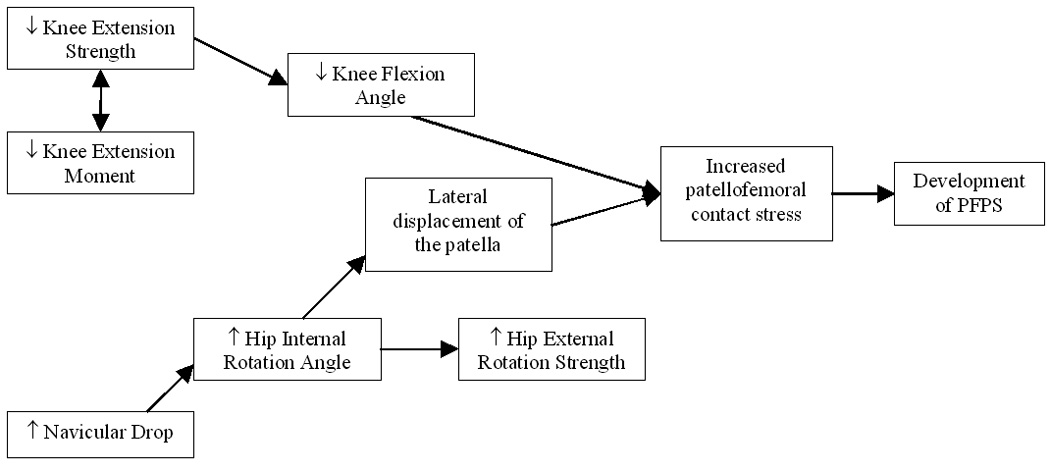
Risk factors for the development of patellofemoral pain syndrome included decreased knee flexion angle, decreased vertical ground-reaction force, and increased hip internal rotation angle during the jump-landing task. Additionally, decreased quadriceps and hamstring strength, increased hip external rotator strength, and increased navicular drop were risk factors for the development of patellofemoral pain syndrome.
Multiple modifiable risk factors for patellofemoral pain syndrome pain have been identified in this investigation. To decrease the incidence of this chronic injury, the risk factors for patellofemoral pain syndrome need to be targeted in injury prevention programs.
Prevention programs should focus on increasing strength of the lower extremity musculature along with instructing proper mechanics during dynamic movements to decrease the incidence of patellofemoral pain syndrome.
髌股疼痛综合征是最常见的慢性膝关节损伤之一;然而,针对这种损伤的危险因素,研究甚少。
下肢运动学和动力学改变、力量下降和姿势测量改变将是危险因素。
队列研究(预后);证据水平,2 级。
共有 1597 名参与者参与了这项研究,并从入组日期(2005 年 7 月、2006 年 7 月或 2007 年 7 月)前瞻性随访至 2008 年 1 月,最长随访时间为 2.5 年。每位参与者在美国海军学院新生暑期前进行基线数据采集。基线数据采集包括跳跃着陆任务中的 3 维运动分析、6 项下肢等长力量测试和姿势对准测量(舟骨下降和 Q 角)。
髌股疼痛综合征发展的危险因素包括跳跃着陆任务中膝关节屈曲角度减小、垂直地面反作用力减小和髋关节内旋角度增加。此外,股四头肌和腘绳肌力量下降、髋关节外旋肌力量增加以及舟骨下降增加是髌股疼痛综合征发展的危险因素。
本研究确定了髌股疼痛综合征疼痛的多个可改变危险因素。为了降低这种慢性损伤的发生率,需要在损伤预防计划中针对髌股疼痛综合征的危险因素进行干预。
预防计划应侧重于增强下肢肌肉力量,并在动态运动中指导正确的力学,以降低髌股疼痛综合征的发生率。