El-Metwally Ashraf, Salminen Jouko J, Auvinen Anssi, Kautiainen Hannu, Mikkelsson Marja
Tampere School of Public Health, FIN-33014 University of Tampere, Tampere, Finland.
BMC Musculoskelet Disord. 2006 Jan 18;7:3. doi: 10.1186/1471-2474-7-3.
The child's lower limb is the most commonly reported musculoskeletal location with pain and also the most commonly injured site in sports. Some potential risk factors have been studied, but the results are inconsistent. We hypothesized that distinction of traumatic from non-traumatic pain would provide a clearer picture of these factors. The aim of this study is to assess factors associated with lower extremity pain and its impact on preadolescents in a population-based cohort.
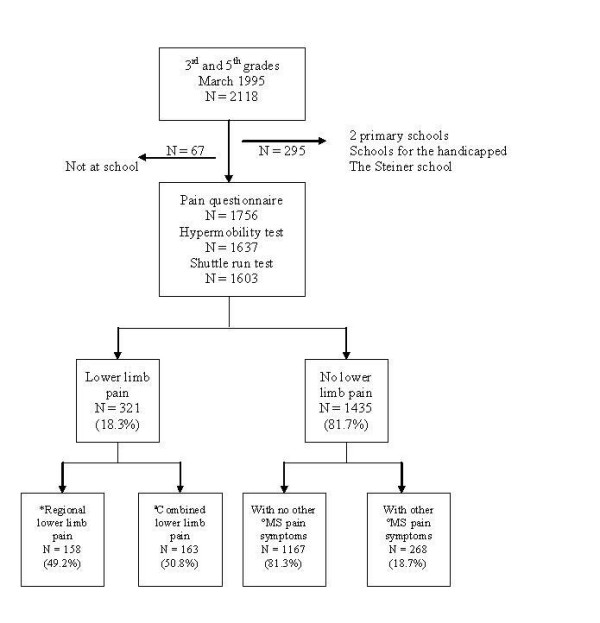
A structured pain questionnaire was completed by 1756 schoolchildren of third and fifth grades to assess musculoskeletal pain, psychosomatic symptoms, subjective disabilities, school absence and frequency of exercise. In addition, hypermobility and physical fitness were measured.
The knee was the most common site of pain followed by the ankle-foot and thigh. Of the children who reported pain in their lower extremity, approximately 70% reported at least one disability and 19% reported school absence attributed to their pain during the previous three-month period. Children with traumatic pain had a higher subjective disability index than those with non-traumatic pain (P = 0.02). Age less than 11 years, headache, abdominal pain, depressive feelings, day tiredness, and vigorous exercise were more common in children with lower limb pain than those free of it. In the stratified analysis, younger age was related to both traumatic and non-traumatic pain groups. Vigorous exercise was positively associated with traumatic pain, while subjects with non-traumatic pain had more frequent psychosomatic symptoms.
Risk factors and consequences of traumatic and non-traumatic lower limb pain are not similar. Traumatic lower limb pain is associated with practicing vigorous exercise and high level of physical fitness, while non-traumatic pain is more correlated with psychosomatic symptoms. These differences might be one of the reasons for the discrepancy of previous research conclusions. The two conditions need to be treated as different disorders in future studies.
儿童下肢是最常报告有疼痛的肌肉骨骼部位,也是运动中最常受伤的部位。一些潜在风险因素已得到研究,但结果并不一致。我们假设区分创伤性疼痛和非创伤性疼痛将更清楚地了解这些因素。本研究的目的是评估在一个基于人群的队列中与下肢疼痛相关的因素及其对青春期前儿童的影响。
1756名三、五年级学童完成了一份结构化疼痛问卷,以评估肌肉骨骼疼痛、身心症状、主观残疾、缺课情况和运动频率。此外,还测量了关节活动过度和身体素质。
膝盖是最常见的疼痛部位,其次是踝足和大腿。在报告下肢疼痛的儿童中,约70%报告至少有一种残疾,19%报告在前三个月因疼痛而缺课。创伤性疼痛儿童的主观残疾指数高于非创伤性疼痛儿童(P = 0.02)。下肢疼痛儿童中年龄小于11岁、头痛、腹痛、抑郁情绪、日间疲劳和剧烈运动比无下肢疼痛的儿童更常见。在分层分析中,较年轻的年龄与创伤性和非创伤性疼痛组均相关。剧烈运动与创伤性疼痛呈正相关,而非创伤性疼痛的受试者有更频繁的身心症状。
创伤性和非创伤性下肢疼痛的风险因素及后果并不相似。创伤性下肢疼痛与进行剧烈运动和高水平身体素质有关,而非创伤性疼痛与身心症状的相关性更强。这些差异可能是先前研究结论存在差异的原因之一。在未来的研究中,这两种情况需要被视为不同的疾病。