Department of Biostatistics, University of Alabama at Birmingham, Ryals School of Public Health, Birmingham, Alabama, United States of America.
PLoS One. 2009 Oct 2;4(10):e7312. doi: 10.1371/journal.pone.0007312.
In randomized controlled trials (RCTs), some drugs, including CB1 antagonists for obesity treatment, have been shown to cause increased suicidal ideation. A key question is whether drugs that increase or are associated with increased suicidal ideations are also associated with suicidal behavior, or whether drug-induced suicidal ideations are unlinked epiphenomena that do not presage the more troubling and potentially irrevocable outcome of suicidal behavior. This is difficult to determine in RCTs because of the rarity of suicidal attempts and completions.
To determine whether drugs associated with more suicidal ideations are also associated with more suicide attempts in large spontaneous adverse event (AE) report databases.
Generalized linear models with negative binomial distribution were fitted to Food and Drug Administration (FDA) Adverse Event (AE) Reporting System (AERS) data from 2004 to 2008. A total of 1,404,470 AEs from 832 drugs were analyzed as a function of reports of suicidal ideations; other non-suicidal adverse reactions; drug class; proportion of reports from males; and average age of subject for which AE was filed. Drug was treated as the unit of analysis, thus the statistical models effectively had 832 observations.
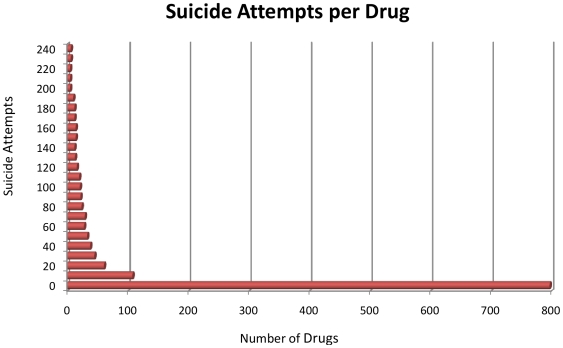
Reported suicide attempts and completed suicides per drug.
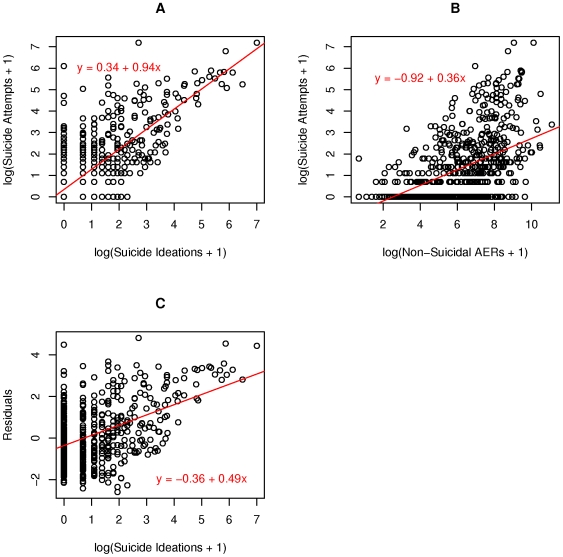
832 drugs, ranging from abacavir to zopiclone, were evaluated. The 832 drugs, as primary suspect drugs in a given adverse event, accounted for over 99.9% of recorded AERS. Suicidal ideations had a significant positive association with suicide attempts (p<.0001) and had an approximately 131-fold stronger magnitude of association than non-suicidal AERs, after adjusting for drug class, gender, and age.
In AE reports, drugs that are associated with increased suicidal ideations are also associated with increased suicidal attempts or completions. This association suggests that drug-induced suicidal ideations observed in RCTs plausibly represent harbingers that presage the more serious suicide attempts and completions and should be a cause for concern.
在随机对照试验(RCT)中,一些药物,包括用于治疗肥胖的 CB1 拮抗剂,已被证明会引起自杀意念增加。一个关键问题是,那些增加或与自杀意念增加相关的药物是否也与自杀行为相关,或者药物引起的自杀意念是否是无关的偶然现象,不会预示着更麻烦和潜在不可逆转的自杀行为结局。在 RCT 中,由于自杀尝试和完成的罕见性,很难确定这一点。
在大型自发不良事件(AE)报告数据库中,确定与更多自杀意念相关的药物是否也与更多自杀尝试相关。
使用负二项式分布的广义线性模型,对 2004 年至 2008 年期间的食品和药物管理局(FDA)不良事件(AE)报告系统(AERS)数据进行拟合。共分析了 832 种药物的 1404470 例 AE,作为自杀意念报告;其他非自杀性不良反应;药物类别;男性报告比例;以及报告 AE 的受试者的平均年龄的函数。药物被视为分析单位,因此统计模型实际上有 832 个观测值。
每种药物报告的自杀尝试和自杀完成情况。
评估了 832 种药物,范围从阿巴卡韦到佐匹克隆。这 832 种药物,作为特定不良事件中的主要怀疑药物,占 AERS 记录的 99.9%以上。自杀意念与自杀尝试有显著的正相关(p<.0001),并且在调整药物类别、性别和年龄后,与非自杀性 AER 的关联强度大约高出 131 倍。
在 AE 报告中,与自杀意念增加相关的药物也与自杀尝试或完成的增加相关。这种关联表明,在 RCT 中观察到的药物引起的自杀意念可能代表预示着更严重的自杀尝试和完成的先兆,应该引起关注。